Tagged: engineer

Role of Condition Monitoring, Human & Organizational Factors in Oil Failures

Choosing the right oil for the system is just one part of the puzzle. How do we know the oil is performing when it’s in the system? This is where condition monitoring can work hand in hand to help ensure that the oil does not fail the asset.

If a proper oil analysis program does not exist, operators will not know whether the oil is properly lubricating the asset. They will also not be aware of whether the oil is breaking down too quickly and failing to protect the asset. Oil analysis can also alert operators to signs of wear in the asset, so they can fix them before they turn into functional failures.

An oil analysis program that lives in a drawer protects assets about as well as no program at all.

There is also the possibility that an oil analysis program exists but is not top of mind, or that its results are put in a drawer. This can also cause the asset to fail even though the correct oil is being used. Apart from the aforementioned factors, if operators are not warned of the impending failure of the oil, this can result in production losses, increased downtime, and, in some extreme cases, the complete loss of the asset if it has failed beyond repair.

Incorrect sampling is another area in which the actual condition of the asset is not reported. Even with the correct oil used, if a sample is collected from a dead leg or an area that is not truly representative of the conditions inside the component, its actual condition will not be known. With incorrect data about the component, the asset can be misdiagnosed or treated for symptoms that do not exist, which can lead to its detriment.

Human and Organizational Factors

Not all failures occur at the equipment level; human and organizational factors can also cause the asset to fail even when the correct oil is used. If humans aren’t properly trained in oil sampling techniques or storage and handling practices, these can affect the asset’s functionality. We often forget that, at the heart of it all, lies the human factor, which is partially governed by the organization’s systems.

Training needs are an organizational factor that is often overlooked when considering how an asset can fail. However, if operators have not been trained in condition monitoring techniques, they will not be able to read oil analysis reports or take appropriate actions to protect the asset. Training can help bridge some competency gaps that directly impact asset performance.

It doesn’t matter what oil is in the system if no one is trained to monitor it – or motivated to care.

Culture is another factor swept under the rug. If the culture doesn’t exist to look after the assets, it doesn’t matter what type of oil is placed in the system; the asset will fail eventually. The performance of the asset does not only rely on using the correct oil. By implementing a culture of Asset ownership, where operators look after the asset and are accountable for its performance, assets are optimized to provide the functionality they should. This is one way to ensure the right oil is used to enable the assets’ performance.

Another area of concern is the documentation of maintenance procedures. If maintenance procedures are not adequately documented, someone new to the operation may not be aware of the correct practice. This, coupled with a lack of training, can spell disaster for the equipment. In these cases, even though the right oil was selected, the wrong practice or lack thereof can fail the asset.

Turning the “Right oil” into the “Right Outcome.”

As explained in this article, improper practices can jeopardize the asset’s health, even when the right oil is used. However, if all the right things align, we can have an asset that lasts for its expected lifetime or beyond.

This starts with selecting the right oil based on the application, environmental conditions, and OEM recommendations. If we follow this up with good storage and handling practices, proper condition-monitoring programs, documentation, and training, we can look toward a longer-lasting asset. The right oil enables reliability – but only disciplined practices deliver it.

Find out more in the full article, "When 'Right oil, Wrong practice' still fails assets" featured in Precision Lubrication Magazine by Sanya Mathura, CEO & Founder of Strategic Reliability Solutions Ltd. 

Common Modes of Failure for Lubricants

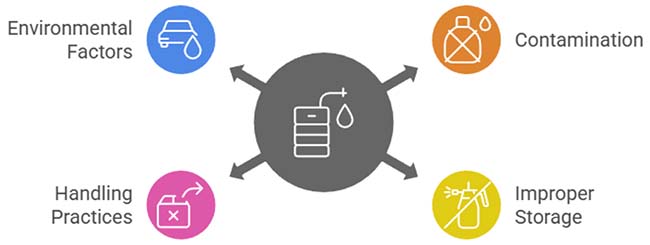
Regardless of the oil selected, common modes of failure can occur with every lubricant. These include: contamination, improper storage and handling practices, and environmental factors as shown in Figure 4.

Figure 4: Common modes of failure for lubricants

Contamination can be defined as any foreign particle entering the system. This includes any gases, liquids, or solids. Especially when the lubricant system runs alongside the process side, process gases and liquids can leak into the oil. These contaminants can influence the oil’s degradation, leading to deposits or chemical reactions that break it down. Common process contaminants include ammonia or treated water.

The biggest threat to the right oil is often what gets added to it – whether it’s process contamination or the wrong oil during a top-up.

Another liquid that can contaminate oil is another oil. During top-ups, operators can add the wrong oil to the system, causing contamination and, depending on the oil, a possible shutdown. Adding motor oil to hydraulic oil can be catastrophic, as the additive packages work differently and the motor oil additives may counteract the hydraulic additives, removing them from the oil, leaving the asset open to wear and failure. Despite selecting the correct lubricant for your system, adding the wrong oil (mistakenly) will shorten its lifecycle and cause the asset to fail.

Bad storage and handling practices can also erode your oil, regardless of the oil you choose. Turbine and hydraulic oils are used in precise equipment. As such, they need to be clean and free of dirt or other contaminants. However, if oils are not stored correctly, contaminants can enter and contaminate the oil.

Simple techniques, such as transferring oil from larger storage containers (pails, drums, or totes) into smaller, more manageable containers (2-3 liters or less), can introduce contaminants into the oil if not done correctly. If oils are to be transferred to another storage container, the storage container must be clean. The transfer process should use clean hoses (not previously used for another lubricant) and be completed in a dust-free environment.

If you wouldn’t use a dirty needle for a blood transfusion, why would you use a dirty hose for an oil transfer?

The transfer of oils from one container to the next can be thought of as a blood transfusion. Would you use dirty needles or vials to transport the blood to be placed into another human? Similarly, oil can be likened to the equipment’s lifeblood and should be treated accordingly. Just as we observe sterile practices for blood transfusions, we should also observe similar types of practices for oil transfers.

Environmental and operational factors can also influence lubricant degradation. As stated earlier, all lubricants can degrade over time under harsh conditions. The lubricant formulation largely influences this, as does whether it was blended to withstand those conditions.

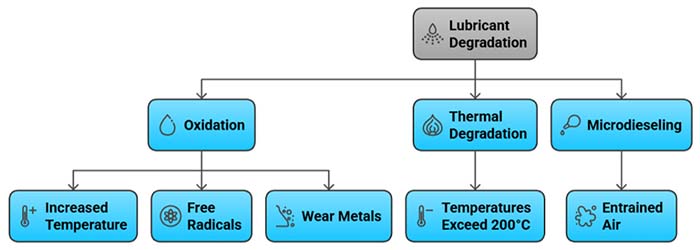
Oxidation can easily occur when temperatures increase, free radicals are present, or when wear metals are present. Thermal degradation occurs when the temperatures exceed 200°C. On the other hand, microdieseling occurs in the presence of entrained air, despite the lubricant used in the system, as shown in Figure 5.

Figure 5: Lubricant Degradation Processes

Any of these degradation mechanisms can occur regardless of the type of oil chosen. Hence, it is essential to remember that operational conditions and environmental factors can heavily influence oil degradation, even when the oil is appropriate for the system.

Find out more in the full article, "When 'Right oil, Wrong practice' still fails assets" featured in Precision Lubrication Magazine by Sanya Mathura, CEO & Founder of Strategic Reliability Solutions Ltd. 
Spec Sheet vs Strategy for choosing the right oil

Sometimes we can spend hours poring over technical data sheets, comparing oil performances, and finally selecting the “right” oil which aligns with the needs of our equipment. Then, within 2 months, the oil degrades, our machines shut down, and we have a bunch of maintenance repairs lined up. What went wrong? We clearly had the “right” oil in the equipment; everything should have worked beautifully. This is where the awareness of lubrication and its practices becomes critical.

Having the correct oil is only one part of the puzzle. Being able to deliver that oil in its purest, cleanest form to the machine is often one of the other pieces that go missing. Another piece is selecting the right oil, not just based on the sales guy’s advice, but on the actual operating conditions of your machine. In this article, we dive a bit deeper into ways you can align the right oil with the proper practices, or avoid the wrong ones, to help extend the life of your asset.

Spec Sheet vs Strategy

For this example, we will consider a turbine oil selection. If a customer wants to change the oil in their turbine, then they may consider the following:

  • What are the OEM specifications that need to be met?
  • Is this oil available from the local supplier?
  • How does it compare to other oils on the market?
  • Does the cost justify the value? (or will the purchasing department want something cheaper?

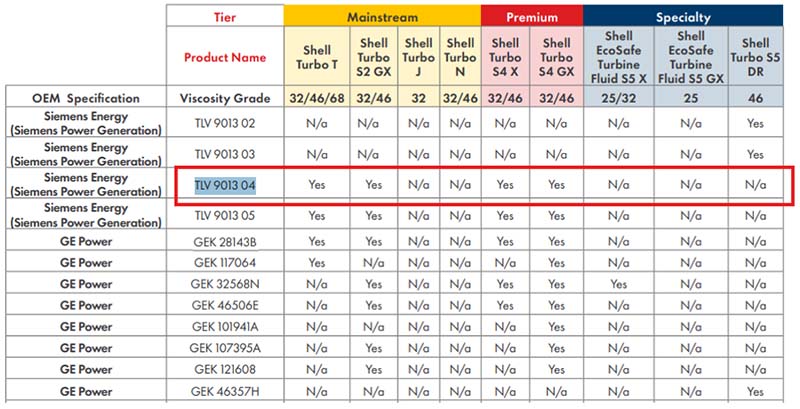
For most of these questions, engineers or the person tasked with selecting the oil can readily find the answers in the oil’s technical data sheet and by talking to their sales representative. But if we dive a bit deeper, are we selecting the right oil for the operating and environmental conditions? Let’s examine the selection of a turbine oil for the Siemens SGT 200 Gas turbine that meets the Siemens TLV 9013 04 specification.

As seen in this document from Shell Lubricants, a few of their products meet that specification, namely Shell Turbo T, Turbo S2GX, Turbo S4X & Turbo S4GX.

Figure 1: Shell Turbo Family for the Siemens TLV 9013 04 Specification

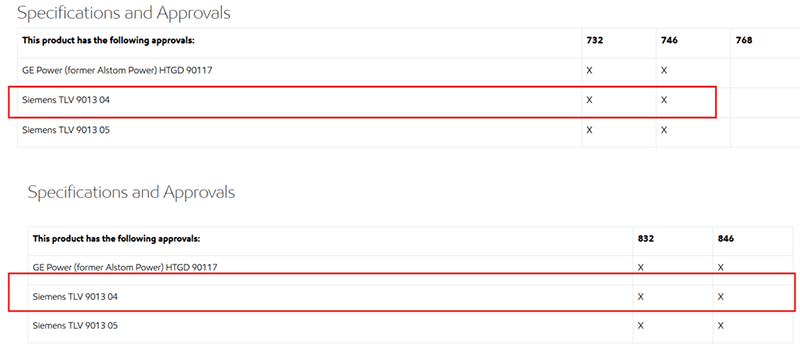
On the other hand, Mobil provides some solutions as well, namely, Mobil DTE 732, 746, or DTE 832, 846

Figure 2: Mobil DTE 700 & 800 Series meeting the Siemens TLV 9013 04 Specification

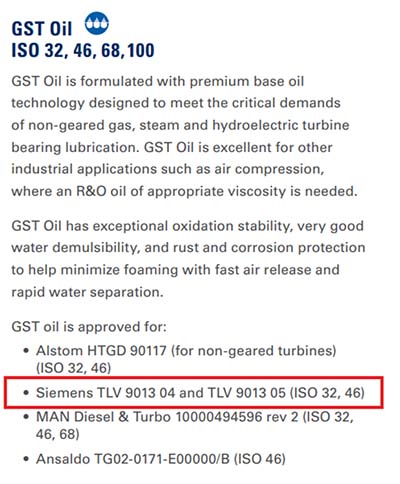
Chevron also provides an option of Chevron GST as follows:

Figure 3: Chevron GST oil meeting the Siemens TLV 9013 04 specification

With so many options, how can one choose the “right” oil? They all meet the required Siemens specification, TLV 9013 04. This is where the data sheets, OEM manual, and knowledge of the equipment’s operating conditions play a crucial role.

As per the manual, there are preset conditions for temperatures and pressures, but if your actual system runs hotter (or production is being pushed a bit more), it is functioning outside the operating envelope.

The spec sheet tells you what the oil can do. Your operating conditions tell you what it must do.

Additionally, if your surroundings are harsh (close to the sea or in a corrosive environment, or in a non-ventilated area where heat can build up), these can place additional stress on the equipment. For these harsher conditions, a synthetic oil might be more appropriate than a mineral oil, albeit more expensive in terms of the initial investment.

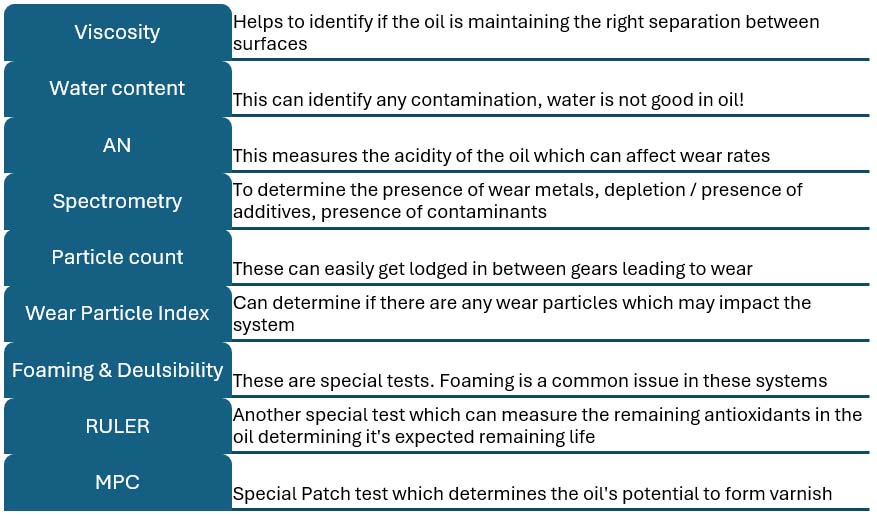
The manual also specifies which tests/characteristics should be used to monitor the condition of the oil, namely: viscosity, particle count, water content, demulsibility, air release, foaming characteristics, RULER®, and MPC. Based on the performance of your current oil in the system, you can determine whether these values fluctuate toward the higher warning zones. This can also influence your decision about which oil to choose.

It’s not just about the right oil or one that aligns with OEM requirements. The selection should also be based on the environmental conditions of the oil and the equipment, and on whether the oil is suited to perform in these conditions. A mineral oil will not withstand the temperatures that a synthetic oil can for extended periods without degrading. Similarly, given the “right” conditions, synthetic oils can also degrade. By cross-examining your spec sheet, OEM manual, and actual conditions, you can determine the best-suited oil for your operations.

Find out more in the full article, "When 'Right oil, Wrong practice' still fails assets" featured in Precision Lubrication Magazine by Sanya Mathura, CEO & Founder of Strategic Reliability Solutions Ltd. 

Critical Condition Monitoring Tests for Compressor Oils

To ensure these oils remain healthy (and not contaminated or degraded), a few basic tests can be performed on all compressors, regardless of type (reciprocating, screw, refrigerant, etc.). These include:

  • Viscosity – this is key as some of the gases can easily affect the viscosity, which (if decreased) will not provide adequate separation for the interacting surfaces and cause wear. Generally, a ±10% limit is used (though OEMs may use different values).
  • Acid Number – if this begins increasing, then we have an accumulation of acids in the oil, which can be because of contamination. For most compressors, a 0.2 mg KOH/g increase is the warning limit, but for refrigeration compressors, the limit is tighter at +0.1 mg KOH/g. Always check with your OEM for these limits.
  • Water content – changes by OEM and refrigerant type, as the different gases will have varied tolerances.
  • Wear metals – these values will vary as per OEM, as well, since they are all designed with different types of metals. Users should look for trends or significant increases in these values to indicate wear.

Some specialty tests for compressors include:

  • MPC (Membrane Patch Colorimetry) – this helps to measure if there is any potential for the oil to form varnish. Given the high temperatures these types of equipment endure and the potential for contamination, the oil is at risk of forming varnish. While limits will vary by OEM, some general guidelines to follow are 0-20 Normal, 20-30 Warning, >30 Action required
  • RULER® (Remaining Useful Life Evaluation Routine) – this quantifies the remaining level of antioxidants in the oil. When oxidation occurs, the antioxidants get depleted. As such, by monitoring antioxidant levels, one can easily determine whether oxidation is happening in the oil. The general rule of thumb is that if the level falls below 25%, there are not enough antioxidants to keep the oil healthy and prevent degradation.
  • Air Release (DIN ISO 9120) – measures the ability of the oil to allow air to escape and not keep the air in the oil. If air bubbles remain in the oil, this can be devastating, as it can lead to micropitting, cavitation, or increased oxidation. Users can trend the values; if they increase, it indicates that the air is taking longer to be released, which means it is staying in the oil and in the system longer.
  • Particle Count – this can identify if there are any contaminants in the system. These oils must be kept clean, and OEMs typically specify target cleanliness levels.

Compressors are critical equipment, and we must understand how they work and the lubricant specifications required. Monitoring their health can also help us avoid unnecessary downtime and keep our facilities running.

References

  1. Mang, T., & Dresel, W. (2007). Lubricants and Lubrication. Weinheim: WILEY-VCH Verlag GmbH & Co. KGaA.
  2. Totten, G. E. (2006). Handbook of Lubrication and Tribology – Volume 1 Application and Maintenance – Second Edition. Boca Raton: CRC Press.
  3. Shell Lubricants. (2025, November 08). The Shell Corena range. Retrieved from Shell Lubricants Compressor Oils: https://www.shell.com/business-customers/lubricants-for-business/products/shell-corena-compressor-oils/_jcr_content/root/main/containersection-0/simple_1354779491/promo_1484925192/links/item0.stream/1759302155345/17be2a9a74057f321bb209128933f68f8b88ca70/s
  4. ExxonMobil. (2025, November 08). Refrigeration Lubricant Selection for Industrial Systems. Retrieved from ExxonMobil Lubricants: https://www.mobil.com/lubricants/-/media/project/wep/mobil/mobil-row-us-1/new-pdf/refrigeration-lubricant-selection-for-industrial-systems.pdf
  5. Chevron Lubricants. (2025, November 08). Optimizing compressor performance and equipment life through best lubrication practices Chevron. Retrieved from Chevron Lubricants: https://www.chevronlubricants.com/content/dam/external/industrial/en_us/sales-material/all-other/Whitepaper_CompressorOils.pdf

Find out more in the full article, "Compressor Oil, Types, Applications and Performance Drivers" featured in Precision Lubrication Magazine by Sanya Mathura, CEO & Founder of Strategic Reliability Solutions Ltd. 
Refrigeration Lubricants

For industrial refrigeration systems, there are a couple of essential pieces of information to consider before selecting the most suitable oil. The user must know the refrigerant in use, the evaporator type (dry or wet; carryover < 15%), the evaporator temperature, the compressor type, and the outlet temperature.

The refrigerant fluids are classified as per the ASHRAE classification (ANSI-ASHRAE Standard 34-2001):

  • R717 — Ammonia
  • R12 — Chlorofluorocarbon (CFC)
  • R22 — Hydrochlorofluorocarbon (HCFC)
  • R600a — Isobutane
  • R744 — Carbon dioxide (CO2)
  • R134a, R404a, R507 — Hydrofluorocarbons (HFC)

It should be noted that CFCs were banned under the Montreal Protocol (1989) due to their Ozone Depletion Potential, and HCFCs are being phased out due to their Global Warming Potential.

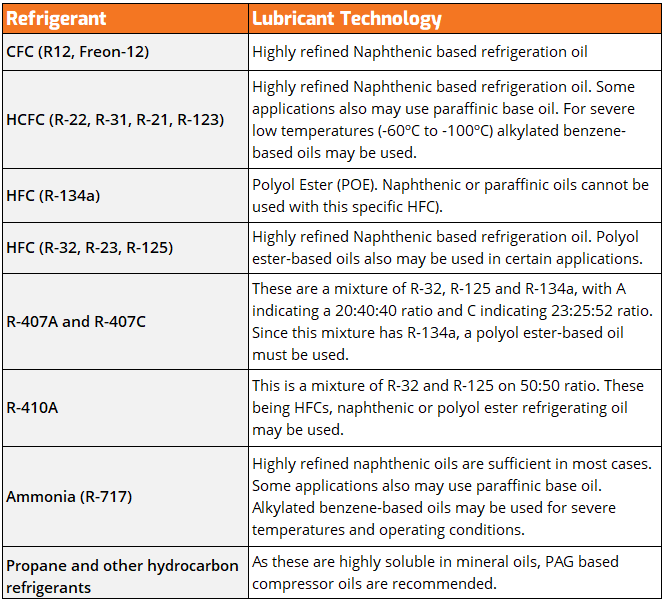
Chevron provides some general guidelines for selecting the appropriate refrigerant, as shown in the table below.5

(But you should always follow the guidelines of your OEM when selecting the appropriate lubricant.)

Table 1: Refrigerants and their associated lubricant technologies

ExxonMobil classifies its refrigeration lubricants based on refrigerant type, evaporator temperature, and compressor type (Piston, Screw, or Centrifugal). This is very helpful when determining the best-suited lubricant for your refrigerant compressor.

Check out the pdf here.


Find out more in the full article, "Compressor Oil, Types, Applications and Performance Drivers" featured in Precision Lubrication Magazine by Sanya Mathura, CEO & Founder of Strategic Reliability Solutions Ltd. 

Industry Standards for Compressor Oils

Some other classifications which users may see when dealing with compressor oils (even though some of these standards may be dated) include:

ISO 6743-3, which uses the following acronyms for associated compressors:

  • DAA, DAB, DAG to DAJ: Air compressors
  • DVA to DVF: Vacuum pumps
  • DGA to DGE: Gas compressors
  • DRA to DRG: Refrigeration compressors


In this standard, the “D” family includes detailed classifications of lubricants used in air, gas, and refrigeration compressors. The second letter usually indicates the type of compressor, and the third letter indicates the application severity or type, especially for gas or refrigeration compressors.

For instance;

DAJ represents:

D -> Compressor Lubricant

A -> Air compressor

J-> Lubricant drain cycles of >4000 hours

DVB represents:

D-> Compressor Lubricant

V->Vacuum pumps, Positive Displacement Vacuum pumps with oil lubricated compression chambers, Reciprocating and rotary drip feed, Rotary oil-flooded (vane and screw)

B-> Low vacuum for aggressive gas (102 to10-1kPa or 103 to 1 mbar)

DGD represents:

D-> Compressor Lubricant

G-> Positive displacement reciprocating and rotary compressors for all gases, Compressors for refrigeration circuits or heat pump circuits, together with air compressors, are excluded.

D-> Gases that react chemically with mineral oil, usually synthetic fluids, HCI, CI2, O2, and oxygen-enriched air at all pressures. CO2 at pressures above 103 kPa (10 bar) with O2- and oxygen-enriched air: mineral oils are prohibited, and very few synthetic fluids are compatible.

DRB represents:

D-> Compressor Lubricant

R-> Compressors, refrigeration systems

B-> Ammonia (NH3), Miscible, Polyalkylene glycol, Commercial and industrial refrigeration, For direct expansion evaporators; PAGs for open compressors and factory-built units.

Another standard which is also used in this industry is DIN 51506, which defines:

  • VB, VC: Uninhibited mineral oils (no oxidation inhibitors)
  • VBL: Mineral oil-based engine oil (additives that protect from corrosion and oxidation and air compressor temperatures up to 140°C)
  • VCL: Mineral oil-based engine oil (additives that protect from corrosion and oxidation and air compressor temperatures up to 160°C)
  • VDL: Inhibited oils with increased aging resistance (additives that protect from corrosion and oxidation and air compressor temperatures up to 220°C, recommended for compressors with 2-stage compression)

One more standard is DIN 52503, which has these classifications:

  • KAA: Not miscible with ammonia
  • KAB: Miscible with ammonia
  • KB: For carbon dioxide (CO2)
  • KC: For partly and fully halogenated fluorinated and chlorinated hydrocarbons (CFC, HCFC)
  • KD: For partly and fully fluorinated hydrocarbons (HFC, FC)
  • KE: For hydrocarbons (e.g., propane, isobutane)

These standards are referenced when discussing certain compressor oils, and their definitions are helpful for navigating acronyms.

Find out more in the full article, "Compressor Oil, Types, Applications and Performance Drivers" featured in Precision Lubrication Magazine by Sanya Mathura, CEO & Founder of Strategic Reliability Solutions Ltd. 
Types of Compressors and Oils

Compressors are integral to many of our operations. They are used to compress gas, increasing its pressure, and to power tools. They can also be used as vacuum pumps or blowers, but each application is different. As such, they require various types of lubrication, particularly for applications that use specific refrigerants and come into contact with the lubricant.

In all these applications, the functions of the oil remain largely the same: it must lubricate the surfaces, prevent wear and corrosion, maintain the required viscosity, and provide proper sealing.

In this article, we will dive into the various types of compressor oils and explain why they are suited to these applications. We will also discuss monitoring the health of these oils and the tests that should be performed to ensure your compressor oils remain healthy.

Types of Compressors

Essentially, there are two main types of compressors: Displacement and Dynamic. For displacement compressors, gas is drawn into a chamber, compressed, and expelled by a reciprocating piston. On the other hand, for dynamic compressors, turbine wheels accelerate a medium, which is then abruptly accelerated.1

Positive displacement compressors include Reciprocating and Rotating compressors. These can be further subdivided as shown in Figure 1. For Dynamic (Turbo) compressors, these are further subdivided into Centrifugal, Axial, and Mixed types (also shown in Figure 1).

Figure 1: Types of compressors

Depending on the type of compressor, the required lubricant will vary. For example, positive-displacement compressors use rolling or sliding motion and include bearing and sealing components within the compression chamber. On the other hand, dynamic compressors use hydrodynamic journal and thrust bearings, or rolling-element bearings, to support the main shaft, which is isolated from the compression chamber.

Working pressures, temperatures, and the type of gas being compressed also play a significant role in determining the appropriate lubricant.2

As with most applications, there can be a dry-sump or a wet-sump. Wet sumps are typically seen in reciprocating and rotary screw compressors.  In a wet sump, the gas usually contacts the oil, lowering its viscosity. This is where it is essential to note the gas’s solubility in the system oil. Natural gas and other hydrocarbons are more soluble in mineral oils and PAOs than in PAGs and diesters. Thus, PAGs may be preferred in some cases to avoid lubricant failure.

Compressor Oils

Most of the major global lubricant OEMs have classified their oils based on:

  • Rotary vane and screw air compressor oils
  • Reciprocating (piston) air compressor oils
  • Refrigeration compressor oils

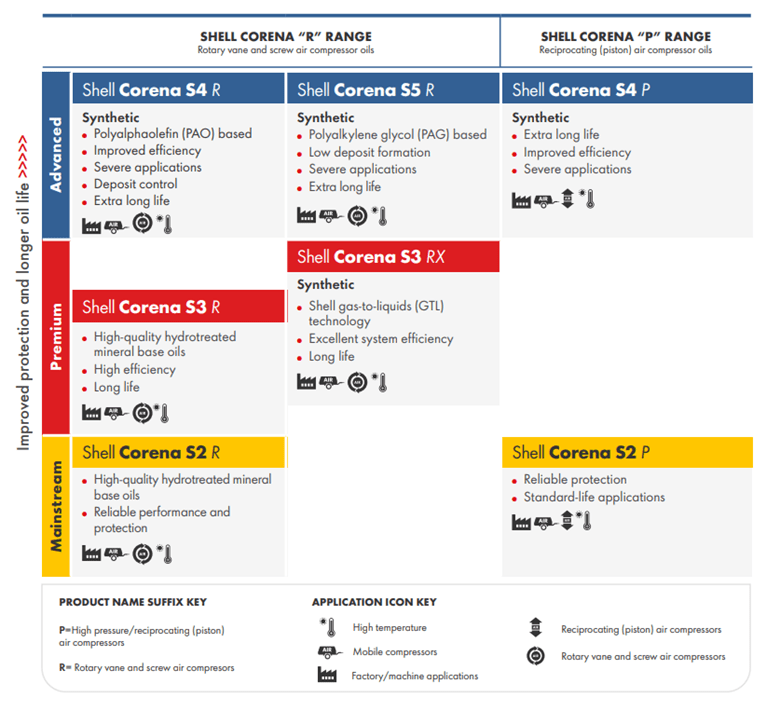
As seen below in Figure 2, Shell Lubricants3 has a line of lubricants, particularly for air compressors, which are further classified into mineral oils, PAOs, and PAGs for Rotary vane and screw air compressors or Reciprocating (piston) air compressors.

Figure 2: Shell Lubricants for Air Compressors

In reciprocating air compressors, cylinder design dictates the lubrication type, as this is the most severe application. Compressing the gas usually results in high temperatures, which can easily lead to oxidation. The compressed gas must be free of contaminants, as contaminants can accelerate oxidation. Typically, for reciprocating air compressors, mineral oils or PAO- or di-ester-based lubricants in the ISO VG 68 to 150 range are preferred.

Rotary vane compressors can experience pressure extremes as the vanes slide to compress the gas, and oil is continuously injected into the compressor chambers. Typically, ISO VG 68-150 oils are used in this application.

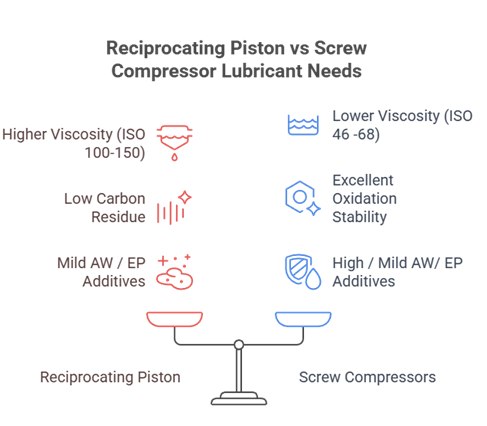
Figure 3: Reciprocating Piston vs Screw Compressor Lubricant Needs

For screw compressors, the oil must perform several functions, including lubricating the meshing rotors and the plain and roller bearings that form part of the geared coupling. ISO VG 46 mineral oils are usually used in these compressors, but the viscosity can be increased to ISO VG 68 or to synthetic PAO or PAG lubricants at higher ambient temperatures. Similarly, Group III base oils of these viscosities can be used in this area. Most screw compressor oils contain mild EP/AW performance additives and require an FZG failure load≥10.

Ideally, reciprocating piston compressors will use higher viscosities (ISO VG 100-150) with extremely low carbon residue and no or mild EP/AW additives. Conversely, screw compressors will use lower viscosities (ISO VG 46 or 68) with excellent oxidation stability and mild/high AW/EP additives1, as shown in Figure 3.

Find out more in the full article, "Compressor Oil, Types, Applications and Performance Drivers" featured in Precision Lubrication Magazine by Sanya Mathura, CEO & Founder of Strategic Reliability Solutions Ltd. 
Sensors vs Traditional Oil Analysis

In this age of AI, it seems that everyone is moving towards sensors and online data. Oil analysis sensors aren’t far behind in this revolution. There are mid-infrared sensors that have been engineered to relate their findings to those of regular oil tests (developed by Spectrolytic). While sensors are the way of the future, the fundamental concept remains the same. What are we doing with the data, and what data are we trending?

Sensors deliver speed, but proven lab methods still set the benchmark for accuracy.

Traditional oil analysis labs trend data, albeit the frequency of the data points is not as high as that of an online sensor. Hence, subtle/instant changes may not be readily noticed or detected. The methods used in these labs have been tried and tested over the years (and approved by various standards committees) to reflect conditions that the oil is facing in the field.

On the other hand, in the sensor world, not many of them (with the few exceptions) correlate exactly to what is being seen in the field. Hence, some lab tests, especially for the specialty tests such as RULER, MPC, and TOST (mainly for turbines), still need to be done by the lab. This is a great opportunity for traditional labs and sensor companies to collaborate and provide customers with collated data.

Moving Towards Sustainable Maintenance

While this article explicitly discusses extending the oil drain intervals for your assets, it underscores the importance of working alongside maintenance and condition monitoring to achieve these results. There is no clear cookie-cutter routine to achieve this, as each fleet of assets will be different and require varying levels of complexity for analysis. One thing is clear, though: we need to move towards sustainable maintenance.

Performing maintenance in the traditional way of just waiting for the appointed interval may be costing us increased labor and parts. However, by working alongside maintenance and condition monitoring, we can get more value from our assets and even increase our ROIs. Sustainable maintenance is the way forward for most asset owners as we move into a new era of maintenance.

How do you set oil-analysis limits for diesel fleets?

What Baselines should you use?

Global oil suppliers have baseline or tolerance limits that are used when providing guidelines to customers about their equipment. The limits for a gearbox will differ from those of an engine. For instance, an iron content level of 3000ppm is normal for an automatic transmission gearbox but highly irregular for a diesel engine! Hence, it is important to know the limits associated with the application.

Some labs have also developed their own set of limits based on years of collecting hundreds of samples and liaising with their customers in the field. OEMs have also developed their own sets of limits (usually displayed in their manuals) based on their testing in the lab and on the field.

Knowing your own “normal” is more valuable than any generic industry limit.

Ideally, when developing your target levels, you should trend your data and find out what “normal” looks like for your equipment. In some cases, what is normal for your environment may be abnormal in a different environment. But it is important to note when normal varies from standard operating tolerances. This is where you would want to work together with your oil supplier, lab, and OEM to develop tolerances that align with your equipment.

Depending on your maintenance program, you can also adjust the tolerance accordingly. If you are aware that maintenance may not act on a threshold limit right away, it may be a good idea to add some padding to those limits. This ensures that the equipment does not suffer by pushing it to the limits.

What are the Oil Analysis Limits for Diesel Fleets?

Let’s explore how to set the limits for a diesel engine fleet of trucks.

Here is a step by step guide on developing an oil analysis program for diesel fleets.

First, let’s categorize the trucks into critical, semi-critical, and non-critical.

The critical ones are those that, if they break down, there is no replacement; the downtime hurts us financially and can delay the project. These need to be available 24/7.

The semi-critical ones are those that still have an impact on the operation if they break down, but it’s not quite as disastrous. These can be trucks that are not on tight deadlines, can afford to have some leniency or delays with their workload.

The non-critical trucks are those that can be easily swapped out for another truck without causing any delay or impact to the project, but they are still important.

Now that these are categorized, we need to find out what types of engines are being used and what the recommended diesel engine oils are for these units. Typically, most operators have mixed fleets. Thus, one may see a wide age/mileage gap in the engines. This gives us an idea of the reliability of the engines, which can impact the setting of the tolerance limits.

Since it’s a diesel engine fleet, it would be worthwhile to consider the type of fuel being used for this fleet. With diesel engines, there are varying levels of sulphur in the fuel, which can impact the oil drain intervals as well.

For this fleet, we may need to establish varying oil drain intervals to ensure maximum reliability, based on the categories outlined by their criticality. Before adopting set oil drain intervals, it is important to execute a pilot project with the fleet to anticipate any rollout challenges for the future. We will discuss these in more detail in the case study section.


Real-World Results from a Diesel Fleet Oil Analysis Program

Fleet: Mixed long-haul trucks of various ages/mileages

Predominant oil: Mineral 15w40 Diesel engine oil (CI4 spec)

Regular Oil Drain Interval: 3000km (based on best practice over time)

Approach: An engine asset list was first compiled for every truck in the fleet. This follows the table below:

Table 1: Sample of Engine Asset listing for Mixed long-haul fleet

It’s important to have a column for comments as this can capture some data that we may not be aware of, such as a recent engine overhaul done to the unit, or the driver has regularly lost power over the past few weeks, or the driver tops up the oil every time he gets back to the yard.

These little details may not be captured in the CMMS (if one exists) or the maintenance logs, but they are crucial in determining whether we can safely extend the oil drain intervals or not. For units that require special attention or are under warranty, these may have to be excluded until more favorable conditions exist.

Based on the fleet (15 trucks), they were categorized into three main groups:

Critical – these units were being used every day on projects that had tight deadlines. They were often unavailable to return to the yard for maintenance or oil changes, as each hour away from the job affected the project deadline.

Semi-critical – these units were utilized by various customers at distant locations and often spent most of their time at the customer site (due to the distance). Hence, basic maintenance was usually performed at the customer’s site, causing minimal disruption to the operation.

Non-Critical – these units are often deployed in situations where extra assistance is required, or they are the standby units if one of the critical units is in trouble.

Even though they had these three groupings, the engine types and mileages were very varied. Hence, a matrix was formed for this fleet.

Table 2: Criticality Matrix – Long-haul fleet

The majority of the fleet falls within the 20-100,000km range, spanning across the critical, semi-critical, and non-critical categories.

A pilot test was done on the following:

  • 3 of the critical units within the 20-100,000km range
  • 1 semi-critical unit in the >100,000km range
  • 1 non-critical unit in the > 100,000km range

Since the typical oil drain interval was 3,000km, we took samples at 1500, 2000, 2500, and then again at 3000km. Based on the trend observed from the first 3 samples, we had a fair indication of the condition of the oil before it got to 3000km.

None of the samples showed any unusual signs of wear, excessive additive depletion, or ingress of contaminants. For these samples, we kept a close eye on maintaining the following parameters:

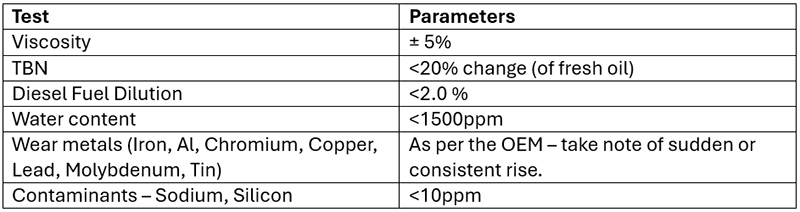
Table 3: Suggested Parameters to monitor for fleet

Samples were then taken at 3500, 4000, 4500, 5000, 5500 & 6000km. Then, another set of samples was taken at 6500, 7000, 7500, and 8000km once the oil analysis values were still within range. The aim was to at least double the oil drain interval for this fleet.

Intervals of 500km were used as a cautionary value to allow enough time for any anomalies to be caught. The critical engines got to these values faster than the semi-critical and non-critical units.

All of the critical units easily got to 9000km without any of the oil analysis values entering the warning zones. However, the semi-critical unit, which had exceeded 100,000km, only made it to 8,500 km before the TBN and fuel dilution values entered the warning zone. The non-critical unit, which exceeded 100,000km, also reached 9,000 km without any issues.

Since the owner wanted to be on the side of caution (and allow some wiggle room between the intervals for trucks which could not get maintenance done at the specified interval), they chose to change the oils across the fleet at the 7500km mark but keep the oil analysis program where they perform samples at 4000 & 7000km.

They will now work alongside oil analysis, and for some trucks, where they believe they can have an even longer interval, they will extend it accordingly.

What does this mean?

These engines take approximately 44 quarts or roughly 42 liters of oil and are changed every 3000km or roughly 2 months (critical units) with an average of 3 hours downtime for the oil change.

Hence, one unit undergoes approximately six oil changes per year:

  • An average of about 3 hours x 6 times = 18 hours downtime
  • An average of 42 liters x 6 times = 252 liters changed per year
  • Thus, for six critical units that would be:
  • Downtime => 18 hours x 6 units = 108 hours
  • Oil consumption = 252 liters x 6 units = 1,512 liters

The new oil drain interval of 7500km resulted in a 2.5-fold increase in the interval.

This means that the new interval would be every 5 months instead of every 2 months.

Thus, these six units would only do oil changes twice for the year.

New downtime = 3 hours x 2 times/year x 6 units = 36 hours / year

New oil consumption = 42 liters x 2 times/year x 6 units = 504 liters

The following table summarizes the changes.

Table 4: Comparison with extended oil drain interval (ODI)

This is just for part of the fleet, and a dollar value has not been assigned to these, but clearly, there are lots of benefits to extending the oil drain interval through guided oil analysis.

Which parameters should you track in oil analysis?


Every type of equipment will have different tests that should be performed to monitor its health. We will break down a few common types and the associated basic and some specific oil analysis tests that should be performed.


Here are the key parameters you should track — and why each matters.

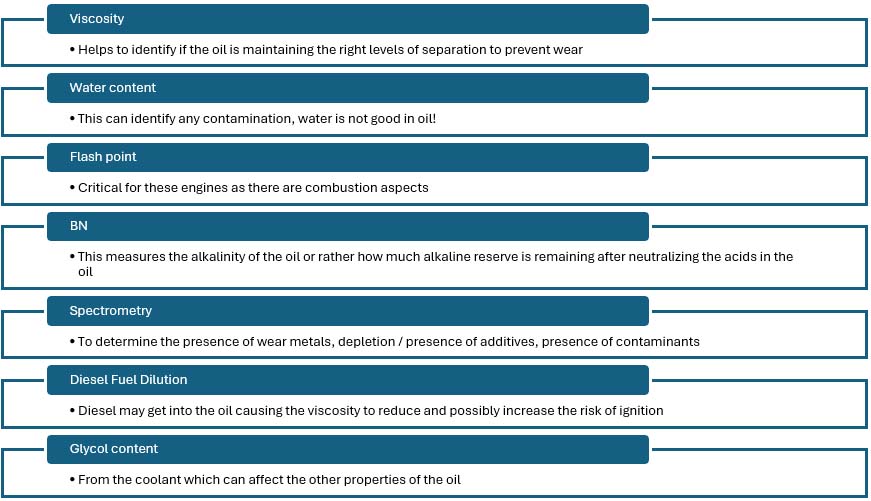
Diesel/Gasoline Engines (can be further broken down into on-road, stationary, aviation, landfill, and marine)

These are some Basic (monthly tests) and why they matter.

diesel-gasoline-engins

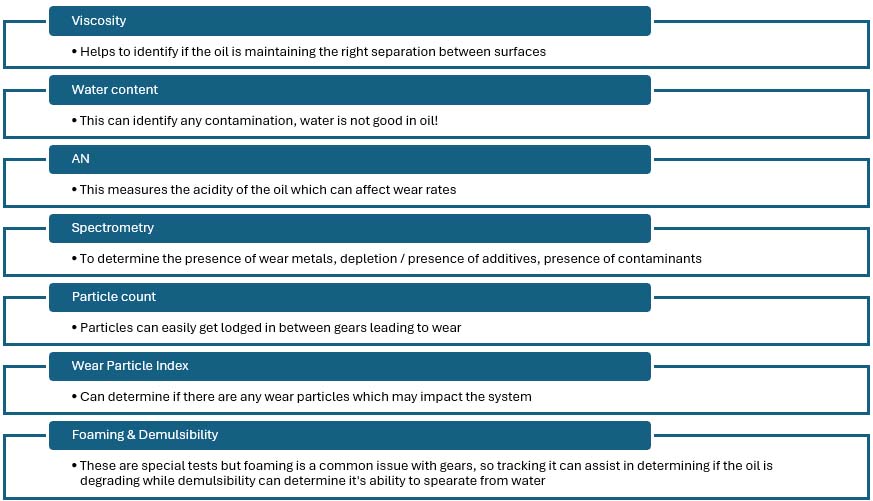
Gearboxes (can be broken down into industrial or automotive). These are the tests and why they matter.

gearboxes

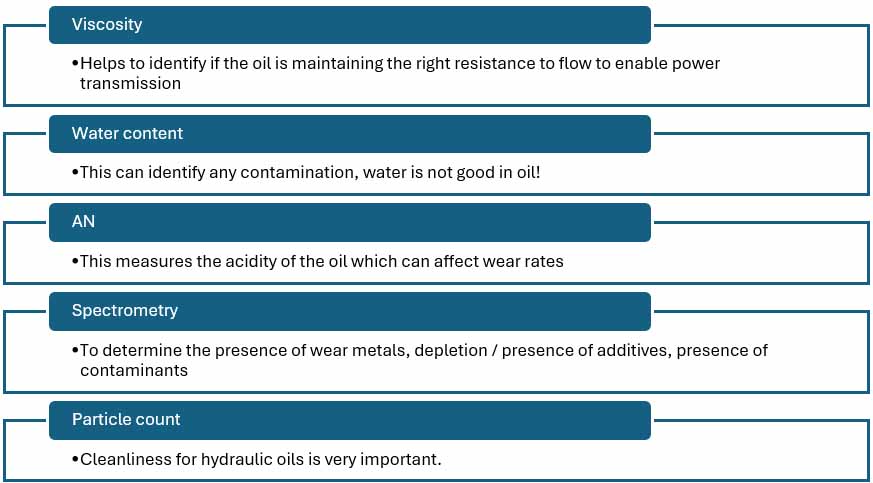
Hydraulics

These are the tests for hydraulics and why they matter.

hydraulics

Turbines and Compressors

Here is a list of tests and why they matter for turbines and compressors.

turbines-compressors

We did not dive into Electrical oils, heat transfer oil, circulating oils, metalworking fluids, or seal oils, but these will have similar type tests and some special tests as well.