
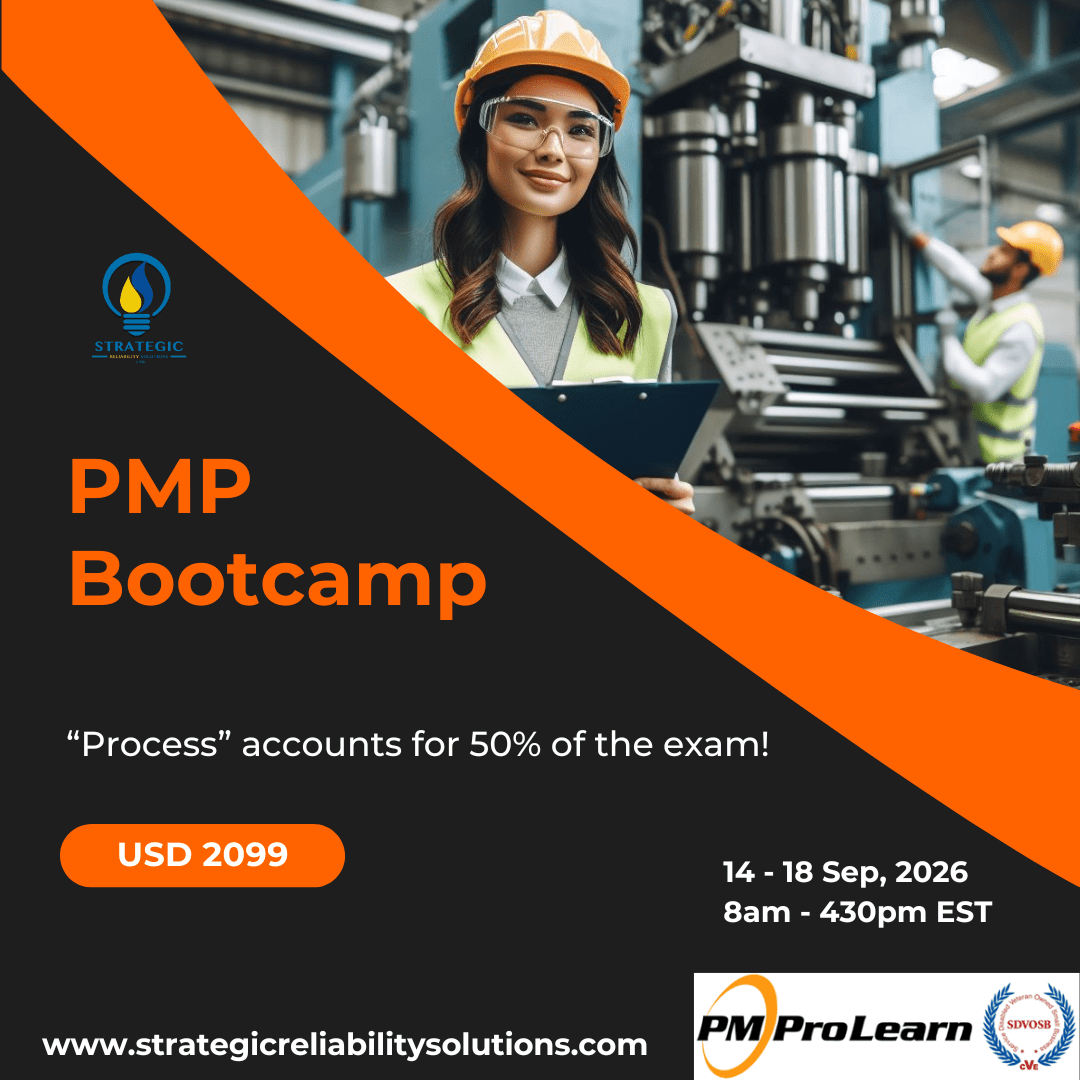
PMP® or CAPM® Boot Camp
Course Summary
This course is designed to prepare PM-ProLearners for the PMP® or CAPM® certification exam. The course focuses on concepts of predictive, adaptive, and hybrid project management. Additional areas discussed in this course are the business environment of projects and project team leadership.
COURSE FEATURES
- PMP or CAPM Exam Fee – Yes, we pay your exam fee as part of your enrollment
- PMP or CAPM 1st Retest Fee – We are so confident in our training system that we will pay your retest fee if you fail the first time
- 35 hours of Instructor-Led Training – Expert instructors lead you through an interactive course with military & civilian project examples that covers everything you need to know to pass the PMP and CAPM Exam
- 1-Year Access to the Learning Management System
- PMP Application review & support – We make sure your application is ready for submission to PMI
- 1-Year Free Re-attendance – Reattend any future course in-person or virtual as many times as you want at no cost
Upcoming Courses in Eastern Time zone
- 14-18 September, 2026
- 02-06 November, 2026
By the end of this course, you should be able to:
- Evaluate and address the project business environment including managing compliance, internal and external factors to the project, supporting organizational change, and employing continuous process improvement on the project.
- Given a scenario, explain the appropriate project methodology based on the urgency of the project and the need to deliver business value.
- Given a selected methodology, assess and plan for the project needs in terms of scope, schedule, cost, quality, risk, communications, stakeholders, and procurements
- Explain and synergize the concepts of leading a high performing team, including virtual teams or team members to train, empower, and engage them with shared understanding
- Given a project scenario, evaluate the project and team progress and make changes as needed within the chosen project methodology
- Given a scenario, explain the techniques to identify, assess issues, and remove impediments, obstacles, and blockers to team performance and desired project outcomes
- Engage and collaborate with stakeholders (internal and external) effectively
- Evaluate the project governance required to successfully complete the project goals including appropriate artifact management
- Establish general understanding of and know when to apply agile methodologies and frameworks such as Scrum, Kanban, and Xtreme Programming (XP)
- Understand and model basic agile principles and mindset on projects
- Understand and model servant leadership concepts
Several features of the course facilitate achieving these course objectives, and some objectives require self-study after the course to fully prepare for the PMP or CAPM certification exam. The PM-ProLearn website and Learning Management System (LMS) provides a guide for the student experience and a foundation for the course materials as well as all post-course study and exam preparation. In addition to the PM-ProLearn site and LMS, students will have access to additional material from PMI to use for study post-course in preparation for the PMP exam.
WEB BASED COURSE MATERIALS
-
Course Length: 35 Hours, Includes:
- Fundamentals Pre-work
- General Test Taking Tips
- Study Plan
- Instructor Assisted Application and Review
- 1000+ Questions
- 25 Question Baseline Test
- 220+ General Project management Questions
- 200+ During Course Questions
- 45+ Homework Questions
- 2200+ Study Quiz Questions
- Full length 180 question practice test with a test bank over 350+ more questions!
A walkthrough video for each of these websites is located in the LMS Your instructor will act as your guide and briefly discuss each of these systems on the first day of class.
Live Session Participation
Students are expected to attend the scheduled synchronous learning class times to receive a score of “pass” and receive the certificate of completion at the end of the course. Each student is expected to attend live sessions and be actively involved in all class discussion, including asking questions and sharing knowledge and experiences with the rest of the class. Instructors will call on students that volunteer to participate, but will avoid calling on the same students repeatedly. There are no penalties for incorrect answers. The intent is to synergize information by thoughtfully reasoning through a problem or asking a pertinent question that adds value to the experience for everyone. “Cold calling” on students that are less participative can be expected.
During live synchronous sessions, the instructor is able to best gage feedback and student retention through in-class quizzing and impromptu questioning. Often more informative feedback is gained from body language and facial expressions. To the extent it is not distracting for fellow PM-ProLearners, the instructor prefers that your video remain on during virtual-led sessions. Microphones should be muted unless actively engaging with the instructor or your fellow students to minimize distracting background noise.
At the end of each topic area, instructors will facilitate one of three activities to verify learning and allow students to discover needed areas of improvement.
- Instructor-Facilitated Group Guided Discussion
- Student-Led Small Group Breakout Sessions
- Socrative In-Class Polling and Quizzing
COURSE OUTLINE
Introduction
- PM-ProLearn Intro
- Qualification Review
- Application Review
- Exam Overview
Lesson 1: The Business Environment
Foundation Learning Objectives:
- Define ‘project’ and how it relates to the larger discussion of project management.
- Discuss the different types of organizational structures and how they relate to your project’s management.
- Discuss the principles of project management.
- Discuss the principles of agile and how they relate to your project’s management.
Strategic alignment Learning Objectives:
- Discuss strategic alignment and its elements.
- Determine how projects align with business strategy.
- Explain the impact of business factors on strategic alignment.
Project benefits and value Learning Objective:
- Identify types of business value.
Organizational Culture and Change Management Learning Objective:
- Describe change management theory and its relation to organizational change.
Project Governance Learning Objective:
- Define and discuss project governance.
Project Compliance Learning Objective:
- Explain project compliance and its importance.
Lesson 2: Start the Project
Identify and Engage Stakeholders Learning Objective:
- Define and discuss stakeholders and the most effective ways to communicate with them.
Form the Team Learning Objective:
- Explain the best ways to form a team.
Build Shared Understanding Learning Objective:
- Describe how to build the most effective understanding of a project and how doing so relates to executing a project successfully.
Determine Project Approach Learning Objective:
- Explain how predictive and adaptive project life cycles work; explain what a hybrid development approach is.
- Decide which kind of development approach or life cycle is best suited for work.
Lesson 3: Plan the Project
Planning Projects Learning Objective:
- Explain the importance of a project management plan.
Scope Learning Objective:
- Provide an overview of scope planning in both predictive and adaptive projects.
Schedule Learning Objective:
- Provide an overview of schedule planning in both predictive and adaptive projects.
Resources Learning Objective:
- Discuss resource planning for a project, including human and physical resources and the role of procurement.
Budget Learning Objective:
- Determine the budgeting structure/method for a project.
- Explain the importance of tailoring a budget.
Risks Learning Objectives:
- Identify strategies for dealing with risks and risk planning.
- Assemble a toolkit of possible responses to risks.
Quality Learning Objectives:
- Define quality and how it relates to the outcomes and deliveries for a project.
Integrated Plans
- Discuss the importance of integrating project management plans and tailoring a change management process.
Lesson 4: Lead the Project
Craft Your Leadership Skills Learning Objective:
- Discuss the guidelines for developing leadership competencies and skills.
Create a Collaborative Project Team Environment Learning Objective:
- Address leadership styles, and the components of leading a successful team, either in person or virtually.
Empower the Team Learning Objective:
- Identify the characteristics and core functions of empowered teams.
Support Team Member Performance Learning Objective:
- Describe artifacts and the strategies for their use.
Communicate and Collaborate with Stakeholders Learning Objective:
- Explain strategies and forms of communication for collaborating in a project team environment.
Train Team Members and Stakeholders Learning Objectives:
- Learn the value of training, coaching and mentoring for a team.
Manage Conflict Learning Objectives:
- Explain the importance of conflict management.
- Discuss the causes and levels of conflict and their outcomes.
Lesson 5: Support Team Performance
Implement Ongoing Improvements
- Explain the various methods for implementing improvement.
Support Performance Learning Objective:
- Explain the various methods for performance measurement.
Evaluate Project Progress Learning Objective:
- Compare these methods with a focus on communication and accountability.
Manage Issues and Impediments Learning Objective:
- Identify the methods for implementing a project and the issues and impediments that arise during a project.
Manage Changes Learning Objective:
- Describe the methods for implementing changes during a project.
Lesson 6 Closing the Project or Phase
Closing Learning Objectives:
- Define the reasons and activities related to the closure of a phase or a project.
- Explain the benefits gained from a project or phase, and how they are managed, sustained, etc.
- Examine the reasons for knowledge transfers and how they relate to the closure of a phase or project.