Tagged: failure

Role of Condition Monitoring, Human & Organizational Factors in Oil Failures

Choosing the right oil for the system is just one part of the puzzle. How do we know the oil is performing when it’s in the system? This is where condition monitoring can work hand in hand to help ensure that the oil does not fail the asset.

If a proper oil analysis program does not exist, operators will not know whether the oil is properly lubricating the asset. They will also not be aware of whether the oil is breaking down too quickly and failing to protect the asset. Oil analysis can also alert operators to signs of wear in the asset, so they can fix them before they turn into functional failures.

An oil analysis program that lives in a drawer protects assets about as well as no program at all.
There is also the possibility that an oil analysis program exists but is not top of mind, or that its results are put in a drawer. This can also cause the asset to fail even though the correct oil is being used. Apart from the aforementioned factors, if operators are not warned of the impending failure of the oil, this can result in production losses, increased downtime, and, in some extreme cases, the complete loss of the asset if it has failed beyond repair.

Incorrect sampling is another area in which the actual condition of the asset is not reported. Even with the correct oil used, if a sample is collected from a dead leg or an area that is not truly representative of the conditions inside the component, its actual condition will not be known. With incorrect data about the component, the asset can be misdiagnosed or treated for symptoms that do not exist, which can lead to its detriment.

Human and Organizational Factors

Not all failures occur at the equipment level; human and organizational factors can also cause the asset to fail even when the correct oil is used. If humans aren’t properly trained in oil sampling techniques or storage and handling practices, these can affect the asset’s functionality. We often forget that, at the heart of it all, lies the human factor, which is partially governed by the organization’s systems.

Training needs are an organizational factor that is often overlooked when considering how an asset can fail. However, if operators have not been trained in condition monitoring techniques, they will not be able to read oil analysis reports or take appropriate actions to protect the asset. Training can help bridge some competency gaps that directly impact asset performance.

It doesn’t matter what oil is in the system if no one is trained to monitor it – or motivated to care.

Culture is another factor swept under the rug. If the culture doesn’t exist to look after the assets, it doesn’t matter what type of oil is placed in the system; the asset will fail eventually. The performance of the asset does not only rely on using the correct oil. By implementing a culture of Asset ownership, where operators look after the asset and are accountable for its performance, assets are optimized to provide the functionality they should. This is one way to ensure the right oil is used to enable the assets’ performance.

Another area of concern is the documentation of maintenance procedures. If maintenance procedures are not adequately documented, someone new to the operation may not be aware of the correct practice. This, coupled with a lack of training, can spell disaster for the equipment. In these cases, even though the right oil was selected, the wrong practice or lack thereof can fail the asset.

Turning the “Right oil” into the “Right Outcome.”

As explained in this article, improper practices can jeopardize the asset’s health, even when the right oil is used. However, if all the right things align, we can have an asset that lasts for its expected lifetime or beyond.

This starts with selecting the right oil based on the application, environmental conditions, and OEM recommendations. If we follow this up with good storage and handling practices, proper condition-monitoring programs, documentation, and training, we can look toward a longer-lasting asset. The right oil enables reliability – but only disciplined practices deliver it.

Find out more in the full article, "When 'Right oil, Wrong practice' still fails assets" featured in Precision Lubrication Magazine by Sanya Mathura, CEO & Founder of Strategic Reliability Solutions Ltd. 
Common Modes of Failure for Lubricants

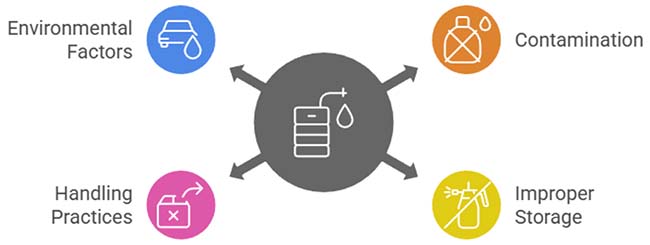
Regardless of the oil selected, common modes of failure can occur with every lubricant. These include: contamination, improper storage and handling practices, and environmental factors as shown in Figure 4.

Figure 4: Common modes of failure for lubricants

Contamination can be defined as any foreign particle entering the system. This includes any gases, liquids, or solids. Especially when the lubricant system runs alongside the process side, process gases and liquids can leak into the oil. These contaminants can influence the oil’s degradation, leading to deposits or chemical reactions that break it down. Common process contaminants include ammonia or treated water.

The biggest threat to the right oil is often what gets added to it – whether it’s process contamination or the wrong oil during a top-up.

Another liquid that can contaminate oil is another oil. During top-ups, operators can add the wrong oil to the system, causing contamination and, depending on the oil, a possible shutdown. Adding motor oil to hydraulic oil can be catastrophic, as the additive packages work differently and the motor oil additives may counteract the hydraulic additives, removing them from the oil, leaving the asset open to wear and failure. Despite selecting the correct lubricant for your system, adding the wrong oil (mistakenly) will shorten its lifecycle and cause the asset to fail.

Bad storage and handling practices can also erode your oil, regardless of the oil you choose. Turbine and hydraulic oils are used in precise equipment. As such, they need to be clean and free of dirt or other contaminants. However, if oils are not stored correctly, contaminants can enter and contaminate the oil.

Simple techniques, such as transferring oil from larger storage containers (pails, drums, or totes) into smaller, more manageable containers (2-3 liters or less), can introduce contaminants into the oil if not done correctly. If oils are to be transferred to another storage container, the storage container must be clean. The transfer process should use clean hoses (not previously used for another lubricant) and be completed in a dust-free environment.

If you wouldn’t use a dirty needle for a blood transfusion, why would you use a dirty hose for an oil transfer?

The transfer of oils from one container to the next can be thought of as a blood transfusion. Would you use dirty needles or vials to transport the blood to be placed into another human? Similarly, oil can be likened to the equipment’s lifeblood and should be treated accordingly. Just as we observe sterile practices for blood transfusions, we should also observe similar types of practices for oil transfers.

Environmental and operational factors can also influence lubricant degradation. As stated earlier, all lubricants can degrade over time under harsh conditions. The lubricant formulation largely influences this, as does whether it was blended to withstand those conditions.

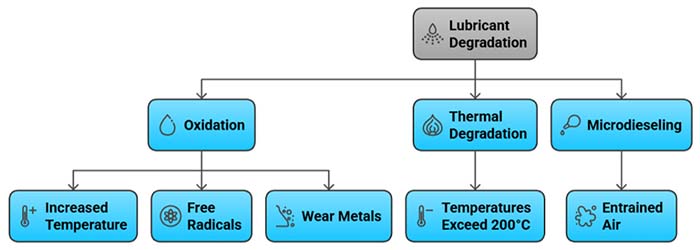
Oxidation can easily occur when temperatures increase, free radicals are present, or when wear metals are present. Thermal degradation occurs when the temperatures exceed 200°C. On the other hand, microdieseling occurs in the presence of entrained air, despite the lubricant used in the system, as shown in Figure 5.

Figure 5: Lubricant Degradation Processes

Any of these degradation mechanisms can occur regardless of the type of oil chosen. Hence, it is essential to remember that operational conditions and environmental factors can heavily influence oil degradation, even when the oil is appropriate for the system.

Find out more in the full article, "When 'Right oil, Wrong practice' still fails assets" featured in Precision Lubrication Magazine by Sanya Mathura, CEO & Founder of Strategic Reliability Solutions Ltd. 
Lubrication failures in Ammonia plants

Quite often, when lubrication failures occur, the first recommended action is to change the lubricant. However, when the lubricant is changed, the real root cause of the lubricant failure has not been solved. As such, the cause of lubrication failure will continue to be present and may escalate further to develop other problems.

Essentially, this can cause catastrophic future failures simply because the root cause was not identified, addressed and eradicated. Moreover, the seemingly “quick fix” of changing the lubricant, is usually seen as the most “cost effective” option. On the contrary, this usually becomes the most expensive option as the lubricant is changed out whenever the issue arises which results in a larger stock of lubricant, loss in man hours and eventually, a larger failure which can cost the company at least a month or two of lost production.

In this article, we investigate lubricant failures in Ammonia plants and their possible causes. Some Ammonia plants have a developed a reputation for having their product come into contact with the lubricant and then having lubrication failures occur. As such, most Ammonia plant personnel accept that the process materials can come into contact with the lubricant and usually change out their lubricants when such issues occur. However, there are instances, where the ammonia is not the issue and plant personnel needed to perform a proper root cause analysis to determine the root cause and eradicate it. Here are a couple of examples of such instances.

Livingstone (1) defies the Lubrication Engineers Handbook in their description of ammonia as an inert and hydrocarbon gas that has no chemical effect on the oil, stating that this is incorrect. Instead, Livingstone (1) lists the number of ways that Ammonia can react with a lubricant under particular reactions such as;

  • ammonia being a base that can act as a nucleophile which can interact with any acidic components of the oil (such as rust/corrosion inhibitors)
  • reaction of ammonia with carboxylic acids (oil degradation products) to produce amides which cause reliability issues
  • transesterification of any ester containing compound to create alcohol and acids and the reaction of ammonia with oxygen to form NOx which is a free radical initiator that accelerates fluid degradation.

As such, one can firmly establish that ammonia influences the lubricant and can lead to lubrication failures should that be the cause of the lubricant failure.

The Use of Root Cause Analysis    

Van Rensselar (2) quotes Zhou as saying the best method for the resolving varnish is to perform a root cause analysis. Wooton and Livingstone (3) also advocate for the use of root cause analysis to solve the issue of varnish. They go on to explain that the characterization of the deposit aids in determining the root cause of the lubricant degradation. As such, Wooton and Livingstone (3) have developed a chart to assist in deposit characterization as shown below.

Deposit Characterization graphic from Wooton and Livingstone (3)

Wooton and Livingstone (3) discussed that with the above figure, once the deposit can be characterized then the type of lubricant degradation can be more accurately identified. As such, the root cause for the lubricant degradation can now be firmly established thereby allowing solutions to be engineering to control and reduce / eliminate lubricant degradation in the future.

Case Studies

A case study from Wooton and Livingstone (3) was done with an Ammonia Compressor in Romania which experienced severe lubricant degradation. In this case study, they found that when the in-service lubricant was subjected to two standard tests namely MPC and RULER, both tests produced results within acceptable ranges. As such, there was no indication from these tests that the lubricant had undergone such drastic degradation as evidenced by substantial deposits within the compressor. Thus, it was determined that the deposits should be analysed as part of the root cause analysis.

For the deposits from the Ammonia compressor, Wooton and Livingstone (3) performed FTIR spectroscopy to discover that its composition consisted of mainly primary amides, carboxylic acids and ammonium salts. It was concluded that the carboxylic acids formed from the oxidation of fluid while in the presence of water.

In turn, the carboxylic acids reacted with the ammonia to produce the primary amides. These amides consisted of ammonium salts and phosphate. As such, the onset of carboxylic acids within the system eventually leads to the lubricant degradation. Thus, an FTIR analysis for carboxylic acids was now introduced to this Ammonia plant as well as MPC testing to monitor the in-service lubricant.

Additionally, chemical filtration technology was implemented to remove carboxylic acids within the lubricant. These two measures allowed for the plant to be adequately prepared for lubricant degradation and avoid failures of this type in the future.

Another case study was done in Qatar with an ammonia refrigeration compressor which was experiencing heavy deposits due to lubrication degradation. For this Ammonia plant, high bearing temperatures and deposits were found on the bearing.

Upon investigation, it was realized that the lubricant had been contaminated externally and there was restricted oil flow to the bearings. After a FTIR was performed it was deduced that that the deposits were organic in nature and there were several foreign elements including high levels of carbon and primary amides.

From further root cause analysis, it was determined that the high temperatures observed were due to the lubricant starvation. Due to these high temperatures, oxidation initiated and with the high levels of contamination (mainly from ammonia within the process) this lead to degradation of the lubricant in the form of heavy deposits.

The bearing oil flow was increased and reduction in external contaminants were implemented. Oil analysis tests of Viscosity, Acid Number, Membrane Patch Calorimetry and Rotating Pressure Vessel Oxidation tests were also regularized in the preventive maintenance program. Thus, for this failure, some operational changes had to be made in addition to increased frequencies of testing. With these measures in place, there would be a reduced likelihood of future failures.

From the case studies mentioned, it can be concluded that ammonia systems have a higher possibility of undergoing lubricant degradation due to the contamination of the lubricant by ammonia gas / liquid due to its properties. However, it must also be noted that the ingression of ammonia into the lubrication system is not the only cause for lubrication failure.

Therefore, it is imperative that a proper root cause analysis be carried out to determine the varying causes for lubrication failure before the ingression of ammonia accepts full responsibility for any such failure.

References:

  1. Livingstone, Greg (Chief Innovation Officer, Fluitech International, United States America). 2016. E-mail message to author, March, 08.
  2. Van Rensselar, Jeanna. 2016. “The unvarnished truth about varnish”. Tribology & Lubrication Technology, November 11.
  3. Wooton, Dave and Greg Livingstone. 2013. “Lubricant Deposit Characterization.” Paper presented at OilDoc Conference and Exhibition Lubricants Maintenance Tribology, OilDoc Academy, Brannenburg, Rosenheim, Germany, United Kingdom, January 22-24, 2013.

Written by Sanya Mathura, CEO & Founder of Strategic Reliability Solutions Ltd. 
Lubrication failures in Industrial plants

When failures occur in industrial plants, the first culprit to be suspected is usually the lubricant. However, should this be the first area that one looks at and what are the main causes of the lubricant failing? To understand this, I’ve taken a look at lubrication failures in industrial plants both globally and locally to understand the impact that they have on the sector.

Van Rensselar(1) explained that a recent study conducted by ExxonMobil Lubricants & Specialities of 192 US based power plants, 40% of these have reported issues of varnishing within their facilities. On the other hand; Livingstone, Prescott and Wooton(2) describe a study carried out by EPT Inc which document 44% lubrication failure of gas turbines (not including GE Frame 7FA & EA). It is therefore clear to see that there exists a prevalent issue of lubrication failure within the industry.

When a lubrication failure occurs, it costs an estimate of USD100,000 per trip in a power plant(1). As such, lubrication failures are costly within the industry and methods to reduce issues relating to these types of failures should be explored. Van Rensselar(1) also interviewed Joe Z. Zhou senior research chemist for Chevron Lubricants in Richmond California who explained that one of the main causes of varnish is the primarily oxidized hydrocarbon molecules which undergo surface aggregation and further surface reaction to produce the varnish. However, Livingstone and Oakton(3) add to this description of the main causes of varnish as the oxidation of the oil whereby there is a loss of electrons from the molecules within the lubricant. They go on to state that hydrolysis and thermal degradation are also leading factors for the degradation of the lubricant.

Van Rensselar(1) explored the main cause of such increased volumes of varnish cases in recent times and found that due to changes in turbine designs to allow for reduced operating and capital costs, the clearances have become smaller, operations are now continuous and a common lubricant for both bearings and controls is now being used. With the reduced clearances, the lubricant can now heat up faster and allow for quicker oxidation occurrences thus leading to varnish. Additionally, with the use of a common lubricant for bearings and control functions, there are significantly different levels of filtration required. Bearings allow for at least a 200-micron filtration system whereas servo valves will accept nothing less than 3-micron filtration(1). As such, it has now become easier for servo valves to become clogged due to varnish as compared to instances in the past.

Case Studies

Johnson, Wooton, and Livingstone(4) describe a case study on a power plant in Arizona, USA where a failure occurred during a routine test. Upon inspection, soft varnish/sludge was found on the trip valve piston. The varnish/sludge was analysed using FTIR testing and its chemical properties suggested the presence of carboxylic acid, primary amide and methacrylate ester. Further investigations revealed that the varnish had accumulated in a uniformed fashion. However, MPC testing did not reveal significant varnish accumulation since these tests were conducted monthly and the varnish had accumulated significantlyduring that time. Upon performing a root cause analysis, it was discovered that a steam leak containing hydrazine gave rise to the presence of ammonia in the system which reacted with the carboxylic acids (produced from oxidation of turbine oils) to form varnish within the system. It was then decided that lower MPC levels were needed to manage the volume of varnish within the system and reduce the steam leaks into the oil. These actions were taken to ensure that the varnish levels could be managed such that there would be no future trips as a result of this issue.

Wooton and Livingstone(5) conducted another case study on a combined cycle power plant in the US which experienced a type of lubrication failure. The plant had been shut down during an outage and it was noticed that when the lubricant storage tank cooled past 32°C large black tar balls formed and floated at the surface of the tank. The filters appeared to contain the black tar when in a liquid form but when allowed to cool, the tar turned into a black / brown solid. FTIR testing on the deposit revealed decomposed amine antioxidant, an ester and an additive not characteristic of the lubricant in service. The non-characteristic additive was identified as a foam inhibitor which was not found in the lubricant in service. It was then concluded, that an incompatible fluid was mixed with the in-service lubricant. A quality control program was implemented to ensure that all the incoming fluids are compatible with the in-service lubricant. As such, for this case study, lubricant degradation occurred due to contamination.

Trinidad & Tobago

After conducting a lubrication survey with turbine users for the period 2014-2015 and it was found that within Trinidad & Tobago, turbine users can be classified into three main categories namely; Power generation, Oil & Gas and Petrochemical. It was found that internationally, there is a greater focus on the Power Generation sector in research regarding lubrication failures. However locally, Power Generation represents 40% of turbine users while Petrochemical represents 34%. On the contrary, it was found that the Petrochemical sector suffered more lubricant degradation issues as compared to the Power Generation sector from this study. Overall, the Petrochemical industry experienced the highest volume of lubricant failures.

Overall, it appears that while Power generation sector has a higher percentage of turbine users, locally the Petrochemical sector emerges as the larger shareholder of lubrication failures in the industrial sector. Given that most of the lubrication failures occurred via oxidation and contamination (both locally and internationally), one can only conclude that within the industrial sector a greater emphasis should be placed on the monitoring of the condition of the lubricants especially for critical equipment. When lubrication failures occur, they can be very costly, as such greater emphasis should be placed on the monitoring of these lubricants in service.

References:

1 Van Rensselar, Jeanna. 2016. “The unvarnished truth about varnish”. Tribology & Lubrication Technology, November 11.

2 Livingstone, Greg, Jon Prescott, and Dave Wooton. 2007. “Detecting and Solving lube oil varnish problems”. Power Magazine, August 15.

3 Livingstone, Greg and David Oakton. 2010. “The Emerging Problem of Lubricant Varnish.” Maintenance & Asset Management, Jul/Aug.

4 Johnson, Bryan, Dave Wooton, and Greg Livingstone. 2013. “Root Cause Determination of an Unusual Chemical Deposit on a Key Oil Wetted Component.” Paper presented at OilDoc Conference and Exhibition Lubricants Maintenance Tribology, OilDoc Academy, Brannenburg, Rosenheim, Germany, United Kingdom, January 22-24, 2013.

5 Wooton, Dave and Greg Livingstone. 2013. “Lubricant Deposit Characterization.” Paper presented at OilDoc Conference and Exhibition Lubricants Maintenance Tribology, OilDoc Academy, Brannenburg, Rosenheim, Germany, United Kingdom, January 22-24, 2013.


Written by Sanya Mathura, CEO & Founder of Strategic Reliability Solutions Ltd. 
How can a lubricant fail?

How can a lubricant fail?

This question has caused many sleepless nights and initiated countless discussions within the industrial and even transportation sectors. Before examining the causes for lubrication failure, one must first consider the definition of lubricant failure.

lubricant_fails

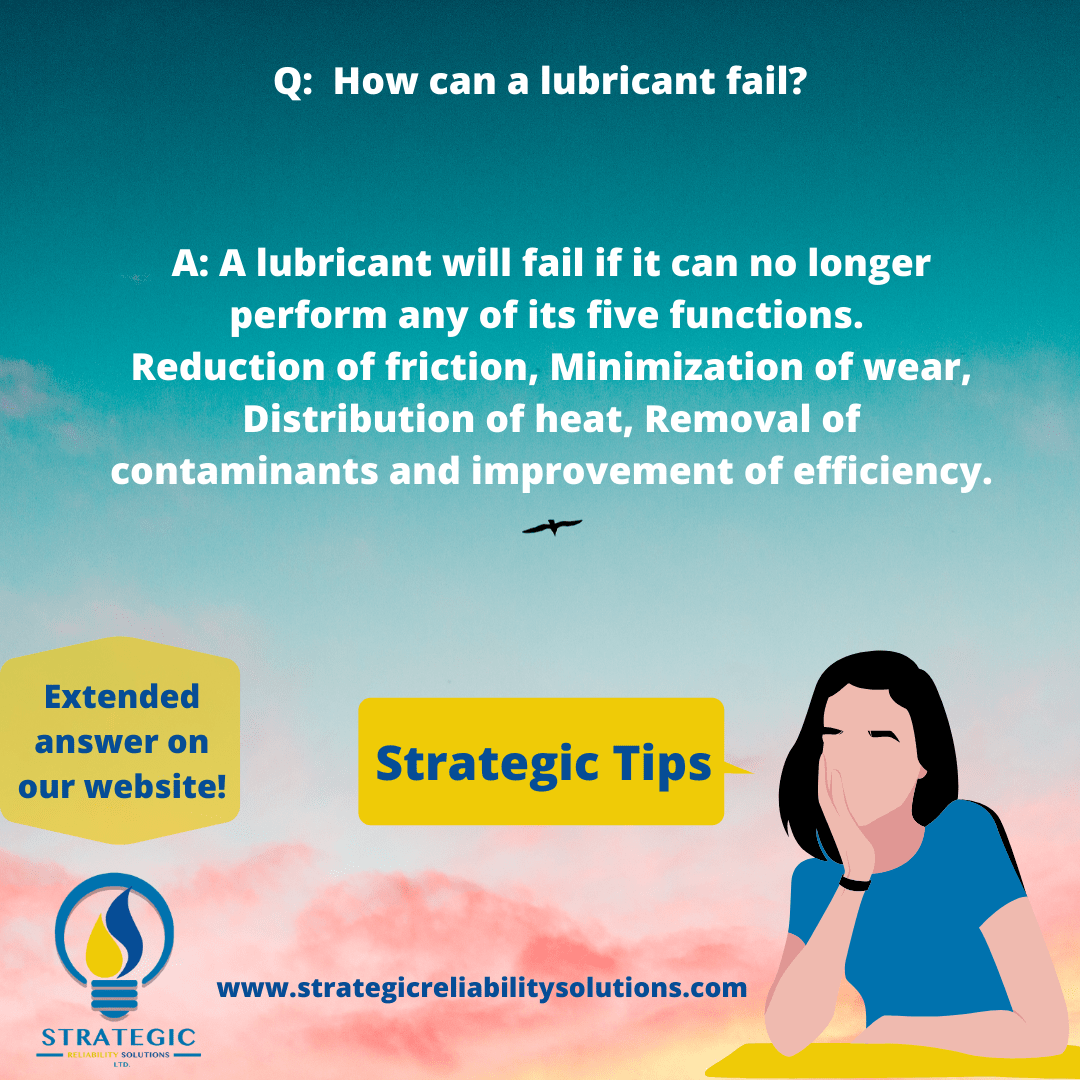
The composition of a liquid lubricant can be described as a combination of base oil and additives (Menezes, Reeves and Lovell 2013, 295). These two components work in tandem to define particular characteristics of the lubricant to perform its functions. According to Menezes, Reeves and Lovell (2013, 296) the five functions of a lubricant include;

  • the reduction of friction
  • minimization of wear
  • distribution of heat
  • removal of contaminants and
  • improvement of efficiency.

As such, lubrication failure can then be described as the failure of a lubricant to adequately perform any or a combination of its five functions as a result of the degradation of any of its two components; namely the base oil or additive package. Thus, it can be deduced that lubrication failure is as a result of lubricant degradation.

Now that we understand that a lubricant fails when it undergoes degradation which by extension results in the lubricant not being able to perform any of its functions properly, we need to explore further on the types of degradation that exist. Only then can we really answer the question of how a lubricant can fail.

Barnes (2003, 1536) focuses on three main mechanisms of lubricant degradation namely;

  • Thermal Degradation
  • Oxidation and
  • Compressive Heating (Microdieseling).

One may argue that these three types form the basis of all mechanisms of lubricant degradation.

ldm
6deg_mech

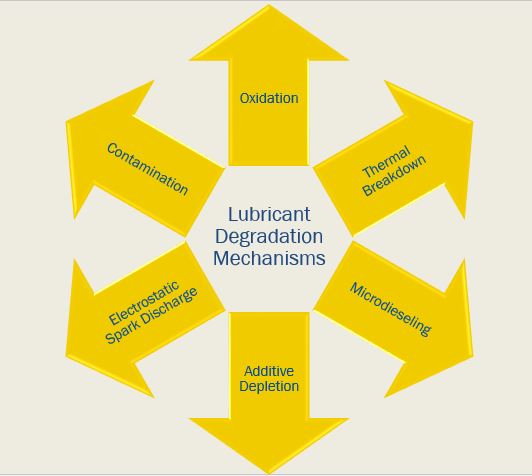
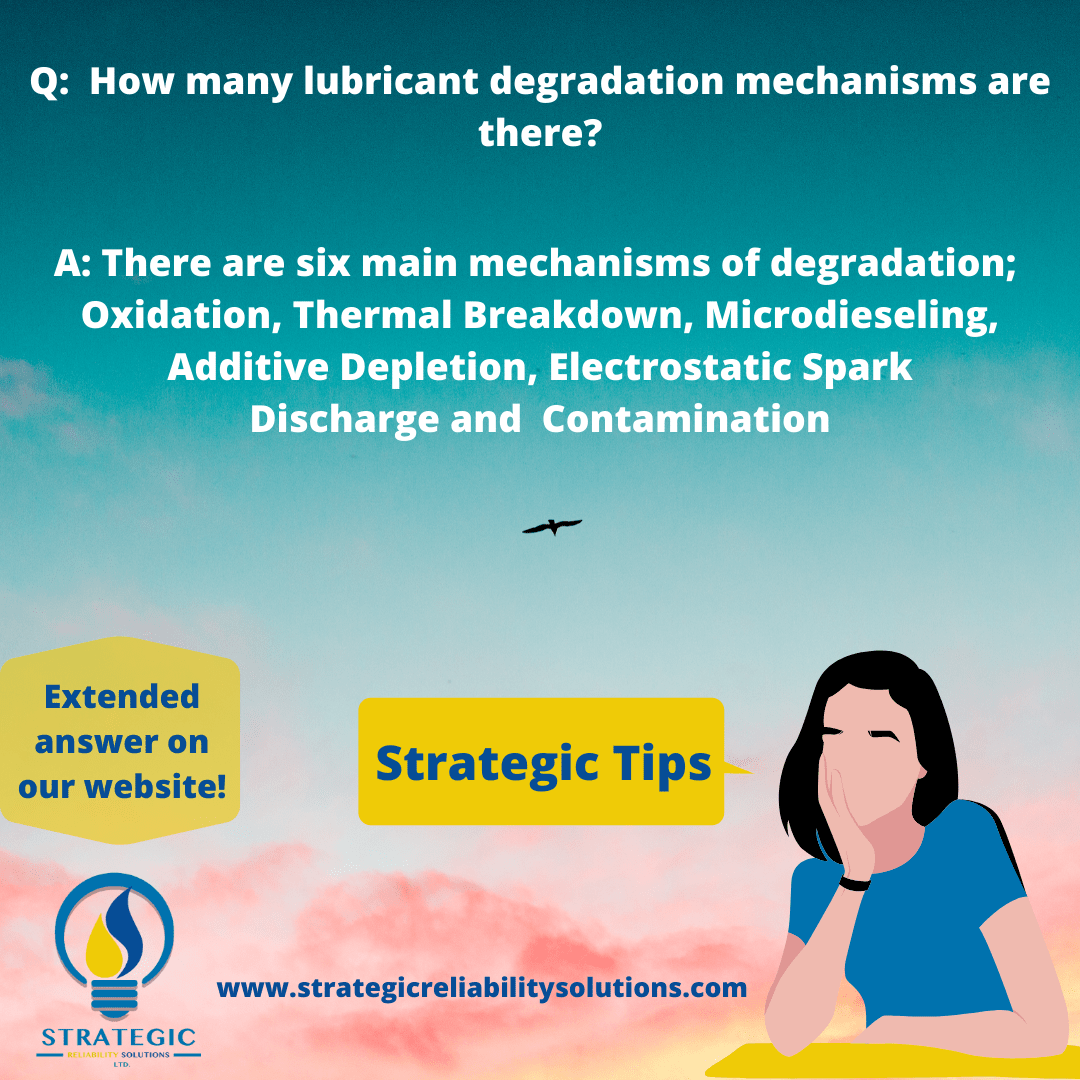
However, Livingstone, Wooton and Thompson (2007, 36) identify six main mechanisms of degradation namely;

  • Oxidation
  • Thermal Breakdown
  • Microdieseling
  • Additive Depletion
  • Electrostatic Spark Discharge and 
  • Contamination.

In this instance, the six identified mechanisms all produce varying identifiable characteristics which lend to these six forming the foundation of identification of lubricant degradation mechanisms. With these six in mind, one would need to be able to determine which degradation mechanism is at work in their facility. Afterwards, methods to treat with these mechanisms must be administered. Firstly, let’s understand each mechanism.

Oxidation

This mechanism involves the reaction of oxygen with the lubricant. According to Livingstone, Wooton and Thompson (2007, 36) oxidation can result in the formation of varnish, sludge, increase in viscosity, base oil breakdown, additive depletion and loss in antifoaming properties of the lubricant.

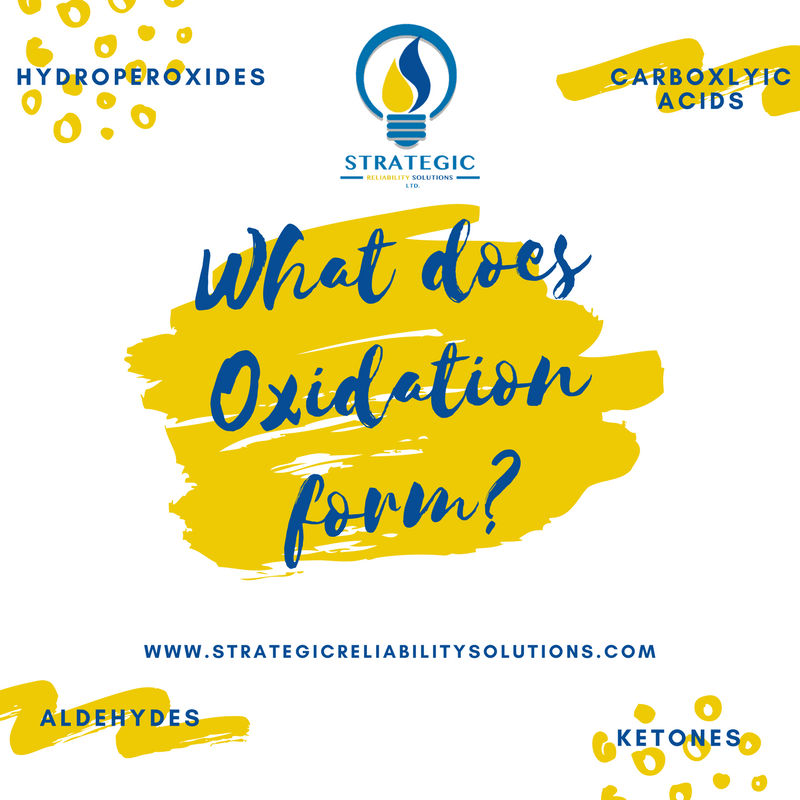
Barnes (2003, 1536) refers to this phenomenon as the addition of oxygen to the base oil to form:

  • Aldehydes
  • Ketones
  • Hydroperoxides and
  • Carboxylic Acids.
What is Oxidation_
Stages of Oxidation

On the other hand, Wooton (2007, 32) explains that there are three main stages of oxidation namely initiation, propagation and termination. Fitch (2015, 41) explains that:

  • Initiation entails the production of a free radical via the lubricant and a catalyst.
  • Propagation involves the production of more free radicals via additional reactions.
  • Finally, termination entails either the continuation of the oxidation process after the antioxidants have been depleted or the antioxidant stopping the oxidation process.

Microdieseling

Livingstone, Wooton and Thompson (2007, 36) have characterized Microdieseling as a form of pressure induced thermal degradation. They describe it as the transition of entrained air from a low pressure to a high pressure zone which results in the adiabatic compression.

This type of compression results in localized temperatures almost on excess of 1000°C.As such, the lubricant undergoes dramatic degradation. Wright (2012, 14) explains that because of these high temperatures, the bubble interface becomes carbonized. As such, carbon by products are produced and the oil undergoes oxidation.

microdieseling
Stages_ESD

Electrostatic Spark Discharge

Livingstone, Wooton and Thompson (2007, 36) describe this phenomenon as the generation of static electricity at a molecular level when dry oil passes through tight clearances. It is believed that the static electricity can build up to a point whereby it produces a spark. This spark can induce localized temperatures in excess of 10,000°C which can significantly degrade the lubricant at an accelerated rate.

Van Rensselar (2016, 30) also advocates that Electrostatic Discharge contributes to the formation of free radicals in the lubricant which subsequently results in uncontrolled polymerization. This polymerization of the lubricant gives rise to the formation of varnish and sludge which may deposit on the surface of the equipment or remain in solution. Van Rensselar (2016, 32) indicates that the most common result of Electrostatic Discharge is an elevated rate of fluid degradation and the presence of insoluble materials.

Thermal Breakdown

This mechanism is largely dependent on temperature as one of its contributory factors even though dissipation of heat was highlighted above as one of the functions of a lubricant. However, during the operation of machinery particular components tend to develop increasing temperatures.

As described by Livingstone, Wooton and Thompson (2007, 36) once this temperature exceeds the thermal stability point of a lubricant, the consequences can include shearing of the molecules. This phenomenon is also called the thermal cracking of the lubricant which can result in the production of unwanted by products, polymerization and decrease in viscosity.

Subsequently, Barnes (2003, 1536) explains that thermal degradation usually occurs when the lubricant experiences temperatures in excess of 200°C. He also states that the by-products of thermal degradation differ from that of oxidation.

Wooton and Livingstone (2013) state that there are two main actions that can occur once a lubricant is thermally degraded.

  • Either the small molecules will become cleaved off and volatize from the lubricant. This does not leave any deposit in the lubricant.
  • On the other hand, there is the condensation of the remainder of the molecule in the absence of air thus dehydrogenation also occurs. Consequently, coke is formed as the final deposit with numerous types of deposits forming between the start of the condensation to its final deposit of coke.

The main contributing factor for thermal degradation can therefore be linked to dramatic increases in temperature or constant high temperatures.

Additive Depletion

Wooton and Livingstone (2013) indicate that additive depletion can result in either organic or inorganic deposits. The nature of the deposit is dependent on the type of additive that has been depleted and its reaction with other components in the oil.

For instance, if the rust and oxidation additives drop out of the oil, they typically react to form primary antioxidant species thus producing organic deposits. However, as Wooton and Livingstone (2013) explain, inorganic deposits can also be formed from additives that have dropped out of the oil but did not react with anything. This unresponsive reaction is typical of ZDDP (Zinc dithiophosphate) which is an additive that assists with reducing wear in the lubricant.

In cases of additive depletion, the FTIR test seeks to identify spectra relating to the reacted or unreacted additive packages for the lubricant in use (Wooton and Livingstone, 2013).

Contamination

This mechanism of degradation can include foreign material entering the lubricant and being used as catalysts for degradation mechanisms listed above. Contaminants can include a variety of foreign material, however Livingstone, Wooton and Thompson (2007, 36) have narrowed the list to metals, water and air. These main contaminants can significantly contribute to the degradation of the lubricant by oxidation, thermal degradation or compressive heating.

From the above, we can summarize these lubricant degradation mechanisms into the following table:

From this summary, we can now assess the methods in which a lubricant can fail. While this article may serve as a guide in determining various lubricant degradation mechanisms, each mechanism must be treated differently depending on the conditions (environmental and operational) that exist during the lubricant failure. A proper root cause analysis should always be done when investigating any type of failure.

References

1 Livingstone, Greg, Dave Wooton, and Brian Thompson. 2007. “Finding the Root Causes of Oil Degradation.” Practicing Oil Analysis, Jan – Feb.

2 Barnes, M. 2003. “The Lowdown on Oil Breakdown.” Practicing Oil Analysis Magazine, May-June.

3 Livingstone, Greg and David Oakton. 2010. “The Emerging Problem of Lubricant Varnish.” Maintenance & Asset Management, Jul/Aug.

4 Wooton, Dave and Greg Livingstone. 2013. “Lubricant Deposit Characterization.” Paper presented at OilDoc Conference and Exhibition Lubricants Maintenance Tribology, OilDoc Academy, Brannenburg, Rosenheim, Germany, United Kingdom, January 22-24, 2013.

5 Van Rensselar, Jeanna. 2016. “The unvarnished truth about varnish”. Tribology & Lubrication Technology, November 11.


Written by Sanya Mathura, CEO & Founder of Strategic Reliability Solutions Ltd.