Tagged: reliability

How to identify the Root Causes of ESD in Lubrication

Thus far, all the prevention methods have focused on the physical roots of ESD. We did not explore some of the human or systemic roots that are also accountable for ESD. In this section, we will develop a logic tree designed to address a critical failure occurring in a plant. This will be used as an example of the logic tree, which can be developed when investigating the root causes of ESD.

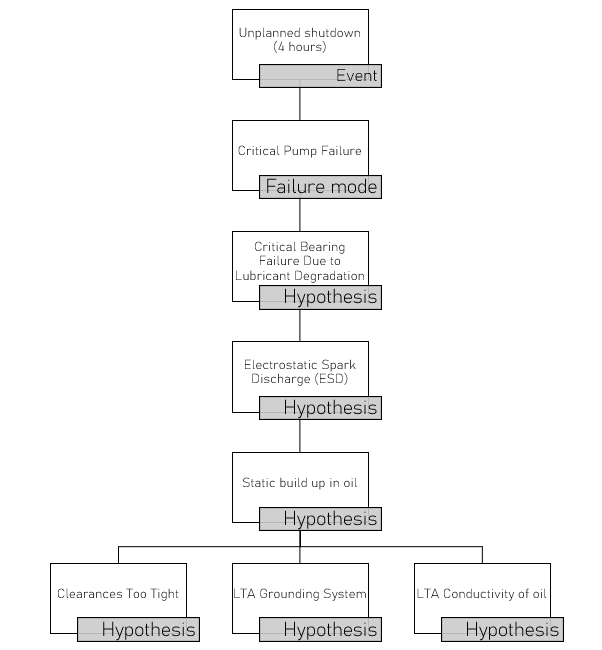
Let’s start with the top of the logic tree, where we define the event or the reason we care. In this situation, it is an unplanned shutdown for 4 hours. An unplanned shutdown will impact the plant’s production, which is why we care about conducting this investigation.

We will assume that the failure mode occurred on one of the critical pumps, and we are investigating how that failure could have happened. Note, we did not ask the question “Why?” because it can be misleading to an opinion, and we are trying to stay as factual as possible.

A disciplined root cause analysis doesn’t start with ‘why’ – it starts with evidence. Each degradation mechanism tells its own story, and Electrostatic Spark Discharge is just one of them.

For this investigation, we will investigate the hypothesis of a critical bearing failing due to lubricant degradation. Since we are focused on ESD for this article, we will have only one hypothesis regarding the degradation mode being ESD. However, in the real world, if this logic tree were being developed, we would be investigating the six various lubricant degradation mechanisms: oxidation, thermal degradation, microdieseling, ESD, additive depletion, and contamination.

Figure 1: Top part of the Logic tree for ESD

As shown in Figure 1, at the top of the logic tree, we start by placing our hypotheses on the tree, and then using evidence/facts, we can rule them out afterwards. This is a critical step as the investigation should be able to stand on its own in the court of law (even if it may not reach that point). The next hypothesis is the buildup of static in the oil. There are three possible ways for this to occur;

  • Clearances too tight (as discussed earlier, this can lead to molecular friction, which can induce static)
  • Less than adequate grounding system (if a proper grounding system doesn’t exist, then there isn’t an option for the static to dissipate)
  • Less than adequate conductivity of the oil (if the conductivity of the oil is too low, then the charge can build up and cause it to be dissipated along the system, such as the filters)

Now, we need to investigate each of the three main hypotheses stated and find out the root causes for them.

Let’s begin with the Clearances being too tight hypothesis.

For this hypothesis, we will ask the question, “How can clearances be too tight?”. In this case (and we will have to keep it general and in broad buckets, so we can drill down into these later and eliminate as necessary), there are three possible reasons:

  • The OEM could have designed the system such that it was less than adequate (LTA)
  • The flow rate could have been increased above the recommended threshold
  • Incorrect viscosity of the lubricant could cause additional friction (we will dive into this one later).

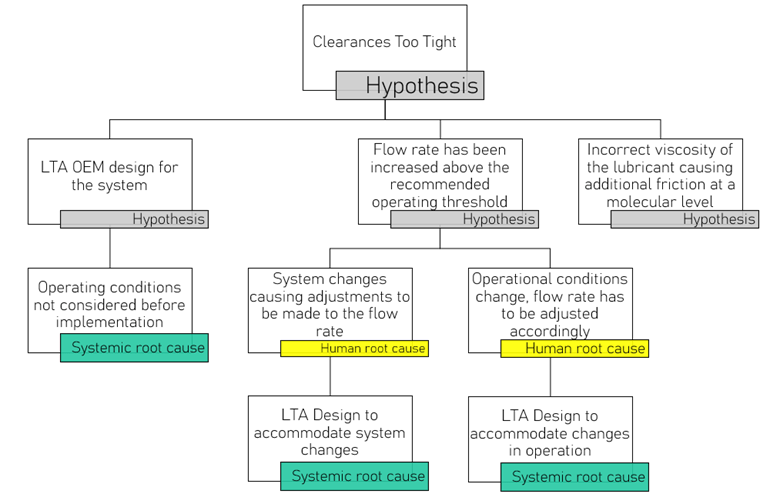
We will develop the other two hypotheses in Figure 2.

Figure 2: Investigating the hypothesis, "Clearances too tight"

If we further investigate where the OEM did not design the system effectively, we can determine that the operating conditions were probably not adequately considered before implementation. This is a systemic root cause and one that needs to be addressed with the OEM.

On the other hand, if we investigated the flow rate, there could be two main reasons for the adjustment. One could be because of system changes, which forced adjustments to the flow rate. Since a decision was made here, it is a human root cause. Someone decided to change the flow rate based on the variables involved. However, if we investigate why these changes were made (once a human is involved, the question moves from how to why), we can determine that the system was not designed to accommodate these changes. This is a systemic root.

Similarly, if the operational conditions change (such as when a higher output is required, which is different from system changes), then the flow rate must be adjusted. Again, a decision must be made here, and a human is involved. Then we ask the question, “Why?”. In this case, we have the same systemic root, and the design is inadequate to accommodate the necessary changes.

For this part of the tree, we have found some human root causes where decisions were made, as well as systemic root causes. Both need to be addressed when we perform the final root cause analysis. For the human root causes, we can think about the procedures that guided them to make those decisions (if they existed) and amend these accordingly.

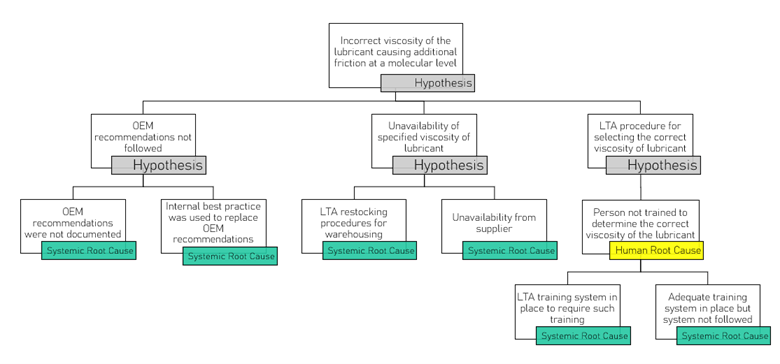
On to the next hypothesis, which we have yet to investigate (still under the clearances being too tight), the incorrect viscosity of the lubricant, which is shown in Figure 3. There are a couple of ways in which this can happen:

  • OEM recommendations were not followed
  • There was an unavailability of the specified viscosity of the lubricant
  • There was a less-than-adequate procedure for selecting the correct viscosity of lubricant

If we investigate why the OEM recommendations were not followed, we can find two main reasons. Either they were not documented and therefore could not be followed, or the internal best practice was used instead to replace the OEM recommendations. In both cases, these would be systemic root causes, and we should investigate why these were not documented or why they were replaced.

Figure 3: Investigating the hypothesis, “Incorrect viscosity of lubricant”

When investigating the unavailability of the specified viscosity of the lubricant, we can find two main causes. Either there was an issue with the restocking of this lubricant at the warehouse due to their forecasting, or appropriate checks were not carried out. This is a systemic root cause that should be investigated further.

Another hypothesis could be that the specified lubricant was unavailable from the supplier. This is another systemic root cause and should be addressed with the supplier to ensure it is resolved in the future.

When lubricant viscosity errors trace back to missing stock or missing training, the problem isn’t the person or the product – it’s the system that allowed both to fail.

On the other hand, if we examine the procedure for selecting the correct viscosity of the lubricant, we identify a human root cause, as someone would have made the decision on which viscosity to use. But in this case, we need to investigate why the person was not trained to determine this value.

There are two main reasons why a person does not receive training: either it doesn’t exist, or it was not followed. In both cases, these are systemic roots that need to be further investigated and addressed.

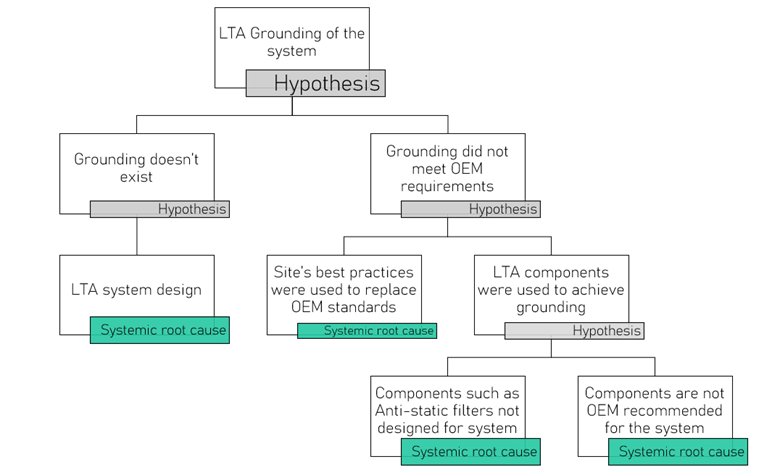
Now, we will investigate the next major hypothesis, “LTA grounding of the system” in Figure 4.

Figure 4: Investigating the hypothesis, “LTA Grounding of the system”

When investigating the grounding of a system, we can identify two major classes: either it doesn’t exist, or it didn’t meet the requirements. If grounding did not exist, then this is an inadequate system design and therefore a systemic root cause. On the other hand, if the grounding did not meet the OEM requirements, we need to determine how this was possible.

Figure 5: Investigation of the hypothesis, “LTA Conductivity of oil”

There are two possibilities: the site’s best practices were used to replace the OEM standards, which is something we often see, especially if these requirements have worked in the past. This is a systemic root cause that should be investigated. Or there were fewer than adequate components to achieve grounding.

In this case, we can have components that are not designed for the system (do not meet the system’s requirements) or components that were not OEM-recommended and are being used (such as aftermarket products that do not meet the necessary specifications).

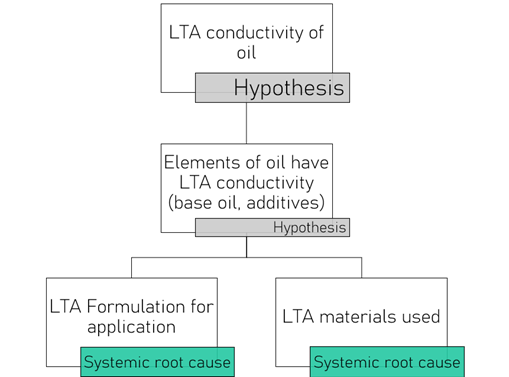
Finally, on to the last major hypothesis, “LTA conductivity of the oil,” as shown in Figure 5.

As noted earlier, if an oil has a conductivity of more than 100pS/m, it will be able to dissipate any accumulated charge easily. However, if it falls below this value, the charge will be dissipated in the system at the earliest opportunity.

How can oil have less than adequate conductivity? Perhaps the elements of the oil have a less-than-adequate conductivity. If that is the case, then there can be two plausible reasons for this. Either the formulation was not appropriately designed, or the materials (base oils, additives) were not of a particular standard. Both causes are systemic root causes and should be investigated further to determine if anything can be done to correct these.

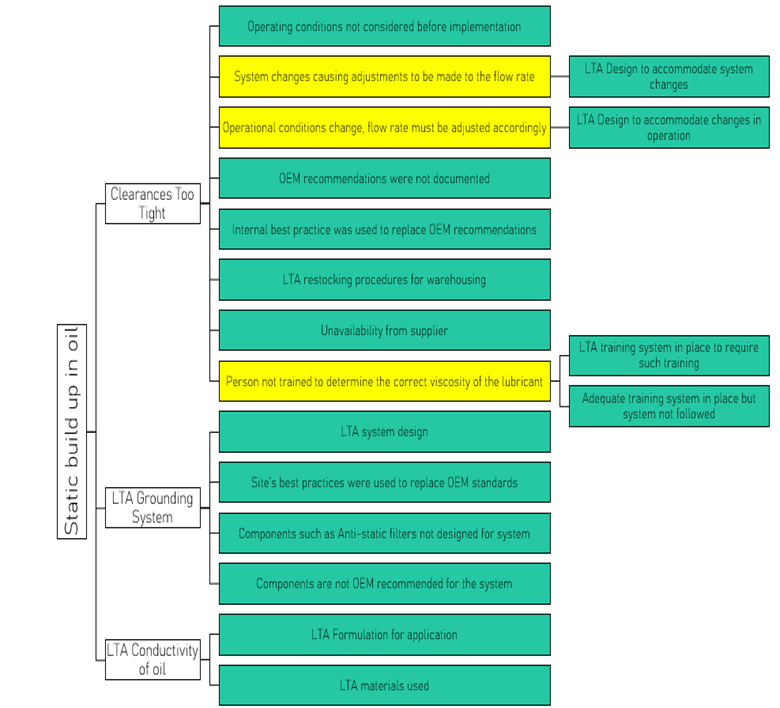
If we were to summarize a list of the root causes, we would see that many are systemic, while a few are human, as shown in Figure 6.

Figure 6: Summary of the root causes of ESD

This further reiterates the need to develop a comprehensive logic tree when investigating any failure, as many root causes are not physical or surface-level. If these are not adequately addressed, the failure mode will recur in the future. The entire logic tree can be found here under additional support material, along with logic trees for other degradation mechanisms.

References

Mathura, S. (2020). Lubrication Degradation Mechanisms: A Complete Guide. Boca Raton: CRC Press.

Mathura, S., & Latino, R. (2021). Lubrication Degradation: Getting into the Root Causes. Boca Raton: CRC Press.

What are Effective Strategies to Prevent ESD in Lubrication?

ESD occurs when there is a buildup of static in the oil; therefore, one of the best methods of preventing it is to ensure that the static levels remain low or are dissipated before they have a chance to wreak havoc on the system. The simplest and most common way of reducing this static is the installation of antistatic filters. These filters can help to remove static from the system before it builds up to dangerous levels, where it can burn the membranes or develop varnish.

Static in oil is inevitable – how you control and discharge it determines whether your system runs clean or burns itself from within.

Ensuring that the system is grounded correctly is another way to guarantee that any built-up static is removed. This is where your electricians can perform checks and install proper grounding devices for your equipment to safeguard against this buildup of static in the system. Therefore, if static charges get built up in the system, they can be dissipated without the effects of ESD.

If oils experience high levels of conductivity, they can conduct static. Typically, if the conductivity is above 100pS/m, there is potential for the fluid to conduct the charge and allow it to be discharged along the system without causing harm.

Unfortunately, there are base oils with low conductivity (below 100pS/m) that cannot carry the charge and dissipate more easily. As such, these types of oils will see an increase in the presence of ESD if not formulated correctly for modern lubrication systems.

As the viscosity of the oil decreases, more force is required to pass through the filters, which can lead to a buildup of static at a molecular level. Additionally, as temperatures decrease, the viscosity also decreases. In these cases, keeping the oil at the system temperature (designed for that particular viscosity) can help to reduce the buildup of static charge in the oil.

Understanding Electrostatic Spark Discharge and Its Impact on Lubrication Systems

Electrostatic Spark Discharge typically occurs when static is built up in an oil at a molecular level, causing it to discharge in the system and create free radicals, which increase the opportunity for varnish to form. This usually occurs at temperatures of around 10,000 °C.

If we were to liken this to an everyday situation, we could think about walking around a carpeted room where the static builds up in our body. When we touch a metallic object (more than likely a door handle), we get a bit of a shock as the built-up static is discharged through us and the door handle.

Inside a lubricant system, static doesn’t just build – it ignites microscopic sparks powerful enough to scar filters and start the chain reaction that leads to varnish.

Similarly, in lubricants, static exists at a molecular level, and in areas of tighter clearances, some molecules are forced to rub against each other, causing a buildup of static. When it accumulates to the point of becoming a full charge, it dissipates at the first opportunity, usually at the filter membrane or some sharp-edged object along the way. These are seen as burnt patches on the filter membrane.

When this spark occurs, it creates a chemical reaction that generates free radicals. Free radicals are highly reactive species that need to engage with other substances. These are the initiators of varnish, and their presence can accelerate reactions, leading to deposits forming in the lubricant. Eventually, this will lead to a system that has experienced both ESD and oxidation.

In this article, we will discuss various identification methods and ways to prevent ESD in modern lubrication systems. We will also spend some time identifying typical root causes for ESD by developing a logic tree as a guide for future investigations.


How to Identify Electrostatic Spark Discharge in Lubrication Systems

Every degradation mechanism produces varying results in the form of deposits or in how these are formed. For ESD, some tell-tale signs alert the user to its occurrence. These include:

  • Crackling sounds / buzzing outside of components – This noise is representative of sparks as they discharge on part of the media/asset. Typically, this occurs when the fluid is in motion, allowing it to be heard near the filters when the system is operating.
  • Burnt or pinhole filter membrane – The filters usually feel the full effect of ESD, and small burn patches or even pinholes are created when ESD occurs. When changing filters, the membranes should be examined for these patches to determine if ESD is occurring.

Free radicals are produced when ESD occurs. As such, this leads to polymerization of the lubricant, which produces varnish and sludge. This is part of the oxidation process, and the antioxidant levels will begin to decrease. During ESD, certain gases are also released in the oil. Some of the lab tests which can be used for identifying where ESD has occurred include:

  • RULER® – Remaining Useful Life Evaluation Routine test, which quantifies the presence of antioxidants in the oil. By trending this over time, one will be able to determine whether the levels of antioxidants are decreasing or not. Typically, this test can be performed twice annually on larger sumps (such as turbines) or the frequency can be increased according to the criticality of the equipment. If the value gets below 25% then this is the critical limit, and methods to regenerate the oil or change it should be explored.
  • MPC – Membrane Patch Colorimetry – this measures the potential of the oil to form varnish or deposits. Depending on the equipment, the warning limits will vary, but a good rule of thumb is to treat results below 10 as normal, those above 15 as within the monitor range, and those above 20-25 as the critical range. Be sure to double-check these levels with the OEM of the equipment.
  • FTIR – Fourier Transform Infrared Spectroscopy can identify various molecules in the oil. It is likened to identifying the fingerprint of the oil, where each molecule has a specific characteristic spectra representative of that molecule. This test can be used to identify the presence of oxidation or any deposits that may have formed.
  • DGA – Dissolved Gas Analysis – this test can be used to identify the presence of particular gases that are released during ESD, such as acetylene, ethylene, and methane.

Those above are just some of the methods that can be used to identify the presence of ESD in a lubrication system.

What is the global market size and growth projection for hydraulic oil?

In 2021, the global size of the hydraulic fluid market was $7.6 billion, with a projected compound annual growth rate (CAGR) of 5.2% from 2022 to 2030. On the other hand, in 2021, the US hydraulic fluids market was valued at $654.5 million, as shown in Figure 15 below. They have an estimated compound annual growth rate (CAGR) of 4.8% from 2022 to 2030.

Figure 15. US Hydraulic Fluids Market by size and base oil type as per Grand View Research

Key Drivers and Challenges in the Market

An increase in construction due to greater global demand for infrastructure is noted as one of the key factors driving the demand for hydraulic fluids. Previously, during the pandemic in 2020, there were supply chain issues that affected the delivery of base oils to many markets. Additionally, the Russia-Ukraine war has also led to supply shortages, disrupting the regular market demand.

Regional and Industry-specific Trends in Hydraulic Oil Consumption

While the global hydraulic fluid market size was $7.6B in 2021, the most prevalent sector was construction (25.3%) as seen in Figure 16 below. As initially noted, the construction sector has seen a significant increase, but this should not distract from the prevalence of hydraulics in many other industries, including metal and mining, oil and gas, Agriculture, Automotive, aerospace, and defense, to name a few.

Figure 16. Global Hydraulic Market by sector as per Grand View Research

Emerging Technologies and Their Impact on the Market

As regulations regarding emissions and their impact on the environment become more stringent, we are seeing some movement towards EALs (Environmentally Acceptable Lubricants) and even synthetic hydraulic lubricants. Users are more aware of the environmental implications of hydraulic oils entering waterways and the overall CO2e associated with mineral oils compared to synthetic lubricants.

References

  1. Mang, T., & Dresel, W. (2007). Lubricants and Lubrication 2nd Edition. Weinheim: WILEY-VCH Verlag GmbH & Co. KGaA.
  2. Hard Chrome Specialists. (2025, March 01). The History of Hydraulics. Retrieved from Hard Chrome Specialists: https://hcsplating.com/resources/hydraulic-systems-guide/history-of-hydraulics/
  3. National Lubricating Grease Institute. (2025, March 01). Grease Glossary H1/H2/H3/3H/HX1. Retrieved from National Lubricating Grease Institute: https://www.nlgi.org/grease-glossary/h1-h2-h3-3h-hx1/
  4. Totten, G. E. (2006). Handbook of Lubrication and Tribology Volume I Application and Maintenance Second Edition. Boca Raton: CRC Press, Taylor & Francis Group.
  5. United States Environmental Protection Agency, Office of Wastewater Management, Washington, DC 20460. (2011, November). Environmentally Acceptable Lubricants, EPA 800‐R‐11‐002. Retrieved from U.S. Environmental Protection Agency: https://www3.epa.gov/npdes/pubs/vgp_environmentally_acceptable_lubricants.pdf
  6. European Commssion. (2025, April 05). Aquatic toxicity. Retrieved from The Joint Research Centre: EU Science Hub: https://joint-research-centre.ec.europa.eu/projects-and-activities/reference-and-measurement/european-union-reference-laboratories/eu-reference-laboratory-alternatives-animal-testing-eurl-ecvam/alternative-methods-toxicity-testing/validated-test-methods-h
  7. Houston, M. (2015). New EPA Regulations for Environmentally Acceptable Lubricants and their effect on the dredging industry. Proceedings of Western Dredging Association and Texas A&M University Center for Dredging Studies’ “Dredging Summit and Expo 2015”, (pp. 384-391).
  8. Grand View Research. (2022). Hydraulic Fluids Market Size, Share & Trends Analysis Report By Base Oil (Mineral Oil, Synthetic Oil, Bio-based Oil), By End-use (Construction, Oil & Gas, Agriculture, Metal & Mining), By Region, And Segment Forecasts, 2022 – 2030. San Francisco: Grand View Research.

How should you store and dispose of hydraulic oil safely?

Hydraulic oils are easily contaminated, particularly during storage and handling. Due to the tight clearances in hydraulic systems and their function of transmitting power, any contaminant can cause an issue with the system’s efficiency. As such, it is crucial to store and dispose of these oils properly.

Every ounce of contamination prevented during storage saves hours of troubleshooting later.

Proper storage of hydraulic oils includes keeping the containers closed and protected from the elements, as this prevents dirt particles from entering easily. These oils should not be stored in an area that is not covered or exposed to the elements, as this increases the risk of contamination. For any oil that is decanted into smaller containers, filters should be used during decanting (into a clean container) and upon decanting into the equipment to minimize the transfer of particles from the outside.

When hydraulic oil reaches the end of its life, it must be disposed of properly. In different countries, various rules and regulations govern this disposal. In many countries, a certificate of custody and chain of transfer is required when moving used hydraulic oils from the equipment site to the site where they are disposed of. Some waste oil removal companies ask that the hydraulic oils be separated from other oils, especially in cases where these will be re-refined to create new oils.

How do you select the right hydraulic oil for your system?

With numerous hydraulic oils available on the market, selecting the one that best suits your system can be a challenging task. Several factors should be considered when choosing the most suitable hydraulic oil.

Factors to Consider When Choosing Hydraulic Oil

As with many oils, the first set of factors to consider when selecting an oil are the operational limits of the system and the oil. Typically, OEMs can guide users accordingly in this area, as they pay attention to the operating temperatures, pressures of the system, as well as the required viscosity of the oil.

Next, they need to consider the environment in which they are working. Are there any possibilities of the oil entering waterways or the soil? In such cases, environmentally friendly lubricants should be used.  They also need to determine if these oils will be exposed to harsher environmental conditions than regular ones. If this is the case, then they may consider utilizing synthetic oils instead of mineral oils.

Are hydraulic oils compatible with equipment and seals?

Most mineral hydraulic oils are compatible with seals and some metals. However, certain hydraulic oils are not. HFC fluids (Water polymer fire-resistant hydraulic fluids with water content >35%) react aggressively with tin and cadmium. As such, silicone rubber and Teflon are the materials utilized when these fluids are in use.

On the other hand, HFD fluids (water-free, synthetic fire-resistant hydraulic fluids) attack aluminum and aluminum alloys in the presence of friction stresses. Therefore, the only materials used with HFD oils are Viton and Teflon.

Due to the polar nature of environmentally friendly ester fluids, this causes significant swelling of conventional standard elastomers. On the other hand, Epikote and DD paints are resistant to HEPG (water-free, rapidly biodegradable polyalkylene glycols that are soluble in water), HFC, and HFD fluids to a certain extent. Therefore, the inside of tanks or other exposed surfaces should not be coated with these materials to avoid corrosion.


What are the Environmental Regulations for Hydraulic Oils?

Environmental lubricants are typically classified into three main categories:

Biodegradability – measure of the breakdown of a chemical (or chemical mixture) by microorganisms. This can be Primary (where there is a loss of one or more active groups that renders the compound inactive regarding that function) or Ultimate biodegradation (also known as mineralization, where the chemical compound is converted to carbon dioxide, water, and mineral salts).

Figure 9. Internationally Standardized Test Methods for Measuring Biodegradability as per United States EPA5

Two additional operational properties that define biodegradability are inherently biodegradable (showing evidence of biodegradability in any test for biodegradability) and readily biodegradable (where a fraction of the compound is ultimately biodegradable within a specific time frame, as specified by a test method).  Figure 9 shows a table of internationally standardized test methods for measuring biodegradability.

Aquatic Toxicity – This refers to the effects of a chemical on organisms that live in water and is determined using organisms representing three trophic levels: algae or plants (primary producers), Invertebrates (primary consumers or secondary producers), and vertebrates (secondary consumers).

Acute toxicity is determined by exposing fish to a series of concentrations of a chemical over a short period. The concentration that is lethal to 50% of the test fish is calculated and expressed as the LC50 value.

On the other hand, Chronic Toxicity covers a longer exposure time. It examines the effects on hatching, growth, and survival to determine the NOEC (No Observed Effect Concentration) values, LOEC (Lowest Observed Effect Concentration), or ECx values, where x is a percentage and the concentration of a chemical at which that percentage of the population shows some effect.

As seen in Figure 10, this is the list of OECD (Organization for Economic Co-operation and Development) Aquatic Toxicity Tests.

Figure 10. OECD Aquatic Toxicity Tests as per United States EPA
Figure 11. Summary of Bioaccumulation potential by Base oil Types as per United States EPA

Bioaccumulation – this refers to the accumulation of chemicals within the tissues of an organism over time. Depending on the degradation rate of the chemical, this can lead to a buildup in the organism over time, ultimately resulting in adverse biological effects. The bioaccumulation potential of a compound is directly related to its water solubility. Figure 11 presents a summary of the bioaccumulation potential by base oil type.

Overall, when investigating the environmentally acceptable properties of lubricants, we can compare their behavior based on their base oil type, as shown in Figure 12.

Figure 12. Comparative Environmental Behavior of Lubricants by Base Oil Type as per United States EPA

Additionally, a comparison of their features by type is illustrated in Figure 13.

Figure 13. Comparison of EAL types and features as per Houston

Several labelling programs provide guidance for EALS. These are summarized below in Figure 14.

Figure 14. Comparison of EAL Labelling Programs as per United States EPA

Maintenance and Testing of Hydraulic Oil

Keeping hydraulic oils clean is critical to their operation, as any contaminant can interfere with the amount of power that they can transmit. These oils are also subjected to harsh conditions, so monitoring their quality will help to ensure that they provide the maximum efficiency for the system in which they are working.

Importance of Regular Maintenance

Hydraulic oil systems are notoriously known for leaks. Sometimes this revolves around failed seals or the improper use of material for the actual system, which cannot tolerate the existing conditions. Despite the root cause of the leak, it is essential to perform regular inspections on hydraulic equipment, as a leak can lead to a loss of power, potentially delaying or causing work in progress to come to an unexpected halt.

Hydraulic leaks are also detrimental to the environment, particularly if they seep into the ground or waterways. Hence, it is crucial to perform regular checks and maintenance on hydraulic systems to prevent harm to the environment.

A single unnoticed hydraulic leak can halt production and harm the environment.

Some other factors to consider regarding the maintenance of hydraulic fluids include maintaining the temperature and oil levels at the expected system values, as well as keeping the hydraulic oil clean to avoid contaminants.

Users should also be performing routine oil analysis (to catch any changes to the oil, which may lead to detrimental effects). Additionally, routine inspections can include checking noise levels, shock loads, filtration, vibration, leakage, fluid odor, color, and the presence of foaming. These additional methods can prove beneficial for intercepting early failures.

Common Methods for Monitoring Hydraulic Oil Condition

When monitoring hydraulic oils, several key characteristics to pay attention to include viscosity, AN (Acid Number), Water content, the presence of wear metals, and contaminants.

Any change in viscosity can affect the transfer of power, while an increase in Acid Number (AN) can indicate the degradation of the oil. On the other hand, the presence of any contaminant can also impact the performance of the oil, possibly leading to its degradation while acting as a catalyst.

Alternatively, the presence of wear metals can also indicate that wear is occurring on the inside of the hydraulic equipment. It may initiate a physical maintenance check to determine the extent of the wear.

Steps for Changing Hydraulic Oil

When changing hydraulic oil, it is important to note the previous condition of the oil. If there is a high concentration of contaminants, the system should ideally be flushed before introducing a new batch of oil. This prevents the new oil from also becoming contaminated and degrading at an accelerated rate.

Additionally, some physical contaminants may have also become lodged in the tighter clearances. Hence, it is always a good idea to perform a flush on the system, ensuring that it is clean before a new batch of oil is used.

Proper Storage and Handling

Hydraulic oils must be clean, and depending on the system, they have very specific cleanliness requirements. As such, when storing hydraulic oils, special care should be taken to ensure that the rooms are clean, the decanting equipment is clean (free from dirt or other contaminants), and a filter cart is used when decanting new oil into a system. Hydraulic oils do not mix well with other oils, and dedicated systems or equipment are required for decanting these oils.

Troubleshooting Common Issues

One of the main issues with hydraulic oils is their susceptibility to contamination. Contaminants can be in the form of physical particles, liquids, or gases.

In the case of gases, this usually leads to cavitation (one very common challenge with hydraulic oils) or an increase in the presence of foam. Hydraulic oils can also become contaminated with water, which affects their ability to transfer the required amount of power.

If your pump sounds like marbles, air or cavitation is already stealing performance.

Typically, technicians have reported hearing the “sound of marbles” within pumps that are experiencing cavitation. In these cases, there is usually an air leak or air entering the system where it is not intended to. This can be an issue with the intake or suction part of the pump, where the oil levels are low enough to allow for air to enter the system and then become trapped. In these cases, a baffle plate can be placed inside the reservoir at a 60-degree angle to trap some of the air bubbles.

On the other hand, when water is present in the hydraulic oils, depending on the concentration, a vacuum dehydrator or regular filtration system can be used to help remove the water.  Subsequently, for hydraulic oils that contain a high level of physical contaminants, a filtration system can also be used to help remove them from the system.

What are the key properties and characteristics of hydraulic oil?

Hydraulic oils must be able to withstand particular conditions and still perform their primary function of transferring power from one point to another.  As such, they have characteristics that make them unique from regular oils.

Viscosity of Hydraulic Oil

The viscosity of an oil is one of the most essential characteristics, especially for hydraulic oils, as they must transfer power. As such, the viscosity-temperature characteristic of hydraulic oils is also critical. As the temperature of the oil increases, its viscosity decreases (or becomes thinner). Similarly, if the temperature of the oil decreases, its viscosity will increase (or become thicker).

Figure 8. Viscosity-Temperature chart for Shell Tellus S2MX oils

For hydraulic oils, some manufacturers plot their viscosity against temperature to help customers determine the ideal viscosity for their system based on the system’s operational temperatures. Figure 8 shows a chart for Shell Tellus S2MX, illustrating the varying viscosities as the temperature changes.

Choosing the wrong viscosity can cripple power transmission before the system even starts.

For instance, if the system is running at 60°C and the oil needs to have a viscosity of 30cSt, then an ISO VG 68 would be the most ideal oil. However, if the system is running at 40°C, and the viscosity needs to be 30cSt, then an ISO 46 oil would be more appropriate.

The relationship between viscosity and temperature is known as the viscosity index. For hydraulic oils, the higher the viscosity index, the less susceptible the viscosity is to changes in temperature. As a reference, mineral base oils have a natural viscosity index (VI) of 95-100, while synthetic ester-based base oils have a VI of 140-180, and polyglycols have a natural VI of 180-200.

Oxidation and Thermal Stability

The TOST (Turbine Oil Oxidation Stability Test) is usually used to determine the oxidation stability of an oil. Although the test name mentions “turbines”, it can also be applied to hydraulic oils.

Another test that can be used to evaluate whether oxidation has taken place or not would be the RULER® test, which quantifies the remaining antioxidants in the oil. Overall, determining the oxidation and thermal stability of the oil provides the user with an average estimate of the oil’s life expectancy when subjected to environmental extremes.

Foam and Air Release Properties

Due to the operating environment of hydraulic oils, air tends to become trapped in them. This can become a problem as it can easily lead to cavitation inside pumps (the most prevalent form of wear for these systems). Therefore, hydraulic oils must have good air release and anti-foaming properties.

Good air release allows the dissolved or trapped air to coagulate and rise to the surface, where it can then be dissipated. This is where the issue of foam “arises” as it further impedes the oil’s ability to form a full wedge between the two surfaces in any system.

Demulsibility and Water Content

Demulsibility refers to the ability of oil to repel water. Typically, hydraulic oils are designed to operate in environments with some water or high humidity, where water can easily enter the oil.

For hydraulic oils containing detergents or dispersants (DD), fluids (such as water) or other fine contaminants are usually held in suspension. Therefore, the demulsibility test, in which water and oil are mixed and then allowed to separate, will not be effective in determining the water separation characteristic of these hydraulic oils. Filtration should be used for these DD oils, which become contaminated with water.

Water in hydraulic oil isn’t harmless — it’s a silent trigger for failure.

On the other hand, for those oils that do not contain detergents or dispersants, the demulsibility test (ASTM D1401) can be performed. For this test, equal parts of oil and water are mixed at a specific temperature to create an emulsion and then allowed to separate. The amount of oil, water, and emulsion is recorded at 5-minute intervals.

If the viscosity of the oil is less than 90 cSt and there is 3 mL of emulsion or less after 30 minutes, the oil is acceptable. If the oil has a viscosity greater than 90cSt, the result is taken at the end of 60 minutes (if the value of the emulsion is less than 3 mL, it is acceptable). The results are usually recorded in the format: mL oil / mL water / mL emulsion (time recorded in minutes).

Corrosion Protection

Many hydraulic systems contain copper metals, brass, or bronze, especially in cooling systems, pumps, bearing elements, or guides. Therefore, hydraulic oils must be resistant to copper corrosion, as this could compromise the entire system. One such test, which can be used to identify the corrosivity of these oils, is the Copper Strip Corrosion test.

In this test, the copper strip is placed in hydraulic oil for a typical duration of 3 hours at 100°C. The results can be quantified based on the level of discoloration, which correlates with the degree of corrosion.

A similar type of test can also be done with steel / ferrous corrosion. In this case, the oil is mixed with distilled water or artificial seawater and stirred constantly for 24 hours at 60°C while the steel rod is submerged in the mixture.  Afterwards, the steel rod is examined for corrosion and allocated ratings accordingly.

Testing and Analyzing Hydraulic Oil Composition

There are several basic tests that should be used to determine the condition and health of hydraulic oils. These include:

  • Viscosity (ASTM D445) – Generally, if this value falls below or above10-15%, there is cause for concern. Any increase in viscosity (outside of the system limits) can lead to the system experiencing higher pressures. Conversely, any decrease in viscosity outside of the limits will not allow for the full transfer of power through the fluid.
  • Water content (ASTM D6304) – Too much water in a system is always a bad thing (except in a swimming pool). In particular, if the water content starts trending upwards of 500 ppm, the source of water ingression should be found and eliminated at once. This can hinder the transmission of power in the system, making it less efficient.
  • Presence of wear metals (ASTM D5185-05) – These values will differ depending on the system in which the hydraulic oil is being operated. It would be a good idea to contact the OEM about the limits for the wear metals for your system to ensure that no irregular wear is occurring. The presence of these wear metals may also act as catalysts for other reactions, potentially leading to the degradation of the oil.
  • Particle Count (ISO 4406) – This also depends on your system, as varying levels of cleanliness are typically aligned with different systems. However, with hydraulic systems, there is usually some guidance on the tolerance levels. The presence of these particles can hamper the transmission of power in the system or block clearances.

Specialty tests for hydraulic oils also exist. These include tests for monitoring antiwear and extreme pressure, foaming, or oxidation stability characteristics of the oil. For determining the antiwear or extreme pressure properties, tests such as the Vickers Vane pump test, 4 Ball test, and FZG rating test can be used.

Chemical Composition of Hydraulic Oil

Due to the unique nature of hydraulic oils, they are formulated differently from other oils. Typically, it follows the regular oil formulation of Base oil + additive to give the finished product. However, many various combinations occur depending on the application for which it is being formulated.

Base Oils Used in Hydraulic Oil

Similar to other oils, any base oil can be used to create hydraulic oils. However, depending on the application in which it is being used, the type of base oil will differ. The following table gives a summary of the types of base oils used for various hydraulic oils.

Table 1. Summary of the types of base oils used in various hydraulic oils

Additives in Hydraulic Oil

Generally, hydraulic oils are composed of 95-98% base oil and roughly 2-5% additives. One major distinction of hydraulic oils is that they can be either zinc-containing or zinc-free (also known as ashless). The ZnDTP molecule is responsible for antiwear properties, but this does not mean that zinc-free oils do not contain some form of antiwear additive.

Zinc-free oils are formulated with no zinc and minimal concentrations of phosphorus and sulphur. These zinc-free oils are formulated for special applications where the presence of zinc could react negatively with the environment, such as equipment containing mixed metals or silver.

There are other additives used for hydraulic oils, which are classified as either surface-active additives or base-oil-active additives.

Surface-active additives include steel/iron corrosion inhibitors, rust inhibitors, metal deactivators, wear inhibitors, friction modifiers, and detergents or dispersants.

Base active additives include: antioxidants, defoamers, VI Improvers, and pour point improvers.

Common Contaminants in Hydraulic Oil

Hydraulic systems are known for very tight clearances. As such, any form of physical contaminant can easily clog the valves or lines, leading to system failure. Keeping hydraulic oils clean is of paramount importance. Figure 6 illustrates typical clearances for hydraulic components, as well as the film thickness for various components.

The contaminants that exist in hydraulic systems can be either internally generated or externally consumed. Typically, dirt from external sources or metal wear (internally generated) form the major contaminants for hydraulic oils.

Figure 6: Hydraulic component clearances and film thickness adapted from (Mang & Dresel, 2007)
Figure 7. Cleanliness categories for various components adapted from (Mang & Dresel, 2007)

However, they are also susceptible to gaseous or liquid contaminants that can enter the system through system processes or external factors during oil handling before it enters the system. Figure 7 shows some cleanliness categories for various components.