Tagged: strategic reliability solutions

Critical Condition Monitoring Tests for Compressor Oils

To ensure these oils remain healthy (and not contaminated or degraded), a few basic tests can be performed on all compressors, regardless of type (reciprocating, screw, refrigerant, etc.). These include:

  • Viscosity – this is key as some of the gases can easily affect the viscosity, which (if decreased) will not provide adequate separation for the interacting surfaces and cause wear. Generally, a ±10% limit is used (though OEMs may use different values).
  • Acid Number – if this begins increasing, then we have an accumulation of acids in the oil, which can be because of contamination. For most compressors, a 0.2 mg KOH/g increase is the warning limit, but for refrigeration compressors, the limit is tighter at +0.1 mg KOH/g. Always check with your OEM for these limits.
  • Water content – changes by OEM and refrigerant type, as the different gases will have varied tolerances.
  • Wear metals – these values will vary as per OEM, as well, since they are all designed with different types of metals. Users should look for trends or significant increases in these values to indicate wear.

Some specialty tests for compressors include:

  • MPC (Membrane Patch Colorimetry) – this helps to measure if there is any potential for the oil to form varnish. Given the high temperatures these types of equipment endure and the potential for contamination, the oil is at risk of forming varnish. While limits will vary by OEM, some general guidelines to follow are 0-20 Normal, 20-30 Warning, >30 Action required
  • RULER® (Remaining Useful Life Evaluation Routine) – this quantifies the remaining level of antioxidants in the oil. When oxidation occurs, the antioxidants get depleted. As such, by monitoring antioxidant levels, one can easily determine whether oxidation is happening in the oil. The general rule of thumb is that if the level falls below 25%, there are not enough antioxidants to keep the oil healthy and prevent degradation.
  • Air Release (DIN ISO 9120) – measures the ability of the oil to allow air to escape and not keep the air in the oil. If air bubbles remain in the oil, this can be devastating, as it can lead to micropitting, cavitation, or increased oxidation. Users can trend the values; if they increase, it indicates that the air is taking longer to be released, which means it is staying in the oil and in the system longer.
  • Particle Count – this can identify if there are any contaminants in the system. These oils must be kept clean, and OEMs typically specify target cleanliness levels.

Compressors are critical equipment, and we must understand how they work and the lubricant specifications required. Monitoring their health can also help us avoid unnecessary downtime and keep our facilities running.

References

  1. Mang, T., & Dresel, W. (2007). Lubricants and Lubrication. Weinheim: WILEY-VCH Verlag GmbH & Co. KGaA.
  2. Totten, G. E. (2006). Handbook of Lubrication and Tribology – Volume 1 Application and Maintenance – Second Edition. Boca Raton: CRC Press.
  3. Shell Lubricants. (2025, November 08). The Shell Corena range. Retrieved from Shell Lubricants Compressor Oils: https://www.shell.com/business-customers/lubricants-for-business/products/shell-corena-compressor-oils/_jcr_content/root/main/containersection-0/simple_1354779491/promo_1484925192/links/item0.stream/1759302155345/17be2a9a74057f321bb209128933f68f8b88ca70/s
  4. ExxonMobil. (2025, November 08). Refrigeration Lubricant Selection for Industrial Systems. Retrieved from ExxonMobil Lubricants: https://www.mobil.com/lubricants/-/media/project/wep/mobil/mobil-row-us-1/new-pdf/refrigeration-lubricant-selection-for-industrial-systems.pdf
  5. Chevron Lubricants. (2025, November 08). Optimizing compressor performance and equipment life through best lubrication practices Chevron. Retrieved from Chevron Lubricants: https://www.chevronlubricants.com/content/dam/external/industrial/en_us/sales-material/all-other/Whitepaper_CompressorOils.pdf

Find out more in the full article, "Compressor Oil, Types, Applications and Performance Drivers" featured in Precision Lubrication Magazine by Sanya Mathura, CEO & Founder of Strategic Reliability Solutions Ltd. 

Refrigeration Lubricants

For industrial refrigeration systems, there are a couple of essential pieces of information to consider before selecting the most suitable oil. The user must know the refrigerant in use, the evaporator type (dry or wet; carryover < 15%), the evaporator temperature, the compressor type, and the outlet temperature.

The refrigerant fluids are classified as per the ASHRAE classification (ANSI-ASHRAE Standard 34-2001):

  • R717 — Ammonia
  • R12 — Chlorofluorocarbon (CFC)
  • R22 — Hydrochlorofluorocarbon (HCFC)
  • R600a — Isobutane
  • R744 — Carbon dioxide (CO2)
  • R134a, R404a, R507 — Hydrofluorocarbons (HFC)

It should be noted that CFCs were banned under the Montreal Protocol (1989) due to their Ozone Depletion Potential, and HCFCs are being phased out due to their Global Warming Potential.

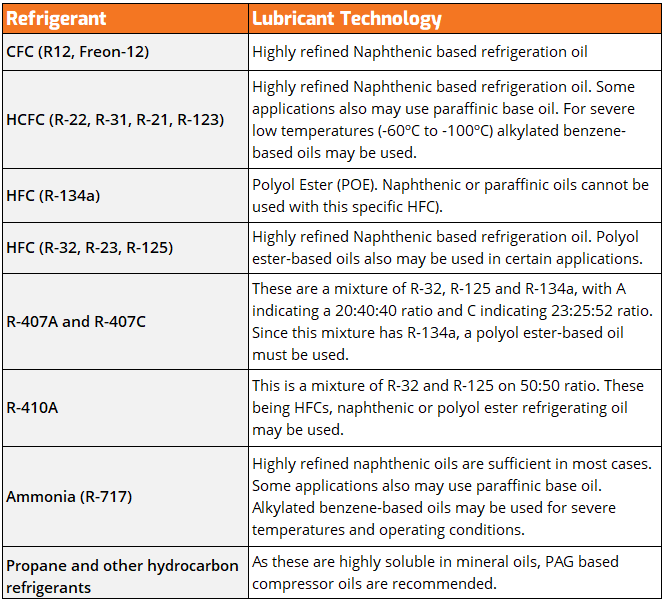
Chevron provides some general guidelines for selecting the appropriate refrigerant, as shown in the table below.5

(But you should always follow the guidelines of your OEM when selecting the appropriate lubricant.)

Table 1: Refrigerants and their associated lubricant technologies

ExxonMobil classifies its refrigeration lubricants based on refrigerant type, evaporator temperature, and compressor type (Piston, Screw, or Centrifugal). This is very helpful when determining the best-suited lubricant for your refrigerant compressor.

Check out the pdf here.


Find out more in the full article, "Compressor Oil, Types, Applications and Performance Drivers" featured in Precision Lubrication Magazine by Sanya Mathura, CEO & Founder of Strategic Reliability Solutions Ltd. 
Industry Standards for Compressor Oils

Some other classifications which users may see when dealing with compressor oils (even though some of these standards may be dated) include:

ISO 6743-3, which uses the following acronyms for associated compressors:

  • DAA, DAB, DAG to DAJ: Air compressors
  • DVA to DVF: Vacuum pumps
  • DGA to DGE: Gas compressors
  • DRA to DRG: Refrigeration compressors


In this standard, the “D” family includes detailed classifications of lubricants used in air, gas, and refrigeration compressors. The second letter usually indicates the type of compressor, and the third letter indicates the application severity or type, especially for gas or refrigeration compressors.

For instance;

DAJ represents:

D -> Compressor Lubricant

A -> Air compressor

J-> Lubricant drain cycles of >4000 hours

DVB represents:

D-> Compressor Lubricant

V->Vacuum pumps, Positive Displacement Vacuum pumps with oil lubricated compression chambers, Reciprocating and rotary drip feed, Rotary oil-flooded (vane and screw)

B-> Low vacuum for aggressive gas (102 to10-1kPa or 103 to 1 mbar)

DGD represents:

D-> Compressor Lubricant

G-> Positive displacement reciprocating and rotary compressors for all gases, Compressors for refrigeration circuits or heat pump circuits, together with air compressors, are excluded.

D-> Gases that react chemically with mineral oil, usually synthetic fluids, HCI, CI2, O2, and oxygen-enriched air at all pressures. CO2 at pressures above 103 kPa (10 bar) with O2- and oxygen-enriched air: mineral oils are prohibited, and very few synthetic fluids are compatible.

DRB represents:

D-> Compressor Lubricant

R-> Compressors, refrigeration systems

B-> Ammonia (NH3), Miscible, Polyalkylene glycol, Commercial and industrial refrigeration, For direct expansion evaporators; PAGs for open compressors and factory-built units.

Another standard which is also used in this industry is DIN 51506, which defines:

  • VB, VC: Uninhibited mineral oils (no oxidation inhibitors)
  • VBL: Mineral oil-based engine oil (additives that protect from corrosion and oxidation and air compressor temperatures up to 140°C)
  • VCL: Mineral oil-based engine oil (additives that protect from corrosion and oxidation and air compressor temperatures up to 160°C)
  • VDL: Inhibited oils with increased aging resistance (additives that protect from corrosion and oxidation and air compressor temperatures up to 220°C, recommended for compressors with 2-stage compression)

One more standard is DIN 52503, which has these classifications:

  • KAA: Not miscible with ammonia
  • KAB: Miscible with ammonia
  • KB: For carbon dioxide (CO2)
  • KC: For partly and fully halogenated fluorinated and chlorinated hydrocarbons (CFC, HCFC)
  • KD: For partly and fully fluorinated hydrocarbons (HFC, FC)
  • KE: For hydrocarbons (e.g., propane, isobutane)

These standards are referenced when discussing certain compressor oils, and their definitions are helpful for navigating acronyms.

Find out more in the full article, "Compressor Oil, Types, Applications and Performance Drivers" featured in Precision Lubrication Magazine by Sanya Mathura, CEO & Founder of Strategic Reliability Solutions Ltd. 

Types of Compressors and Oils

Compressors are integral to many of our operations. They are used to compress gas, increasing its pressure, and to power tools. They can also be used as vacuum pumps or blowers, but each application is different. As such, they require various types of lubrication, particularly for applications that use specific refrigerants and come into contact with the lubricant.

In all these applications, the functions of the oil remain largely the same: it must lubricate the surfaces, prevent wear and corrosion, maintain the required viscosity, and provide proper sealing.

In this article, we will dive into the various types of compressor oils and explain why they are suited to these applications. We will also discuss monitoring the health of these oils and the tests that should be performed to ensure your compressor oils remain healthy.

Types of Compressors

Essentially, there are two main types of compressors: Displacement and Dynamic. For displacement compressors, gas is drawn into a chamber, compressed, and expelled by a reciprocating piston. On the other hand, for dynamic compressors, turbine wheels accelerate a medium, which is then abruptly accelerated.1

Positive displacement compressors include Reciprocating and Rotating compressors. These can be further subdivided as shown in Figure 1. For Dynamic (Turbo) compressors, these are further subdivided into Centrifugal, Axial, and Mixed types (also shown in Figure 1).

Figure 1: Types of compressors

Depending on the type of compressor, the required lubricant will vary. For example, positive-displacement compressors use rolling or sliding motion and include bearing and sealing components within the compression chamber. On the other hand, dynamic compressors use hydrodynamic journal and thrust bearings, or rolling-element bearings, to support the main shaft, which is isolated from the compression chamber.

Working pressures, temperatures, and the type of gas being compressed also play a significant role in determining the appropriate lubricant.2

As with most applications, there can be a dry-sump or a wet-sump. Wet sumps are typically seen in reciprocating and rotary screw compressors.  In a wet sump, the gas usually contacts the oil, lowering its viscosity. This is where it is essential to note the gas’s solubility in the system oil. Natural gas and other hydrocarbons are more soluble in mineral oils and PAOs than in PAGs and diesters. Thus, PAGs may be preferred in some cases to avoid lubricant failure.

Compressor Oils

Most of the major global lubricant OEMs have classified their oils based on:

  • Rotary vane and screw air compressor oils
  • Reciprocating (piston) air compressor oils
  • Refrigeration compressor oils

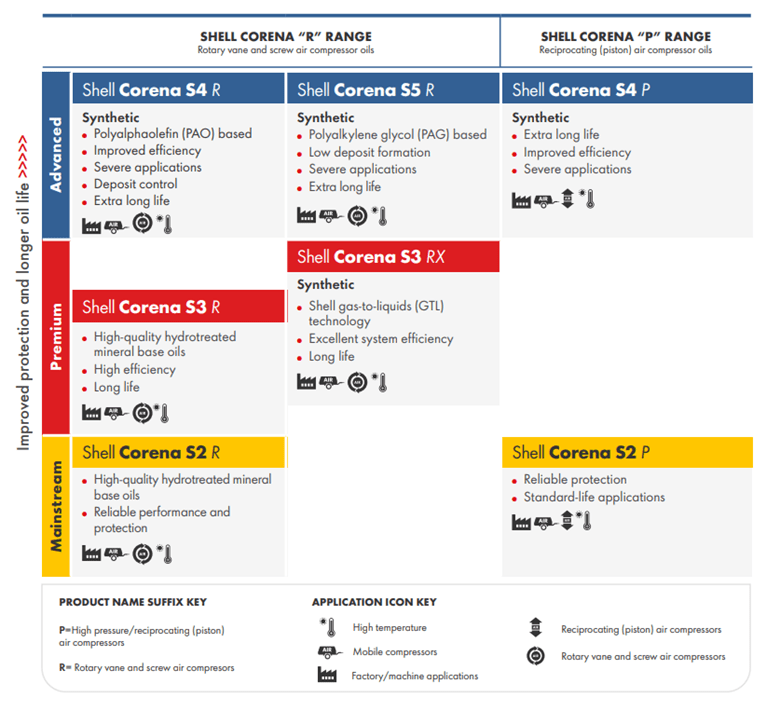
As seen below in Figure 2, Shell Lubricants3 has a line of lubricants, particularly for air compressors, which are further classified into mineral oils, PAOs, and PAGs for Rotary vane and screw air compressors or Reciprocating (piston) air compressors.

Figure 2: Shell Lubricants for Air Compressors

In reciprocating air compressors, cylinder design dictates the lubrication type, as this is the most severe application. Compressing the gas usually results in high temperatures, which can easily lead to oxidation. The compressed gas must be free of contaminants, as contaminants can accelerate oxidation. Typically, for reciprocating air compressors, mineral oils or PAO- or di-ester-based lubricants in the ISO VG 68 to 150 range are preferred.

Rotary vane compressors can experience pressure extremes as the vanes slide to compress the gas, and oil is continuously injected into the compressor chambers. Typically, ISO VG 68-150 oils are used in this application.

Figure 3: Reciprocating Piston vs Screw Compressor Lubricant Needs

For screw compressors, the oil must perform several functions, including lubricating the meshing rotors and the plain and roller bearings that form part of the geared coupling. ISO VG 46 mineral oils are usually used in these compressors, but the viscosity can be increased to ISO VG 68 or to synthetic PAO or PAG lubricants at higher ambient temperatures. Similarly, Group III base oils of these viscosities can be used in this area. Most screw compressor oils contain mild EP/AW performance additives and require an FZG failure load≥10.

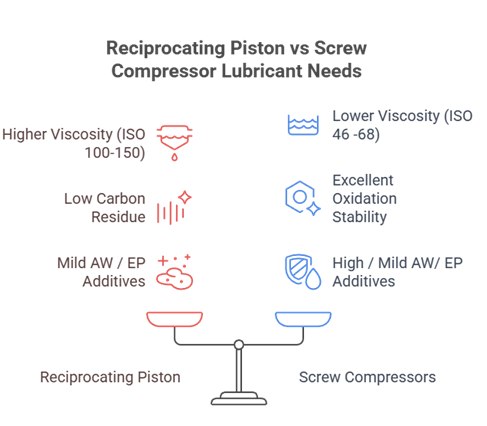
Ideally, reciprocating piston compressors will use higher viscosities (ISO VG 100-150) with extremely low carbon residue and no or mild EP/AW additives. Conversely, screw compressors will use lower viscosities (ISO VG 46 or 68) with excellent oxidation stability and mild/high AW/EP additives1, as shown in Figure 3.

Find out more in the full article, "Compressor Oil, Types, Applications and Performance Drivers" featured in Precision Lubrication Magazine by Sanya Mathura, CEO & Founder of Strategic Reliability Solutions Ltd. 
How to identify the Root Causes of ESD in Lubrication

Thus far, all the prevention methods have focused on the physical roots of ESD. We did not explore some of the human or systemic roots that are also accountable for ESD. In this section, we will develop a logic tree designed to address a critical failure occurring in a plant. This will be used as an example of the logic tree, which can be developed when investigating the root causes of ESD.

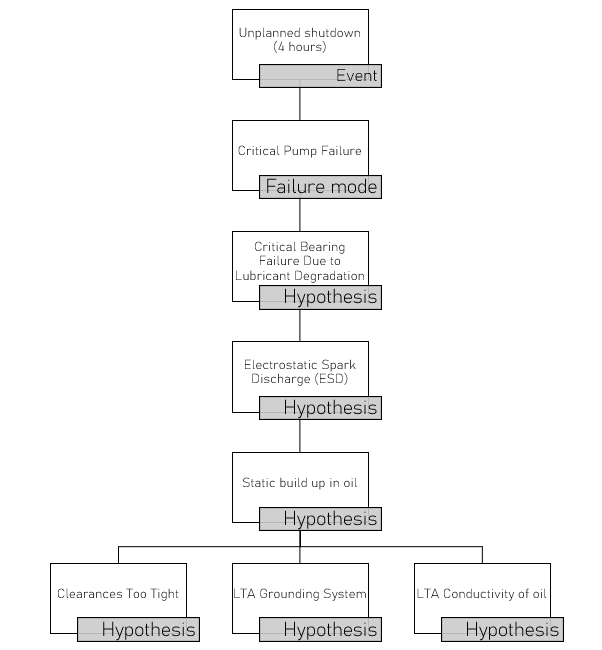
Let’s start with the top of the logic tree, where we define the event or the reason we care. In this situation, it is an unplanned shutdown for 4 hours. An unplanned shutdown will impact the plant’s production, which is why we care about conducting this investigation.

We will assume that the failure mode occurred on one of the critical pumps, and we are investigating how that failure could have happened. Note, we did not ask the question “Why?” because it can be misleading to an opinion, and we are trying to stay as factual as possible.

A disciplined root cause analysis doesn’t start with ‘why’ – it starts with evidence. Each degradation mechanism tells its own story, and Electrostatic Spark Discharge is just one of them.

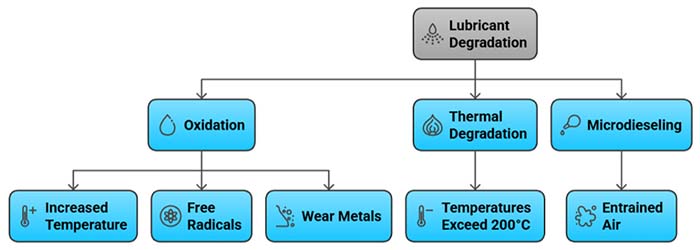
For this investigation, we will investigate the hypothesis of a critical bearing failing due to lubricant degradation. Since we are focused on ESD for this article, we will have only one hypothesis regarding the degradation mode being ESD. However, in the real world, if this logic tree were being developed, we would be investigating the six various lubricant degradation mechanisms: oxidation, thermal degradation, microdieseling, ESD, additive depletion, and contamination.

Figure 1: Top part of the Logic tree for ESD

As shown in Figure 1, at the top of the logic tree, we start by placing our hypotheses on the tree, and then using evidence/facts, we can rule them out afterwards. This is a critical step as the investigation should be able to stand on its own in the court of law (even if it may not reach that point). The next hypothesis is the buildup of static in the oil. There are three possible ways for this to occur;

  • Clearances too tight (as discussed earlier, this can lead to molecular friction, which can induce static)
  • Less than adequate grounding system (if a proper grounding system doesn’t exist, then there isn’t an option for the static to dissipate)
  • Less than adequate conductivity of the oil (if the conductivity of the oil is too low, then the charge can build up and cause it to be dissipated along the system, such as the filters)

Now, we need to investigate each of the three main hypotheses stated and find out the root causes for them.

Let’s begin with the Clearances being too tight hypothesis.

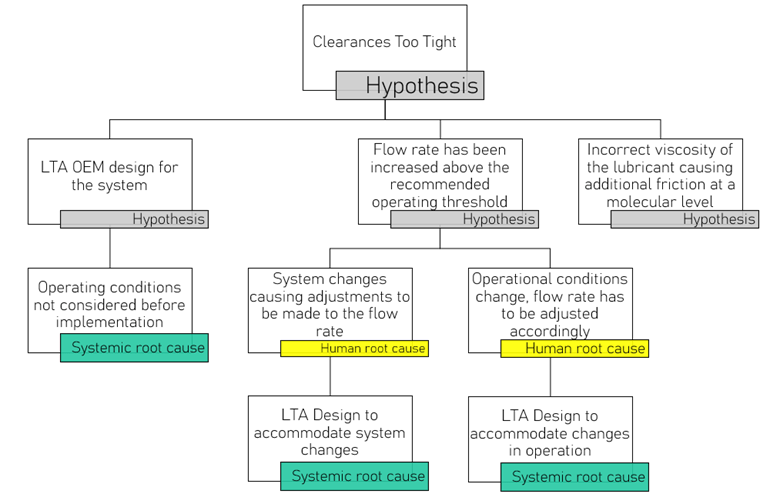
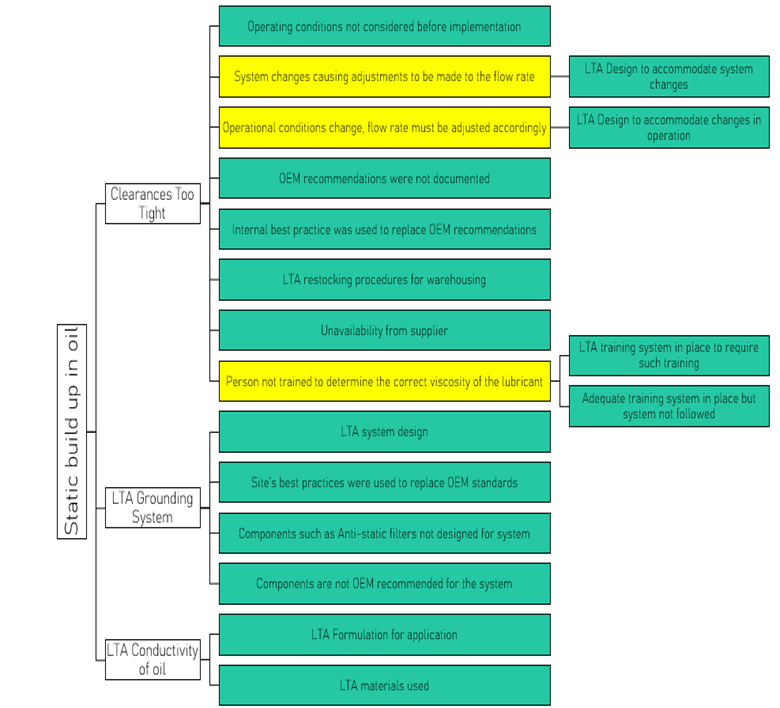
For this hypothesis, we will ask the question, “How can clearances be too tight?”. In this case (and we will have to keep it general and in broad buckets, so we can drill down into these later and eliminate as necessary), there are three possible reasons:

  • The OEM could have designed the system such that it was less than adequate (LTA)
  • The flow rate could have been increased above the recommended threshold
  • Incorrect viscosity of the lubricant could cause additional friction (we will dive into this one later).

We will develop the other two hypotheses in Figure 2.

Figure 2: Investigating the hypothesis, "Clearances too tight"

If we further investigate where the OEM did not design the system effectively, we can determine that the operating conditions were probably not adequately considered before implementation. This is a systemic root cause and one that needs to be addressed with the OEM.

On the other hand, if we investigated the flow rate, there could be two main reasons for the adjustment. One could be because of system changes, which forced adjustments to the flow rate. Since a decision was made here, it is a human root cause. Someone decided to change the flow rate based on the variables involved. However, if we investigate why these changes were made (once a human is involved, the question moves from how to why), we can determine that the system was not designed to accommodate these changes. This is a systemic root.

Similarly, if the operational conditions change (such as when a higher output is required, which is different from system changes), then the flow rate must be adjusted. Again, a decision must be made here, and a human is involved. Then we ask the question, “Why?”. In this case, we have the same systemic root, and the design is inadequate to accommodate the necessary changes.

For this part of the tree, we have found some human root causes where decisions were made, as well as systemic root causes. Both need to be addressed when we perform the final root cause analysis. For the human root causes, we can think about the procedures that guided them to make those decisions (if they existed) and amend these accordingly.

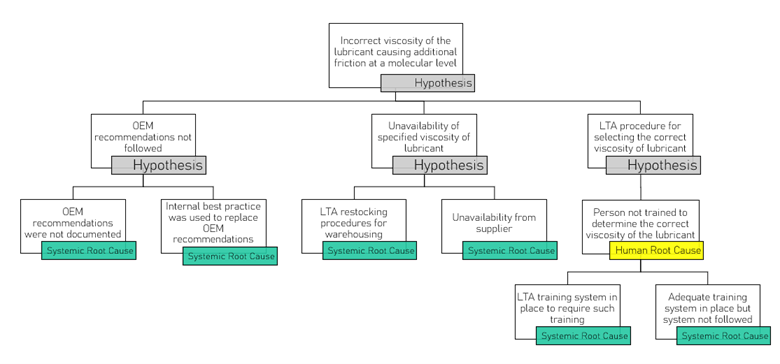
On to the next hypothesis, which we have yet to investigate (still under the clearances being too tight), the incorrect viscosity of the lubricant, which is shown in Figure 3. There are a couple of ways in which this can happen:

  • OEM recommendations were not followed
  • There was an unavailability of the specified viscosity of the lubricant
  • There was a less-than-adequate procedure for selecting the correct viscosity of lubricant

If we investigate why the OEM recommendations were not followed, we can find two main reasons. Either they were not documented and therefore could not be followed, or the internal best practice was used instead to replace the OEM recommendations. In both cases, these would be systemic root causes, and we should investigate why these were not documented or why they were replaced.

Figure 3: Investigating the hypothesis, “Incorrect viscosity of lubricant”

When investigating the unavailability of the specified viscosity of the lubricant, we can find two main causes. Either there was an issue with the restocking of this lubricant at the warehouse due to their forecasting, or appropriate checks were not carried out. This is a systemic root cause that should be investigated further.

Another hypothesis could be that the specified lubricant was unavailable from the supplier. This is another systemic root cause and should be addressed with the supplier to ensure it is resolved in the future.

When lubricant viscosity errors trace back to missing stock or missing training, the problem isn’t the person or the product – it’s the system that allowed both to fail.

On the other hand, if we examine the procedure for selecting the correct viscosity of the lubricant, we identify a human root cause, as someone would have made the decision on which viscosity to use. But in this case, we need to investigate why the person was not trained to determine this value.

There are two main reasons why a person does not receive training: either it doesn’t exist, or it was not followed. In both cases, these are systemic roots that need to be further investigated and addressed.

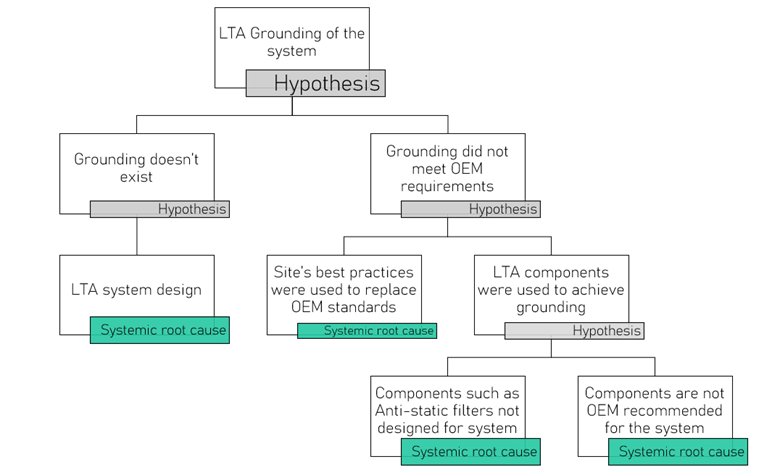
Now, we will investigate the next major hypothesis, “LTA grounding of the system” in Figure 4.

Figure 4: Investigating the hypothesis, “LTA Grounding of the system”

When investigating the grounding of a system, we can identify two major classes: either it doesn’t exist, or it didn’t meet the requirements. If grounding did not exist, then this is an inadequate system design and therefore a systemic root cause. On the other hand, if the grounding did not meet the OEM requirements, we need to determine how this was possible.

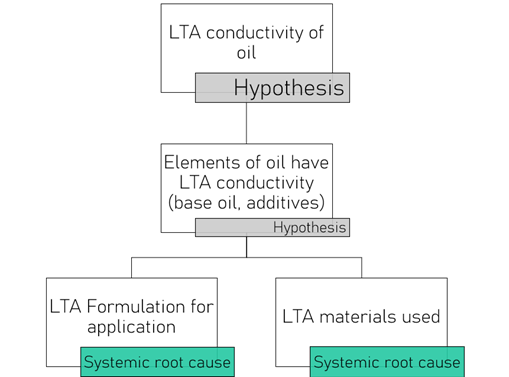
Figure 5: Investigation of the hypothesis, “LTA Conductivity of oil”

There are two possibilities: the site’s best practices were used to replace the OEM standards, which is something we often see, especially if these requirements have worked in the past. This is a systemic root cause that should be investigated. Or there were fewer than adequate components to achieve grounding.

In this case, we can have components that are not designed for the system (do not meet the system’s requirements) or components that were not OEM-recommended and are being used (such as aftermarket products that do not meet the necessary specifications).

Finally, on to the last major hypothesis, “LTA conductivity of the oil,” as shown in Figure 5.

As noted earlier, if an oil has a conductivity of more than 100pS/m, it will be able to dissipate any accumulated charge easily. However, if it falls below this value, the charge will be dissipated in the system at the earliest opportunity.

How can oil have less than adequate conductivity? Perhaps the elements of the oil have a less-than-adequate conductivity. If that is the case, then there can be two plausible reasons for this. Either the formulation was not appropriately designed, or the materials (base oils, additives) were not of a particular standard. Both causes are systemic root causes and should be investigated further to determine if anything can be done to correct these.

If we were to summarize a list of the root causes, we would see that many are systemic, while a few are human, as shown in Figure 6.

Figure 6: Summary of the root causes of ESD

This further reiterates the need to develop a comprehensive logic tree when investigating any failure, as many root causes are not physical or surface-level. If these are not adequately addressed, the failure mode will recur in the future. The entire logic tree can be found here under additional support material, along with logic trees for other degradation mechanisms.

References

Mathura, S. (2020). Lubrication Degradation Mechanisms: A Complete Guide. Boca Raton: CRC Press.

Mathura, S., & Latino, R. (2021). Lubrication Degradation: Getting into the Root Causes. Boca Raton: CRC Press.

What are Effective Strategies to Prevent ESD in Lubrication?

ESD occurs when there is a buildup of static in the oil; therefore, one of the best methods of preventing it is to ensure that the static levels remain low or are dissipated before they have a chance to wreak havoc on the system. The simplest and most common way of reducing this static is the installation of antistatic filters. These filters can help to remove static from the system before it builds up to dangerous levels, where it can burn the membranes or develop varnish.

Static in oil is inevitable – how you control and discharge it determines whether your system runs clean or burns itself from within.

Ensuring that the system is grounded correctly is another way to guarantee that any built-up static is removed. This is where your electricians can perform checks and install proper grounding devices for your equipment to safeguard against this buildup of static in the system. Therefore, if static charges get built up in the system, they can be dissipated without the effects of ESD.

If oils experience high levels of conductivity, they can conduct static. Typically, if the conductivity is above 100pS/m, there is potential for the fluid to conduct the charge and allow it to be discharged along the system without causing harm.

Unfortunately, there are base oils with low conductivity (below 100pS/m) that cannot carry the charge and dissipate more easily. As such, these types of oils will see an increase in the presence of ESD if not formulated correctly for modern lubrication systems.

As the viscosity of the oil decreases, more force is required to pass through the filters, which can lead to a buildup of static at a molecular level. Additionally, as temperatures decrease, the viscosity also decreases. In these cases, keeping the oil at the system temperature (designed for that particular viscosity) can help to reduce the buildup of static charge in the oil.

Understanding Electrostatic Spark Discharge and Its Impact on Lubrication Systems

Electrostatic Spark Discharge typically occurs when static is built up in an oil at a molecular level, causing it to discharge in the system and create free radicals, which increase the opportunity for varnish to form. This usually occurs at temperatures of around 10,000 °C.

If we were to liken this to an everyday situation, we could think about walking around a carpeted room where the static builds up in our body. When we touch a metallic object (more than likely a door handle), we get a bit of a shock as the built-up static is discharged through us and the door handle.

Inside a lubricant system, static doesn’t just build – it ignites microscopic sparks powerful enough to scar filters and start the chain reaction that leads to varnish.

Similarly, in lubricants, static exists at a molecular level, and in areas of tighter clearances, some molecules are forced to rub against each other, causing a buildup of static. When it accumulates to the point of becoming a full charge, it dissipates at the first opportunity, usually at the filter membrane or some sharp-edged object along the way. These are seen as burnt patches on the filter membrane.

When this spark occurs, it creates a chemical reaction that generates free radicals. Free radicals are highly reactive species that need to engage with other substances. These are the initiators of varnish, and their presence can accelerate reactions, leading to deposits forming in the lubricant. Eventually, this will lead to a system that has experienced both ESD and oxidation.

In this article, we will discuss various identification methods and ways to prevent ESD in modern lubrication systems. We will also spend some time identifying typical root causes for ESD by developing a logic tree as a guide for future investigations.


How to Identify Electrostatic Spark Discharge in Lubrication Systems

Every degradation mechanism produces varying results in the form of deposits or in how these are formed. For ESD, some tell-tale signs alert the user to its occurrence. These include:

  • Crackling sounds / buzzing outside of components – This noise is representative of sparks as they discharge on part of the media/asset. Typically, this occurs when the fluid is in motion, allowing it to be heard near the filters when the system is operating.
  • Burnt or pinhole filter membrane – The filters usually feel the full effect of ESD, and small burn patches or even pinholes are created when ESD occurs. When changing filters, the membranes should be examined for these patches to determine if ESD is occurring.

Free radicals are produced when ESD occurs. As such, this leads to polymerization of the lubricant, which produces varnish and sludge. This is part of the oxidation process, and the antioxidant levels will begin to decrease. During ESD, certain gases are also released in the oil. Some of the lab tests which can be used for identifying where ESD has occurred include:

  • RULER® – Remaining Useful Life Evaluation Routine test, which quantifies the presence of antioxidants in the oil. By trending this over time, one will be able to determine whether the levels of antioxidants are decreasing or not. Typically, this test can be performed twice annually on larger sumps (such as turbines) or the frequency can be increased according to the criticality of the equipment. If the value gets below 25% then this is the critical limit, and methods to regenerate the oil or change it should be explored.
  • MPC – Membrane Patch Colorimetry – this measures the potential of the oil to form varnish or deposits. Depending on the equipment, the warning limits will vary, but a good rule of thumb is to treat results below 10 as normal, those above 15 as within the monitor range, and those above 20-25 as the critical range. Be sure to double-check these levels with the OEM of the equipment.
  • FTIR – Fourier Transform Infrared Spectroscopy can identify various molecules in the oil. It is likened to identifying the fingerprint of the oil, where each molecule has a specific characteristic spectra representative of that molecule. This test can be used to identify the presence of oxidation or any deposits that may have formed.
  • DGA – Dissolved Gas Analysis – this test can be used to identify the presence of particular gases that are released during ESD, such as acetylene, ethylene, and methane.

Those above are just some of the methods that can be used to identify the presence of ESD in a lubrication system.

Interpreting the Oil Analysis Report in Practice

Now, we will actually read a report to help put all of these into practice.

Here is a sample report from Eurofins for a turbine oil. In this report, the various types of tests are classified according to wear metals, additives, and contaminants, as shown in Figure 2.

According to the report, samples have been collected over a period of time. This helps with the trending of the data, so we can spot when the values start varying from the “normal levels”. The reference values are also provided in the first column to help users determine whether these values fall within tolerance limits or not.

Figure 2: Sample Turbine Oil Analysis Report

Typically, the lab will provide some type of traffic light system where:

  • Red – indicates there may be an abnormal reading or the oil should be changed immediately, as certain values have surpassed the critical limits.
  • Amber – shows that the values are approaching the warning limits, but there is still some time to investigate and fix the problem.
  • Green – tells us that all values are within the tolerance limits and the oil is performing normally.

For this report, they also include additional tests as shown in Figure 3.

Figure 3: Additional Tests for Turbine Oils

For turbine oils, understanding the demulsibility of the oil is important, as this is the oil’s ability to separate from water, or rather, not to form an emulsion. Excessive water in the oil can lead to rust or even a washout of the additives.

The Foam test is also administered to detect the oil’s ability to release air from the oil, ensuring that the air doesn’t get trapped. If air is trapped, it can lead to microdieseling and cavitation on the inside of the equipment.

RPVOT – Rotating Pressure Vessel Oxidation test is also performed, as it indicates the expected oxidation of the oil. MPC (Membrane Patch Colorimetry) and Ultracentrifuge detect the potential of the oil to form varnish, and the RULER® values give the actual quantity of antioxidants present.  These values are all critical for monitoring the health of the turbine oil, as it is very susceptible to oxidation and the formation of varnish.

In essence, reading the oil analysis report involves understanding what the tests are meant to measure, knowing your equipment and its operating conditions, and having a history of your equipment.  These factors all contribute to trending the data to ensure that there are no surprises with unplanned downtime due to wear or oil degradation.

References

Eurofins. (2025, September 06). Annual Turbine Analysis. Retrieved from Eurofins Testoil: https://testoil.com/services/turbine-oil-analysis/annual-turbine-analysis/

How to Interpret Your Oil Analysis Results

Have you ever received your bloodwork results from your doctor, only to be more confused than ever? With all the long names and numbers just sitting on the piece of paper, Google (or ChatGPT) becomes your best friend to help interpret what they mean. However, even with these tools of reason, there is usually a disclaimer that states, “Please consult your doctor for a more accurate interpretation”.

Numbers alone don’t tell the whole story – context is what makes oil analysis meaningful.

One of the reasons for constantly looping your doctor back into the mix is that they have your history, they know how your body responds to certain things, and values which may get flagged because they are outside of the limits may be waived away by your doctor because it is normal for your body based on your history and DNA.

The same applies to oil analysis. Depending on the application and operating environment, certain conditions may be met that can be interpreted as unusual. Still, if you’re familiar with your system, you will understand the reason behind the numbers.

Figure 1: DIN 515519 table showing viscosity limits

Viscosity

As mentioned earlier, viscosity is the most important characteristic of a lubricant. If it is too thick for the application, this can lead to efficiency loss, increased heating, and a slowdown of the system. Essentially, a significant amount of work needs to be done on the oil to make it compatible with the application.

On the other hand, if it is too thin, then we run the risk of improper lubrication. Therefore, we increase the chances of wear occurring in the applications.

Viscosity is usually measured at either 40°C (for industrial applications) or 100°C (for engine applications). However, most labs put a ±5% tolerance limit for many oils. But why use such a random figure? The DIN 51519 table is used to determine ISO viscosity, with each value within a 10% range, as shown in Figure 1.

When you see an ISO VG 100 oil, the chances are that the actual viscosity of that oil varies between 90-110cSt. Therefore, if we start seeing our results vary by around 5% or trend towards the outer limits of any viscosity class, we know that something is going on with our oil.

Presence of Wear Metals

Wear metals prove that some type of wear is occurring. However, depending on their quantity, they can also provide some more insights into what is actually wearing away and whether it is normal wear or abnormal wear. Wear is reported in parts per million (ppm) or as a percentage. Here’s how to convert those percentages to ppm:

100% = 1,000,000ppm

1% = 10,000ppm

0.1% = 1,000ppm

The most common wear metals tested include Aluminum, Iron, Chromium, Copper, Lead, and Tin. Depending on the application, there are varying levels at which these will be flagged.

Table 1 provides an example of various applications and their respective limitations. These will vary based on your OEM and environment, but can be used as a general guideline. All numbers in Table 1 are in ppm.

Table 1: Wear metal limits for various applications

AN/BN and the Presence of Contaminants

Contaminants are any foreign material in the system. Sometimes, lab tests may not be able to detect contaminants in a system because they are not specifically designed to identify that particular contaminant.

In these cases, users would need to specify what additional contaminants the lab should look for, or perform a broader FTIR (Fourier Transform Infrared) analysis to identify all the components in the oil and then determine which of them are contaminants.

The most common contaminants tested include Silicon, Water, and Fuel. Although AN/BN (Acid Number and Base Number) may not be considered a contaminant, it helps quantify the acid in your system, which shouldn’t be there; therefore, in some ways, it can be viewed as a contaminant. However, it is primarily a physical property and is listed separately.

Acid and base numbers act like an early warning system for oil health.

Table 2: Tolerance limits for some contaminants

For diesel engines, BN is measured as having high base numbers, which will decline over time as acids accumulate. If the BN value declines to around 50% of its original value, then we have an issue with the acids increasing too quickly in the oils. On the other hand, AN is used for all other industrial oils (gears, hydraulics, etc.). There are varying limits for AN depending on the application, as shown in Table 2.

Silicon usually indicates the presence of sand, which is highly abrasive. This can accelerate wear in any equipment by essentially turning the oil into sandpaper and wearing away the insides of the equipment. Some of its limits are shown in Table 2.

Water in any form is highly destructive to all assets. However, some systems can tolerate a bit more water than others. This can be due to the nature of the oils (good demulsibility) or the nature of the systems, where heat is involved to help remove the water. Water in the system can lead to an increase in viscosity and disrupt the oil layer.

As such, the lubricant will not be able to form a full film to protect the asset. Water can also create an emulsion in the oil or lead to corrosivity issues. Table 2 gives some examples of limits for various systems.

Fuel contamination is an issue for most diesel engines. The presence of fuel in your oil can lead to a lower viscosity (hence the oil can no longer protect the components) and an increase in the flash/fire point of the oil, which can be particularly dangerous. We have some limits noted in Table 2.


Presence of Additives

It is more challenging to place these tests in a one-size-fits-all table, as oil formulations are consistently changing. The best way to interpret these additives would be to compare them against the initial values for the finished lubricant.

For your oil analysis program, always have a representative sample of the new oil so that comparisons can be made against it as the oil ages in the system. Additionally, the presence of additives in your report when they shouldn’t be there is also a sign of contamination, likely with another type of oil.

Why Different Oils Require Different Tests

Oil analysis reports often wear an invisible cloak, and only if we have a wizard capable of revealing what the numbers mean, they will more than likely end up in a drawer or file on the computer. There are many similarities between oil analysis and blood tests, as they both serve similar functions.

They both test fluids, quantify the results according to different categories, and provide envelope limits within which these values should exist. If the values fall outside these limits (either below or above), we need to take action to prevent failure of the critical asset (or human organ accordingly).

An oil analysis report is less about numbers and more about the story they reveal.

In this article, we will focus on understanding the basics of reading an oil analysis report, interpreting the results, and developing action items based on the information collected. We will take a closer look at reports on turbines (rotating equipment), gear, hydraulics, and engine oils, and what this all really means for your equipment.

Why Different Oils Require Different Tests

Before we dive into the report, we need to establish that not all oils are the same! As such, different oils are required for various types of applications. Therefore, each type of oil will require slightly different tests to determine whether it is performing optimally or not. However, there are a few tests that remain the same for all oils.

The most critical characteristic of an oil is its viscosity. As such, all oils are typically tested to determine whether their viscosity meets the requirements. Another function of the oil is to prevent wear. Thus, most oils are tested for the presence of wear particles, as this can help the user identify if any wear is occurring in the asset.

Oils should be kept clean; therefore, tests are performed to determine the presence of any contaminants, and these are carried out on most oils. Similarly, additives help oils perform their functions; hence, their presence or absence should be quantified to determine if they are indeed achieving their functions for all oils.

Tests for viscosity, the presence of wear metals, contaminants, and additives are the standard sets of tests that should be performed on any oil. There are more detailed tests that examine the specifics of various types of applications, but we will delve into these later in the article.