Tagged: strategic tips

Role of Condition Monitoring, Human & Organizational Factors in Oil Failures

Choosing the right oil for the system is just one part of the puzzle. How do we know the oil is performing when it’s in the system? This is where condition monitoring can work hand in hand to help ensure that the oil does not fail the asset.

If a proper oil analysis program does not exist, operators will not know whether the oil is properly lubricating the asset. They will also not be aware of whether the oil is breaking down too quickly and failing to protect the asset. Oil analysis can also alert operators to signs of wear in the asset, so they can fix them before they turn into functional failures.

An oil analysis program that lives in a drawer protects assets about as well as no program at all.

There is also the possibility that an oil analysis program exists but is not top of mind, or that its results are put in a drawer. This can also cause the asset to fail even though the correct oil is being used. Apart from the aforementioned factors, if operators are not warned of the impending failure of the oil, this can result in production losses, increased downtime, and, in some extreme cases, the complete loss of the asset if it has failed beyond repair.

Incorrect sampling is another area in which the actual condition of the asset is not reported. Even with the correct oil used, if a sample is collected from a dead leg or an area that is not truly representative of the conditions inside the component, its actual condition will not be known. With incorrect data about the component, the asset can be misdiagnosed or treated for symptoms that do not exist, which can lead to its detriment.

Human and Organizational Factors

Not all failures occur at the equipment level; human and organizational factors can also cause the asset to fail even when the correct oil is used. If humans aren’t properly trained in oil sampling techniques or storage and handling practices, these can affect the asset’s functionality. We often forget that, at the heart of it all, lies the human factor, which is partially governed by the organization’s systems.

Training needs are an organizational factor that is often overlooked when considering how an asset can fail. However, if operators have not been trained in condition monitoring techniques, they will not be able to read oil analysis reports or take appropriate actions to protect the asset. Training can help bridge some competency gaps that directly impact asset performance.

It doesn’t matter what oil is in the system if no one is trained to monitor it – or motivated to care.

Culture is another factor swept under the rug. If the culture doesn’t exist to look after the assets, it doesn’t matter what type of oil is placed in the system; the asset will fail eventually. The performance of the asset does not only rely on using the correct oil. By implementing a culture of Asset ownership, where operators look after the asset and are accountable for its performance, assets are optimized to provide the functionality they should. This is one way to ensure the right oil is used to enable the assets’ performance.

Another area of concern is the documentation of maintenance procedures. If maintenance procedures are not adequately documented, someone new to the operation may not be aware of the correct practice. This, coupled with a lack of training, can spell disaster for the equipment. In these cases, even though the right oil was selected, the wrong practice or lack thereof can fail the asset.

Turning the “Right oil” into the “Right Outcome.”

As explained in this article, improper practices can jeopardize the asset’s health, even when the right oil is used. However, if all the right things align, we can have an asset that lasts for its expected lifetime or beyond.

This starts with selecting the right oil based on the application, environmental conditions, and OEM recommendations. If we follow this up with good storage and handling practices, proper condition-monitoring programs, documentation, and training, we can look toward a longer-lasting asset. The right oil enables reliability – but only disciplined practices deliver it.

Find out more in the full article, "When 'Right oil, Wrong practice' still fails assets" featured in Precision Lubrication Magazine by Sanya Mathura, CEO & Founder of Strategic Reliability Solutions Ltd. 
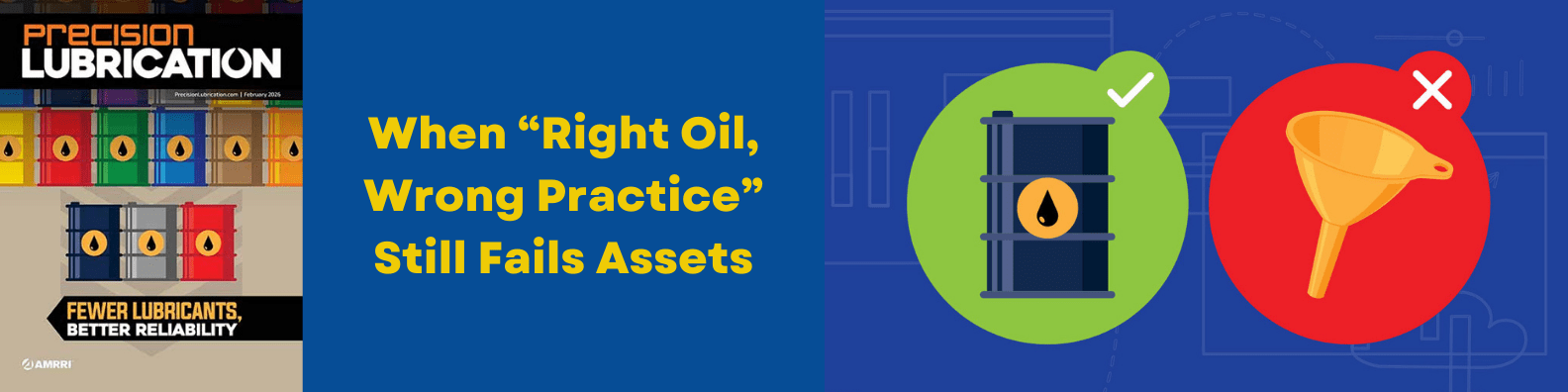
Common Modes of Failure for Lubricants

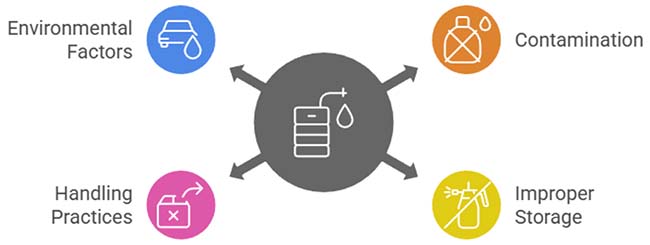
Regardless of the oil selected, common modes of failure can occur with every lubricant. These include: contamination, improper storage and handling practices, and environmental factors as shown in Figure 4.

Figure 4: Common modes of failure for lubricants

Contamination can be defined as any foreign particle entering the system. This includes any gases, liquids, or solids. Especially when the lubricant system runs alongside the process side, process gases and liquids can leak into the oil. These contaminants can influence the oil’s degradation, leading to deposits or chemical reactions that break it down. Common process contaminants include ammonia or treated water.

The biggest threat to the right oil is often what gets added to it – whether it’s process contamination or the wrong oil during a top-up.

Another liquid that can contaminate oil is another oil. During top-ups, operators can add the wrong oil to the system, causing contamination and, depending on the oil, a possible shutdown. Adding motor oil to hydraulic oil can be catastrophic, as the additive packages work differently and the motor oil additives may counteract the hydraulic additives, removing them from the oil, leaving the asset open to wear and failure. Despite selecting the correct lubricant for your system, adding the wrong oil (mistakenly) will shorten its lifecycle and cause the asset to fail.

Bad storage and handling practices can also erode your oil, regardless of the oil you choose. Turbine and hydraulic oils are used in precise equipment. As such, they need to be clean and free of dirt or other contaminants. However, if oils are not stored correctly, contaminants can enter and contaminate the oil.

Simple techniques, such as transferring oil from larger storage containers (pails, drums, or totes) into smaller, more manageable containers (2-3 liters or less), can introduce contaminants into the oil if not done correctly. If oils are to be transferred to another storage container, the storage container must be clean. The transfer process should use clean hoses (not previously used for another lubricant) and be completed in a dust-free environment.

If you wouldn’t use a dirty needle for a blood transfusion, why would you use a dirty hose for an oil transfer?

The transfer of oils from one container to the next can be thought of as a blood transfusion. Would you use dirty needles or vials to transport the blood to be placed into another human? Similarly, oil can be likened to the equipment’s lifeblood and should be treated accordingly. Just as we observe sterile practices for blood transfusions, we should also observe similar types of practices for oil transfers.

Environmental and operational factors can also influence lubricant degradation. As stated earlier, all lubricants can degrade over time under harsh conditions. The lubricant formulation largely influences this, as does whether it was blended to withstand those conditions.

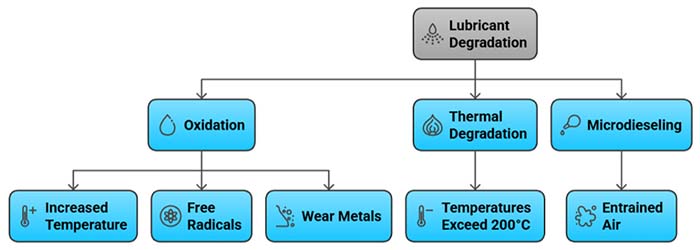
Oxidation can easily occur when temperatures increase, free radicals are present, or when wear metals are present. Thermal degradation occurs when the temperatures exceed 200°C. On the other hand, microdieseling occurs in the presence of entrained air, despite the lubricant used in the system, as shown in Figure 5.

Figure 5: Lubricant Degradation Processes

Any of these degradation mechanisms can occur regardless of the type of oil chosen. Hence, it is essential to remember that operational conditions and environmental factors can heavily influence oil degradation, even when the oil is appropriate for the system.

Find out more in the full article, "When 'Right oil, Wrong practice' still fails assets" featured in Precision Lubrication Magazine by Sanya Mathura, CEO & Founder of Strategic Reliability Solutions Ltd. 
Spec Sheet vs Strategy for choosing the right oil

Sometimes we can spend hours poring over technical data sheets, comparing oil performances, and finally selecting the “right” oil which aligns with the needs of our equipment. Then, within 2 months, the oil degrades, our machines shut down, and we have a bunch of maintenance repairs lined up. What went wrong? We clearly had the “right” oil in the equipment; everything should have worked beautifully. This is where the awareness of lubrication and its practices becomes critical.

Having the correct oil is only one part of the puzzle. Being able to deliver that oil in its purest, cleanest form to the machine is often one of the other pieces that go missing. Another piece is selecting the right oil, not just based on the sales guy’s advice, but on the actual operating conditions of your machine. In this article, we dive a bit deeper into ways you can align the right oil with the proper practices, or avoid the wrong ones, to help extend the life of your asset.

Spec Sheet vs Strategy

For this example, we will consider a turbine oil selection. If a customer wants to change the oil in their turbine, then they may consider the following:

  • What are the OEM specifications that need to be met?
  • Is this oil available from the local supplier?
  • How does it compare to other oils on the market?
  • Does the cost justify the value? (or will the purchasing department want something cheaper?

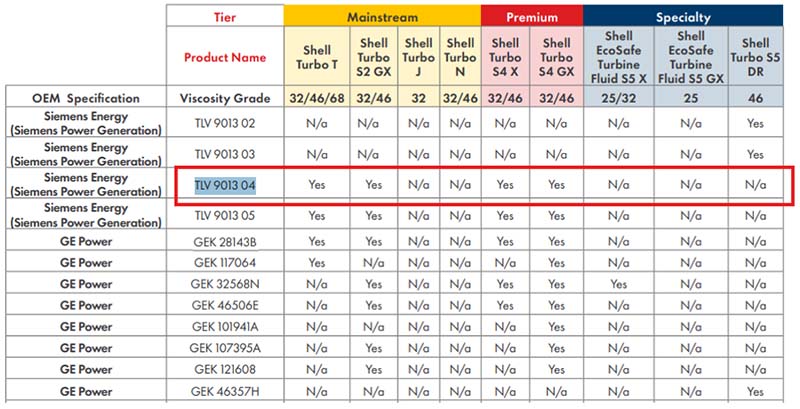
For most of these questions, engineers or the person tasked with selecting the oil can readily find the answers in the oil’s technical data sheet and by talking to their sales representative. But if we dive a bit deeper, are we selecting the right oil for the operating and environmental conditions? Let’s examine the selection of a turbine oil for the Siemens SGT 200 Gas turbine that meets the Siemens TLV 9013 04 specification.

As seen in this document from Shell Lubricants, a few of their products meet that specification, namely Shell Turbo T, Turbo S2GX, Turbo S4X & Turbo S4GX.

Figure 1: Shell Turbo Family for the Siemens TLV 9013 04 Specification

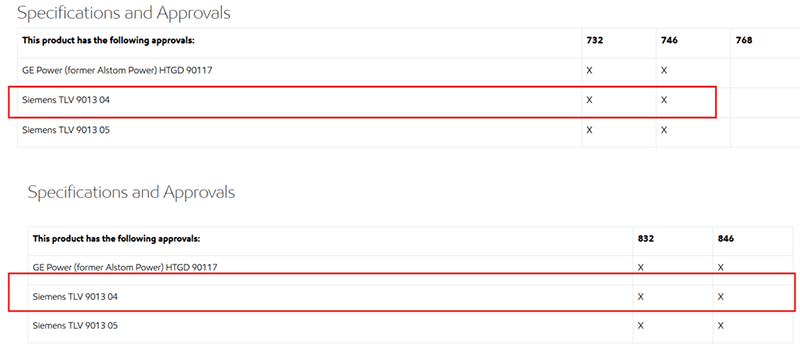
On the other hand, Mobil provides some solutions as well, namely, Mobil DTE 732, 746, or DTE 832, 846

Figure 2: Mobil DTE 700 & 800 Series meeting the Siemens TLV 9013 04 Specification

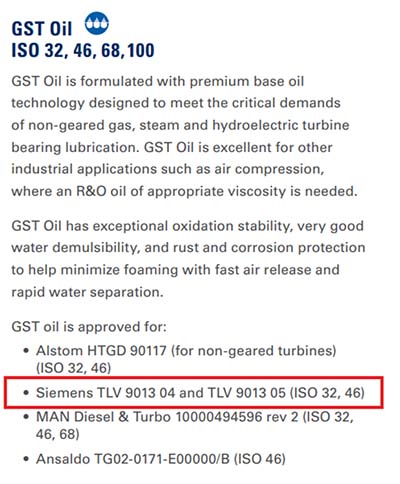
Chevron also provides an option of Chevron GST as follows:

Figure 3: Chevron GST oil meeting the Siemens TLV 9013 04 specification

With so many options, how can one choose the “right” oil? They all meet the required Siemens specification, TLV 9013 04. This is where the data sheets, OEM manual, and knowledge of the equipment’s operating conditions play a crucial role.

As per the manual, there are preset conditions for temperatures and pressures, but if your actual system runs hotter (or production is being pushed a bit more), it is functioning outside the operating envelope.

The spec sheet tells you what the oil can do. Your operating conditions tell you what it must do.

Additionally, if your surroundings are harsh (close to the sea or in a corrosive environment, or in a non-ventilated area where heat can build up), these can place additional stress on the equipment. For these harsher conditions, a synthetic oil might be more appropriate than a mineral oil, albeit more expensive in terms of the initial investment.

The manual also specifies which tests/characteristics should be used to monitor the condition of the oil, namely: viscosity, particle count, water content, demulsibility, air release, foaming characteristics, RULER®, and MPC. Based on the performance of your current oil in the system, you can determine whether these values fluctuate toward the higher warning zones. This can also influence your decision about which oil to choose.

It’s not just about the right oil or one that aligns with OEM requirements. The selection should also be based on the environmental conditions of the oil and the equipment, and on whether the oil is suited to perform in these conditions. A mineral oil will not withstand the temperatures that a synthetic oil can for extended periods without degrading. Similarly, given the “right” conditions, synthetic oils can also degrade. By cross-examining your spec sheet, OEM manual, and actual conditions, you can determine the best-suited oil for your operations.

Find out more in the full article, "When 'Right oil, Wrong practice' still fails assets" featured in Precision Lubrication Magazine by Sanya Mathura, CEO & Founder of Strategic Reliability Solutions Ltd. 

The Evolution of Engine Oil

History of Engine Oil

Over time, engine oils have undergone significant evolution. Initially, there were only monograde oils, which had to be replaced seasonally. During the summertime, one oil could withstand the higher temperatures, and during the winter months, another oil was designed for those cold starts. This eventually led to the multigrade revolution, which allowed for the best of both worlds.

As we transitioned from monograde to multigrade, developments in the base oil sector continued, and we saw the rise of Group II mineral base oils. This eventually led to increased the production of Group III base oils and the development of their “hybrid” or Group III+ counterparts, which exhibit quasi-synthetic traits. As we evolved, introducing synthetic base oils as first fills for cars also became a new trend.

We have also seen the transition of straight mineral oils (50 or 60 weight) go down to 0W-16, unfathomable 20 years ago. The introduction of high-mileage oils was also a significant change in the industry, as cars became older, but owners needed to preserve their engines.

Over time, OEMs developed more specific standards as they designed their engines with greater precision, smaller spaces, and higher horsepower. One such standard is the BMW LL04 oils, which are fully synthetic and branded as long-life oils. This standard did not exist 50 years ago!

Improvements in Oil Technologies

Oil technologies have undergone significant improvements over the years. From refined base stocks to more balanced additives that consider the full impact of the oil, technology continues to improve. Technologies were forced to improve as OEMs made engine sizes smaller and more compact, but placed the oil under more stress. As such, oil manufacturers had to develop new methods to address more complex oil handling issues.

Shift Towards Synthetic Oils

Synthetic oils offered a solution that provided longer oil life and withstood harsher conditions compared to mineral oils. These oils provided the protection needed by more modern engines. Today, many auto manufacturers explicitly state that they prefer the use of fully synthetic oils in their engines for the entire lifetime of the vehicle.

Future of Engine Oil

Gasoline and diesel engines are likely to remain in use for quite some time. They won’t be coming off the market soon, as it would require 80% of the car population to have an early retirement. The spin-off to this is that car owners would also have to make significantly large investments in new vehicles.

We are witnessing the rise of alternative fuel engines, such as methanol and hydrogen, which are gradually making their way into mainstream areas. Even if it’s a new fuel source for engines, one thing that will not change is the need for moving parts. In any engine, there will always be moving parts that require some form of lubricant to reduce the friction, heat, and wear that can be generated.

Therefore, there will always be the need for lubricants, it’s just that the application and type may change or evolve over time.

Impact of Electric Vehicles on the Engine Oil Industry

One of the major developments in the automotive industry was the introduction of electric vehicles. However, one may argue that this concept has been around for more than 50 years; however, it has only recently entered the market due to an increase in manufacturing capability.

Many oil suppliers initially thought that this was the end of passenger car motor oils since the main “engine” was now an electric motor. However, this just changed the mode of lubrication to more grease applications for this part of the vehicle.

While electric vehicles are expected to continue growing in various markets, we can anticipate a decline in the volume of engine oil consumed. However, this does not mean that the innovation with engine oils will stop. More likely than not, it will continue as engine manufacturers are pushed to greater limits regarding carbon emissions and other stringent regulations.

References

American Petroleum Institute. (2023). API 1509 – Engine Oil Licensing and Certification System – Annex F. Washington: API Publishing Services.

American Petroleum Institute. (2025, January 18). API’s Motor Oil Guide. Retrieved from American Petroleum Institute: https://www.api.org/-/media/Files/Certification/Engine-Oil-Diesel/Publications/Motor%20Oil%20Guide%201020.pdf

American Petroleum Institute. (2025, January 18). Engine Oil Licensing & Certification System (EOLCS). Retrieved from American Petroleum Institute: https://www.api.org/products-and-services/engine-oil

Gulf Oil Lubricants. (2025, January 19). Your guide for using and disposing of Car oil. Retrieved from Gulf Oil Blog: https://me.gulfoilltd.com/en/blog/your-guide-for-using-and-disposing-of-engine-oil

Mathura, S. (2023, March 26). Oil Viscosity: A Practical Guide. Retrieved from Precision Lubrication Magazine: https://precisionlubrication.com/articles/oil-viscosity/

Motorway. (2025, January 18). How many different car brands are there? Retrieved from motorway: https://motorway.co.uk/sell-my-car/guides/how-many-different-car-brands-are-there

Sinclair Group. (2025, January 19). Do I need to top up my Audi’s engine oil. Retrieved from Sinclair Group: https://www.sinclairgroup.co.uk/news/audi-engine-oil/

United States Environmental Protection Agency. (2025, January 19). Managing Used Oil: Answers to Frequent Questions for Businesses. Retrieved from United States Environmental Protection Agency: https://www.epa.gov/hw/managing-used-oil-answers-frequent-questions-businesses

United States Environmental Protection Agency. (2025, January 19). Managing, Reusing, and Recycling Used Oil. Retrieved from United States Environmental Protection Agency: https://www.epa.gov/recycle/managing-reusing-and-recycling-used-oil

Find out more in the full article, "Engine oil types and how to choose the right one" featured in Precision Lubrication Magazine by Sanya Mathura, CEO & Founder of Strategic Reliability Solutions Ltd. 
How to Properly Dispose of Used Engine Oil

Changing our motor oil is important and must be done regularly, but how do we dispose of the used oil in a safe and environmentally friendly manner? Approximately 42 gallons of crude oil are required to produce 0.5 gallons of new oil for lubricants. However, only one gallon of used oil needs to be converted into 0.5 gallons of new oil.

Hence, recycling used oil significantly reduces the number of resources required to produce new oil. There are numerous benefits to recycling used oil, which can help in the fight against declining resources. Let’s dive into this a bit more.

What is the Environmental Impact of Improper Disposal?

When motor oil reaches the end of its life, it can become contaminated with harmful pollutants, which can negatively impact the environment if improperly disposed of. Some of these can be toxic to plants, and it only takes the used oil from one oil change to contaminate one million gallons of fresh water!  Therefore, we need to be mindful of the disposal of our oils.

Used motor oil can typically contain metal fillings (from engine wear), chemicals from by-products, and possibly fuel. Improper disposal, especially into waterways, can disrupt the supply of clean drinking water for many people. If this used oil seeps into the soil, it could also contaminate the water table and negatively impact plants and, by extension, humans who may consume these plants at some point.

Laws and Regulations for Disposing of Oil

The EPA (United States Environmental Protection Agency) provides guidelines in Title 40 of the Code of Federal Regulations, specifically CFR part 279, regarding the disposal of used oil. In the UAE, there are strict guidelines for the disposal of used oil; otherwise, individuals may face severe fines and legal action. These used oils should never be poured down drains, onto the ground, or into bodies of water.

Community Recycling Programs

Some communities have a local collection point for used motor oils, which they then take to the larger refineries. This way, a larger volume of oil is collected and recycled by the refineries.

Tips for Safe and Responsible Oil Disposal

Motor oils contain 30% additives; therefore, mixing them with other used oils may not be the best option for those trying to recycle them. Ideally, these oils can be reconditioned (where they are cleaned up) or re-refined (where they are reused as base stock). Collecting your used motor oil in a clean container and taking it to your local recycling facility, where it will be properly disposed of.

Some facilities may burn it to process it for energy recovery, using it as fuel after removing the water and contaminants. One gallon of used oil processed for fuel contains about 140,000 British thermal Units (Btus) of energy. Regardless of the method you choose to dispose of your used motor oil, ensure you do not harm the environment.

Find out more in the full article, "Engine oil types and how to choose the right one" featured in Precision Lubrication Magazine by Sanya Mathura, CEO & Founder of Strategic Reliability Solutions Ltd. 

What are the Effects of Using the Wrong Engine Oil?

Sometimes, the wrong engine oil is used. Whether it’s an issue of the unavailability of the correct stock or trying to standardize across the fleet without consulting the manufacturer’s recommendations, numerous issues can arise when the wrong engine oil is used.

Engine Sludge Build-Up

One of the most common side effects of using the wrong oil is a build-up of engine sludge. If we recheck the API standards, oils were designed to reduce sludge formation. When the incorrect oil is used, it cannot adequately compensate for the engine’s conditions, simply because it wasn’t designed for that purpose.

This can also occur when oil is used with an incorrect viscosity or with the wrong fuel (specifically, the concentration of sulphur for diesel engines).

Increased Friction and Wear

Earlier, we discussed how OEMs typically recommend several different types of viscosity for engines, depending on the specific conditions. However, if a viscosity is used that is too low to provide the correct amount of support and separation between the two surfaces, then increased friction and wear can result, damaging the engine’s internals.

Poor Performance and Efficiency

With the incorrect engine oil, the engine will not perform at its expected efficiency. This will directly impact its overall performance. If the viscosity exceeds the recommended value, the engine must work harder to achieve the same results, resulting in poor performance and decreased efficiency. Similarly, if the viscosity is lower than the recommended value, increased friction will result, leading to higher heat and reduced engine efficiency.

Damage to Engine Components

As stated above, a viscosity that is either higher or lower than the recommended value can damage the equipment’s internal components. Similarly, if an incorrectly specified product is used, it may not withstand the engine’s regular environmental conditions and can break down prematurely, damaging its components.

Potential for Engine Failure

Using the incorrect oil, the engine’s components will not receive the necessary protection, whether it’s due to the incorrect viscosity or the wrong mix of additives. This can lead to premature oil degradation, which in turn may result in engine failure. The correct oil will be able to protect against these harmful conditions and keep the engine from failing due to lubricant-related issues.


Find out more in the full article, "Engine oil types and how to choose the right one" featured in Precision Lubrication Magazine by Sanya Mathura, CEO & Founder of Strategic Reliability Solutions Ltd. 
How important is it to regularly change your engine oil?

Some oil manufacturers claim that their oil, when added to your engine, will remain “golden” in color and not turn dark. Every engine produces soot /carbon as a byproduct, so if the oil does not change color, it means that the soot/carbon is likely remaining stuck on the insides of your engine, which can lead to engine failure.

In these cases, the oil, especially motor oil, contains detergent and dispersant additives that keep the soot or carbon suspended in the oil. This ensures that these deposits do not adhere to the engine’s internal components, causing clogging of smaller clearances and damaging the engine. Hence, an oil change removes these accumulated deposits. There are several other advantages to changing oil regularly for these engines.

Preventing Engine Wear and Tear

Motor oils are formulated with around 30% additives. These additives can perform various functions, including protecting the internal components from wear. However, over time, they become depleted and should be replenished. Changing your oil regularly can help with that. With an oil change, there is a replenishment of additives that protect the equipment.

Maintaining Proper Engine Functioning

Over time, the viscosity of the oil in engines will decrease due to the conditions that exist within the engine. There will come a time when it reaches the end of its life and will no longer be able to protect the engine. At this point, the crosshatch on the cylinder walls can begin to experience some polishing, as the oil can no longer provide the necessary protection. By changing the oil on time or regularly, this can be avoided, and the engine can maintain its proper functioning.

Avoiding Costly Repairs

When the oil starts to degrade, it loses all its protective elements, and wear can start to occur. With frequent oil changes, this can be avoided as new oil will be able to protect the engine and its components to the best of its ability. This way, increased wear can be minimized, and costly repairs can be avoided.

Following Manufacturer Recommendations

Manufacturers typically recommend oil changes every 5,000 to 7,000 kilometers for passenger cars; however, this interval can vary depending on driving habits, environmental conditions, and even the type of fuel used. Oils are designed to protect the engine, and when they reach the end of their life, they can no longer fully perform this function. By changing the oil regularly (or, in some cases, as recommended by the manufacturer), the engine’s lifespan can be extended.

Monitoring Oil Levels and Quality

In some passenger cars, engine manufacturers specify that there is a loss of oil over time. One manufacturer, Audi specifies that owners should top up 0.5 liters of oil every 1000km. As one can imagine, if there is no top-up or oil replenishment, the oil levels can fall below the minimum value, causing damage to the engine.

Hence, it is essential to follow your manufacturer’s recommendations for topping up your engine to prevent damage. These top-ups also serve to replenish some of the used additives, providing additional protection for your engine.

Find out more in the full article, "Engine oil types and how to choose the right one" featured in Precision Lubrication Magazine by Sanya Mathura, CEO & Founder of Strategic Reliability Solutions Ltd. 
Why are there Different Engine Oil Change Intervals?

At the beginning of this article, we reiterated that there are more than 5000 models of engines that exist. Every engine was built to different specifications, but they all provide the user with the ability to move the vehicle. With different manufacturers, there will also be varying oil specifications for each model, including the recommended oil change intervals. Let’s look at some of those.

Factors Affecting Oil Change Frequency

Lubricants are designed for certain conditions; however, if those conditions are exceeded, then the lubricant can degrade at a faster rate. For instance, if the driver frequently starts and stops or experiences prolonged periods of idling, these patterns can stress the oil more quickly, causing it to degrade.

If the fuel quality is not as expected, it may also contribute to the oil degrading more quickly. In such cases, users may opt for shorter oil change intervals to ensure their engine remains protected.

Another factor affecting the frequency of oil changes is the quality of the oil used. Typically, synthetic oils may have longer oil change intervals than mineral oils. However, there are some cases where the manufacturers advise the same interval length, whether mineral or synthetic.

Using Oil Analysis to Determine Engine Oil Life

There are instances where the oil drain interval can be extended beyond the manufacturer’s recommended interval. However, this must be done with guidance from a lab while utilizing oil analysis. Typically, some applications do not utilize the additives in the oil as quickly and may not require the regular oil change interval; instead, the oil remains healthy by the time it’s supposed to be discarded.

This can be considered a waste of resources. With oil analysis, one can monitor the health of the oil and determine if it is nearing the end of its useful life, allowing for informed decisions on whether to change it or not.

The Debate over Extended Oil Change Intervals

There will always be a debate over whether it is wise to extend the oil change intervals for equipment, as it goes against the manufacturer’s recommendations (or, in some cases, this could void the warranty). However, just as with blood testing (or condition monitoring for oil), close monitoring allows us to justify the outcomes of extending the intervals.

Some of the benefits of extending the intervals include reduced manpower, allowing staff to perform other critical duties, a reduction in oil consumption and its disposal, as well as reduced downtime for maintenance. One can also include the reduction of safety risk depending on the application. These all add up in the end, and the benefits of safely extending the intervals may outweigh remaining at the recommended intervals.


Find out more in the full article, "Engine oil types and how to choose the right one" featured in Precision Lubrication Magazine by Sanya Mathura, CEO & Founder of Strategic Reliability Solutions Ltd. 
What are the benefits of using the right Engine Oil?

As we’ve covered in this article, various types of engines require different levels of performance, and engine oils have been specifically designed for these conditions. Hence, it becomes critical to select the right engine oil for your engine. But what are some of the benefits of selecting the right oil?

Improved Fuel Efficiency

Firstly, the primary purpose of a lubricant is to reduce friction between contacting surfaces. By reducing the friction, a smaller amount of energy is required to perform the same amount of work. Overall, this leads to a more efficient system.

When we’re talking about engines, fuel is also required to produce energy for the engine to work. As engine oils have become more advanced, they have enabled significant improvements in fuel efficiency for many engines. This is one of the requirements in the API service categories. By selecting the incorrect viscosity of oil or type of oil for your vehicle, you can negatively impact the fuel efficiency, which in turn adds up to a higher fuel bill at the end of the month!

Longer Engine Life

The occurrence of wear is one of the most common challenges with engines. By using the correct oil (as recommended by the manufacturer), the viscosity of the oil is ideal for keeping the engine surfaces from touching, which can prevent wear.

Additionally, engine oils contain additives that can also help protect the oil and the engine’s components. Hence, with the right oil (as specified by your OEM), your engine will have the ideal conditions it needs to last longer compared to using an oil that does not provide the optimal protection.

Better Engine Performance

Engines were created with particular standards in mind. OEMs designed engines to withstand certain temperatures and conditions. These attributes are passed to lubricant suppliers who would design engine oils capable of withstanding and performing in these conditions. Using the recommended engine oil ensures better engine performance.

For instance, if the customer decides to use an API CK4 oil in their diesel engine but uses 500 ppm sulphur fuel, they can run the risk of poisoning their catalyst or damaging their aftertreatment devices. This would not lead to better engine performance! Therefore, it is essential to follow the OEM’s recommendations to achieve optimal engine performance.

Reduced Emissions

Many of the newer specified oils are designed to reduce emissions. However, the older spec oils were not developed with reducing emissions in mind. Hence, using an older-specification oil (API SL) in a vehicle manufactured in 2024 may not necessarily help reduce emissions. On the other hand, the API SP oil is designed with enhanced emission control in mind, making it ideal for reducing emissions.

Enhanced Lubrication and Protection

If we recall the straw example from earlier in this article, we will realize that engines have been designed for specific lubricants, both in terms of viscosity and additive packages. By using the recommended lubricants, we can ensure that our engines receive the necessary protection and have the correct amount of lubrication to prevent wear. Use lubricants specifically designed for your engine to ensure enhanced lubrication and protection.


Find out more in the full article, "Engine oil types and how to choose the right one" featured in Precision Lubrication Magazine by Sanya Mathura, CEO & Founder of Strategic Reliability Solutions Ltd. 

What are the types of Engine Oils?

When you walk into the auto repair store, it can be quite overwhelming with the barrage of oils readily available for customers. It’s easy to get distracted by the shiny packaging or marketing claims (‘This is the best oil ever!’) when deciding to purchase oil for your vehicle. However, it begins with understanding the basics of engine oils.

Conventional Oil

This is the oil that has been around since the beginning of the automotive revolution. They are also referred to as mineral oils and represent the API Groups I-III base oils. Ideally, these oils can be traditionally found as the base for lubricants that are on the higher end of the viscosity spectrum (think 40, 50, and 60 weight).

These mineral oils are found on the earth, and their molecules may not all be the same size (unlike synthetic oils). They are usually less costly than synthetic oils but still provide some protection to the engines.

Synthetic Oil

Synthetics are considered the top-tier set of lubricants, as they can withstand harsher conditions compared to mineral oils. They are found in groups IV and V, and many of them are man-made, while others are naturally occurring. Most of their molecules are the same size, allowing for better properties, and they tend to be more expensive than mineral / conventional oils.

Synthetic Blend Oil

A synthetic blend oil refers to an oil that contains both synthetic and mineral base oils. However, there is no set ratio of synthetic to mineral oil that can impact the final performance of the lubricant to be classified as a synthetic blend. Many manufacturers can easily get away with using only 1% synthetic oil blended with 99% mineral oil and still label the oil as a “Synthetic blend.”

This gives the customer the false impression that they are purchasing an oil that will offer the best of both worlds.

High Mileage Oil

Until about a decade ago, high-mileage oils were not really that popular, but with the aging population of automobiles, there has been a significant increase in the purchase of this type of oil. Different manufacturers have varying specifications for these oils and typically use the vehicle’s mileage range to help guide customers in selecting the correct oil.

These oils are blended on the “thicker” side of the viscosity range, meaning on the higher end of the maximum viscosity. For instance, a regular 10w40 would appear to be “thinner” than a High Mileage 10w40. They are also reinforced with seal conditioners to help some of the seals in the older engines. But it does not contain magic, so it can’t repair your engine!

Racing Oil

The performance required of a Ferrari compared to that required of a minivan can differ drastically.  The operating conditions are starkly different, and the engines would require specifications from their manufacturers. As such, there are specially developed racing oils for these higher-performance vehicles built to withstand harsher conditions compared to the regular engines.

This does not mean that you should use racing oil in your regular vehicle to get the performance of a race car. The oils are blended for specific purposes and must be used accordingly to ensure maximum functionality. Similarly, the oil used in the minivan would not be able to withstand the conditions of a racing car. Use oil that is compatible with the type of engine and the required performance.

Find out more in the full article, "Engine oil types and how to choose the right one" featured in Precision Lubrication Magazine by Sanya Mathura, CEO & Founder of Strategic Reliability Solutions Ltd.