Tagged: lubricants

Interpreting the Oil Analysis Report in Practice

Now, we will actually read a report to help put all of these into practice.

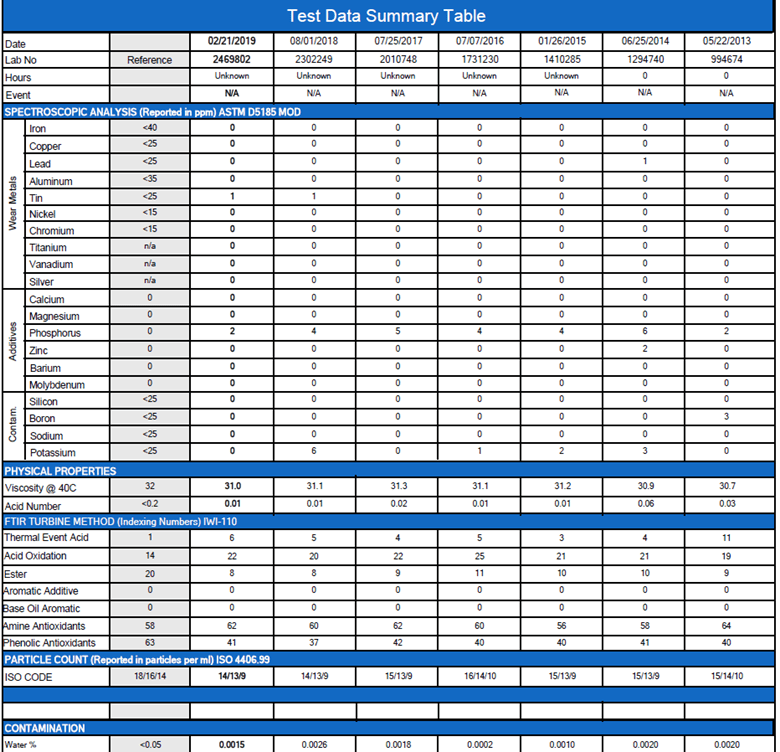
Here is a sample report from Eurofins for a turbine oil. In this report, the various types of tests are classified according to wear metals, additives, and contaminants, as shown in Figure 2.

According to the report, samples have been collected over a period of time. This helps with the trending of the data, so we can spot when the values start varying from the “normal levels”. The reference values are also provided in the first column to help users determine whether these values fall within tolerance limits or not.

Figure 2: Sample Turbine Oil Analysis Report

Typically, the lab will provide some type of traffic light system where:

  • Red – indicates there may be an abnormal reading or the oil should be changed immediately, as certain values have surpassed the critical limits.
  • Amber – shows that the values are approaching the warning limits, but there is still some time to investigate and fix the problem.
  • Green – tells us that all values are within the tolerance limits and the oil is performing normally.

For this report, they also include additional tests as shown in Figure 3.

Figure 3: Additional Tests for Turbine Oils

For turbine oils, understanding the demulsibility of the oil is important, as this is the oil’s ability to separate from water, or rather, not to form an emulsion. Excessive water in the oil can lead to rust or even a washout of the additives.

The Foam test is also administered to detect the oil’s ability to release air from the oil, ensuring that the air doesn’t get trapped. If air is trapped, it can lead to microdieseling and cavitation on the inside of the equipment.

RPVOT – Rotating Pressure Vessel Oxidation test is also performed, as it indicates the expected oxidation of the oil. MPC (Membrane Patch Colorimetry) and Ultracentrifuge detect the potential of the oil to form varnish, and the RULER® values give the actual quantity of antioxidants present.  These values are all critical for monitoring the health of the turbine oil, as it is very susceptible to oxidation and the formation of varnish.

In essence, reading the oil analysis report involves understanding what the tests are meant to measure, knowing your equipment and its operating conditions, and having a history of your equipment.  These factors all contribute to trending the data to ensure that there are no surprises with unplanned downtime due to wear or oil degradation.

References

Eurofins. (2025, September 06). Annual Turbine Analysis. Retrieved from Eurofins Testoil: https://testoil.com/services/turbine-oil-analysis/annual-turbine-analysis/

How to Interpret Your Oil Analysis Results

Have you ever received your bloodwork results from your doctor, only to be more confused than ever? With all the long names and numbers just sitting on the piece of paper, Google (or ChatGPT) becomes your best friend to help interpret what they mean. However, even with these tools of reason, there is usually a disclaimer that states, “Please consult your doctor for a more accurate interpretation”.

Numbers alone don’t tell the whole story – context is what makes oil analysis meaningful.

One of the reasons for constantly looping your doctor back into the mix is that they have your history, they know how your body responds to certain things, and values which may get flagged because they are outside of the limits may be waived away by your doctor because it is normal for your body based on your history and DNA.

The same applies to oil analysis. Depending on the application and operating environment, certain conditions may be met that can be interpreted as unusual. Still, if you’re familiar with your system, you will understand the reason behind the numbers.

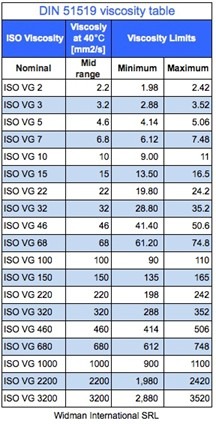
Figure 1: DIN 515519 table showing viscosity limits

Viscosity

As mentioned earlier, viscosity is the most important characteristic of a lubricant. If it is too thick for the application, this can lead to efficiency loss, increased heating, and a slowdown of the system. Essentially, a significant amount of work needs to be done on the oil to make it compatible with the application.

On the other hand, if it is too thin, then we run the risk of improper lubrication. Therefore, we increase the chances of wear occurring in the applications.

Viscosity is usually measured at either 40°C (for industrial applications) or 100°C (for engine applications). However, most labs put a ±5% tolerance limit for many oils. But why use such a random figure? The DIN 51519 table is used to determine ISO viscosity, with each value within a 10% range, as shown in Figure 1.

When you see an ISO VG 100 oil, the chances are that the actual viscosity of that oil varies between 90-110cSt. Therefore, if we start seeing our results vary by around 5% or trend towards the outer limits of any viscosity class, we know that something is going on with our oil.

Presence of Wear Metals

Wear metals prove that some type of wear is occurring. However, depending on their quantity, they can also provide some more insights into what is actually wearing away and whether it is normal wear or abnormal wear. Wear is reported in parts per million (ppm) or as a percentage. Here’s how to convert those percentages to ppm:

100% = 1,000,000ppm

1% = 10,000ppm

0.1% = 1,000ppm

The most common wear metals tested include Aluminum, Iron, Chromium, Copper, Lead, and Tin. Depending on the application, there are varying levels at which these will be flagged.

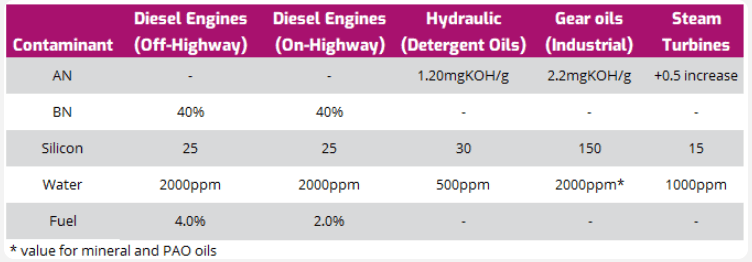
Table 1 provides an example of various applications and their respective limitations. These will vary based on your OEM and environment, but can be used as a general guideline. All numbers in Table 1 are in ppm.

Table 1: Wear metal limits for various applications

AN/BN and the Presence of Contaminants

Contaminants are any foreign material in the system. Sometimes, lab tests may not be able to detect contaminants in a system because they are not specifically designed to identify that particular contaminant.

In these cases, users would need to specify what additional contaminants the lab should look for, or perform a broader FTIR (Fourier Transform Infrared) analysis to identify all the components in the oil and then determine which of them are contaminants.

The most common contaminants tested include Silicon, Water, and Fuel. Although AN/BN (Acid Number and Base Number) may not be considered a contaminant, it helps quantify the acid in your system, which shouldn’t be there; therefore, in some ways, it can be viewed as a contaminant. However, it is primarily a physical property and is listed separately.

Acid and base numbers act like an early warning system for oil health.

Table 2: Tolerance limits for some contaminants

For diesel engines, BN is measured as having high base numbers, which will decline over time as acids accumulate. If the BN value declines to around 50% of its original value, then we have an issue with the acids increasing too quickly in the oils. On the other hand, AN is used for all other industrial oils (gears, hydraulics, etc.). There are varying limits for AN depending on the application, as shown in Table 2.

Silicon usually indicates the presence of sand, which is highly abrasive. This can accelerate wear in any equipment by essentially turning the oil into sandpaper and wearing away the insides of the equipment. Some of its limits are shown in Table 2.

Water in any form is highly destructive to all assets. However, some systems can tolerate a bit more water than others. This can be due to the nature of the oils (good demulsibility) or the nature of the systems, where heat is involved to help remove the water. Water in the system can lead to an increase in viscosity and disrupt the oil layer.

As such, the lubricant will not be able to form a full film to protect the asset. Water can also create an emulsion in the oil or lead to corrosivity issues. Table 2 gives some examples of limits for various systems.

Fuel contamination is an issue for most diesel engines. The presence of fuel in your oil can lead to a lower viscosity (hence the oil can no longer protect the components) and an increase in the flash/fire point of the oil, which can be particularly dangerous. We have some limits noted in Table 2.


Presence of Additives

It is more challenging to place these tests in a one-size-fits-all table, as oil formulations are consistently changing. The best way to interpret these additives would be to compare them against the initial values for the finished lubricant.

For your oil analysis program, always have a representative sample of the new oil so that comparisons can be made against it as the oil ages in the system. Additionally, the presence of additives in your report when they shouldn’t be there is also a sign of contamination, likely with another type of oil.

Why Different Oils Require Different Tests

Oil analysis reports often wear an invisible cloak, and only if we have a wizard capable of revealing what the numbers mean, they will more than likely end up in a drawer or file on the computer. There are many similarities between oil analysis and blood tests, as they both serve similar functions.

They both test fluids, quantify the results according to different categories, and provide envelope limits within which these values should exist. If the values fall outside these limits (either below or above), we need to take action to prevent failure of the critical asset (or human organ accordingly).

An oil analysis report is less about numbers and more about the story they reveal.

In this article, we will focus on understanding the basics of reading an oil analysis report, interpreting the results, and developing action items based on the information collected. We will take a closer look at reports on turbines (rotating equipment), gear, hydraulics, and engine oils, and what this all really means for your equipment.

Why Different Oils Require Different Tests

Before we dive into the report, we need to establish that not all oils are the same! As such, different oils are required for various types of applications. Therefore, each type of oil will require slightly different tests to determine whether it is performing optimally or not. However, there are a few tests that remain the same for all oils.

The most critical characteristic of an oil is its viscosity. As such, all oils are typically tested to determine whether their viscosity meets the requirements. Another function of the oil is to prevent wear. Thus, most oils are tested for the presence of wear particles, as this can help the user identify if any wear is occurring in the asset.

Oils should be kept clean; therefore, tests are performed to determine the presence of any contaminants, and these are carried out on most oils. Similarly, additives help oils perform their functions; hence, their presence or absence should be quantified to determine if they are indeed achieving their functions for all oils.

Tests for viscosity, the presence of wear metals, contaminants, and additives are the standard sets of tests that should be performed on any oil. There are more detailed tests that examine the specifics of various types of applications, but we will delve into these later in the article.

What are the Effects of Using the Wrong Engine Oil?

Sometimes, the wrong engine oil is used. Whether it’s an issue of the unavailability of the correct stock or trying to standardize across the fleet without consulting the manufacturer’s recommendations, numerous issues can arise when the wrong engine oil is used.

Engine Sludge Build-Up

One of the most common side effects of using the wrong oil is a build-up of engine sludge. If we recheck the API standards, oils were designed to reduce sludge formation. When the incorrect oil is used, it cannot adequately compensate for the engine’s conditions, simply because it wasn’t designed for that purpose.

This can also occur when oil is used with an incorrect viscosity or with the wrong fuel (specifically, the concentration of sulphur for diesel engines).

Increased Friction and Wear

Earlier, we discussed how OEMs typically recommend several different types of viscosity for engines, depending on the specific conditions. However, if a viscosity is used that is too low to provide the correct amount of support and separation between the two surfaces, then increased friction and wear can result, damaging the engine’s internals.

Poor Performance and Efficiency

With the incorrect engine oil, the engine will not perform at its expected efficiency. This will directly impact its overall performance. If the viscosity exceeds the recommended value, the engine must work harder to achieve the same results, resulting in poor performance and decreased efficiency. Similarly, if the viscosity is lower than the recommended value, increased friction will result, leading to higher heat and reduced engine efficiency.

Damage to Engine Components

As stated above, a viscosity that is either higher or lower than the recommended value can damage the equipment’s internal components. Similarly, if an incorrectly specified product is used, it may not withstand the engine’s regular environmental conditions and can break down prematurely, damaging its components.

Potential for Engine Failure

Using the incorrect oil, the engine’s components will not receive the necessary protection, whether it’s due to the incorrect viscosity or the wrong mix of additives. This can lead to premature oil degradation, which in turn may result in engine failure. The correct oil will be able to protect against these harmful conditions and keep the engine from failing due to lubricant-related issues.


Find out more in the full article, "Engine oil types and how to choose the right one" featured in Precision Lubrication Magazine by Sanya Mathura, CEO & Founder of Strategic Reliability Solutions Ltd. 

How important is it to regularly change your engine oil?

Some oil manufacturers claim that their oil, when added to your engine, will remain “golden” in color and not turn dark. Every engine produces soot /carbon as a byproduct, so if the oil does not change color, it means that the soot/carbon is likely remaining stuck on the insides of your engine, which can lead to engine failure.

In these cases, the oil, especially motor oil, contains detergent and dispersant additives that keep the soot or carbon suspended in the oil. This ensures that these deposits do not adhere to the engine’s internal components, causing clogging of smaller clearances and damaging the engine. Hence, an oil change removes these accumulated deposits. There are several other advantages to changing oil regularly for these engines.

Preventing Engine Wear and Tear

Motor oils are formulated with around 30% additives. These additives can perform various functions, including protecting the internal components from wear. However, over time, they become depleted and should be replenished. Changing your oil regularly can help with that. With an oil change, there is a replenishment of additives that protect the equipment.

Maintaining Proper Engine Functioning

Over time, the viscosity of the oil in engines will decrease due to the conditions that exist within the engine. There will come a time when it reaches the end of its life and will no longer be able to protect the engine. At this point, the crosshatch on the cylinder walls can begin to experience some polishing, as the oil can no longer provide the necessary protection. By changing the oil on time or regularly, this can be avoided, and the engine can maintain its proper functioning.

Avoiding Costly Repairs

When the oil starts to degrade, it loses all its protective elements, and wear can start to occur. With frequent oil changes, this can be avoided as new oil will be able to protect the engine and its components to the best of its ability. This way, increased wear can be minimized, and costly repairs can be avoided.

Following Manufacturer Recommendations

Manufacturers typically recommend oil changes every 5,000 to 7,000 kilometers for passenger cars; however, this interval can vary depending on driving habits, environmental conditions, and even the type of fuel used. Oils are designed to protect the engine, and when they reach the end of their life, they can no longer fully perform this function. By changing the oil regularly (or, in some cases, as recommended by the manufacturer), the engine’s lifespan can be extended.

Monitoring Oil Levels and Quality

In some passenger cars, engine manufacturers specify that there is a loss of oil over time. One manufacturer, Audi specifies that owners should top up 0.5 liters of oil every 1000km. As one can imagine, if there is no top-up or oil replenishment, the oil levels can fall below the minimum value, causing damage to the engine.

Hence, it is essential to follow your manufacturer’s recommendations for topping up your engine to prevent damage. These top-ups also serve to replenish some of the used additives, providing additional protection for your engine.

Find out more in the full article, "Engine oil types and how to choose the right one" featured in Precision Lubrication Magazine by Sanya Mathura, CEO & Founder of Strategic Reliability Solutions Ltd. 
Why are there Different Engine Oil Change Intervals?

At the beginning of this article, we reiterated that there are more than 5000 models of engines that exist. Every engine was built to different specifications, but they all provide the user with the ability to move the vehicle. With different manufacturers, there will also be varying oil specifications for each model, including the recommended oil change intervals. Let’s look at some of those.

Factors Affecting Oil Change Frequency

Lubricants are designed for certain conditions; however, if those conditions are exceeded, then the lubricant can degrade at a faster rate. For instance, if the driver frequently starts and stops or experiences prolonged periods of idling, these patterns can stress the oil more quickly, causing it to degrade.

If the fuel quality is not as expected, it may also contribute to the oil degrading more quickly. In such cases, users may opt for shorter oil change intervals to ensure their engine remains protected.

Another factor affecting the frequency of oil changes is the quality of the oil used. Typically, synthetic oils may have longer oil change intervals than mineral oils. However, there are some cases where the manufacturers advise the same interval length, whether mineral or synthetic.

Using Oil Analysis to Determine Engine Oil Life

There are instances where the oil drain interval can be extended beyond the manufacturer’s recommended interval. However, this must be done with guidance from a lab while utilizing oil analysis. Typically, some applications do not utilize the additives in the oil as quickly and may not require the regular oil change interval; instead, the oil remains healthy by the time it’s supposed to be discarded.

This can be considered a waste of resources. With oil analysis, one can monitor the health of the oil and determine if it is nearing the end of its useful life, allowing for informed decisions on whether to change it or not.

The Debate over Extended Oil Change Intervals

There will always be a debate over whether it is wise to extend the oil change intervals for equipment, as it goes against the manufacturer’s recommendations (or, in some cases, this could void the warranty). However, just as with blood testing (or condition monitoring for oil), close monitoring allows us to justify the outcomes of extending the intervals.

Some of the benefits of extending the intervals include reduced manpower, allowing staff to perform other critical duties, a reduction in oil consumption and its disposal, as well as reduced downtime for maintenance. One can also include the reduction of safety risk depending on the application. These all add up in the end, and the benefits of safely extending the intervals may outweigh remaining at the recommended intervals.


Find out more in the full article, "Engine oil types and how to choose the right one" featured in Precision Lubrication Magazine by Sanya Mathura, CEO & Founder of Strategic Reliability Solutions Ltd. 

What are the types of Engine Oils?

When you walk into the auto repair store, it can be quite overwhelming with the barrage of oils readily available for customers. It’s easy to get distracted by the shiny packaging or marketing claims (‘This is the best oil ever!’) when deciding to purchase oil for your vehicle. However, it begins with understanding the basics of engine oils.

Conventional Oil

This is the oil that has been around since the beginning of the automotive revolution. They are also referred to as mineral oils and represent the API Groups I-III base oils. Ideally, these oils can be traditionally found as the base for lubricants that are on the higher end of the viscosity spectrum (think 40, 50, and 60 weight).

These mineral oils are found on the earth, and their molecules may not all be the same size (unlike synthetic oils). They are usually less costly than synthetic oils but still provide some protection to the engines.

Synthetic Oil

Synthetics are considered the top-tier set of lubricants, as they can withstand harsher conditions compared to mineral oils. They are found in groups IV and V, and many of them are man-made, while others are naturally occurring. Most of their molecules are the same size, allowing for better properties, and they tend to be more expensive than mineral / conventional oils.

Synthetic Blend Oil

A synthetic blend oil refers to an oil that contains both synthetic and mineral base oils. However, there is no set ratio of synthetic to mineral oil that can impact the final performance of the lubricant to be classified as a synthetic blend. Many manufacturers can easily get away with using only 1% synthetic oil blended with 99% mineral oil and still label the oil as a “Synthetic blend.”

This gives the customer the false impression that they are purchasing an oil that will offer the best of both worlds.

High Mileage Oil

Until about a decade ago, high-mileage oils were not really that popular, but with the aging population of automobiles, there has been a significant increase in the purchase of this type of oil. Different manufacturers have varying specifications for these oils and typically use the vehicle’s mileage range to help guide customers in selecting the correct oil.

These oils are blended on the “thicker” side of the viscosity range, meaning on the higher end of the maximum viscosity. For instance, a regular 10w40 would appear to be “thinner” than a High Mileage 10w40. They are also reinforced with seal conditioners to help some of the seals in the older engines. But it does not contain magic, so it can’t repair your engine!

Racing Oil

The performance required of a Ferrari compared to that required of a minivan can differ drastically.  The operating conditions are starkly different, and the engines would require specifications from their manufacturers. As such, there are specially developed racing oils for these higher-performance vehicles built to withstand harsher conditions compared to the regular engines.

This does not mean that you should use racing oil in your regular vehicle to get the performance of a race car. The oils are blended for specific purposes and must be used accordingly to ensure maximum functionality. Similarly, the oil used in the minivan would not be able to withstand the conditions of a racing car. Use oil that is compatible with the type of engine and the required performance.

Find out more in the full article, "Engine oil types and how to choose the right one" featured in Precision Lubrication Magazine by Sanya Mathura, CEO & Founder of Strategic Reliability Solutions Ltd. 
What is Viscosity and how does that affect Engine Oil Grades?

Engine oil is a lubricating fluid designed to reduce friction and wear between moving parts inside an internal combustion engine, while also cooling, cleaning, and protecting components from corrosion and deposits.

While we may think that there are numerous car manufacturers globally, as of 2025, there are only slightly over 100 original equipment manufacturers (OEMs), but over 5,000 models. Whether it’s a luxury vehicle or a basic, functional one, they all require one thing to keep them running: lubricants (in the EV market, this can mean greases as opposed to traditional oils).

Parallel to the various models of vehicles, there are also numerous types of lubricants on the market, each designed specifically for different requirements. In this article, we will share some knowledge on the areas you need to be familiar with for these types of lubricants, and of course, what impacts they have on your vehicle of choice.

Understanding Viscosity and Engine Oil Grades

Before exploring the types of oils, it is essential to understand one of the most important characteristics of oil: its viscosity. This is what governs the engine’s functionality and, to some extent, dictates its performance.

engine-oil-vis

What is Viscosity?

Oil viscosity is the internal friction within an oil that resists its flow. It measures the oil’s resistance to flow and is one of the most important factors in lubricants. Viscosity is also defined as the ratio of shear stress (pressure) to shear rate (flow rate).

The SAE Viscosity Rating System

The SAE (Society of Automotive Engineers) developed viscosity grades to classify engine oils, enabling engine manufacturers and oil marketers to make recommendations and label their products accordingly. The SAE J300 is a series of two viscosity grades: one with the W and one without the W.

Monogrades with the letter “W” are defined by maximum low-temperature cranking and pumping viscosities and a minimum kinematic viscosity at 100°C. (Typically, this represents the start-up condition of an engine.)

Monogrades without the W are based on a set of minimum and maximum kinematic viscosities at 100°C and a minimum high temperature / high shear measured at 150°C and 1 million reciprocal seconds (s-1). (Typically, this represents the operating conditions of the engine when it is in use.)

Multiple viscosity grade oils or multigrades are defined by:

  • Maximum low-temperature cranking and pumping viscosities
  • A kinematic viscosity at 100°C that falls within the prescribed range of one of the non-W grade classifications
  • A minimum high temperature / high shear viscosity at 150°C and 1 million reciprocal seconds (s-1).

These represent the extremes of startup and engine operation.

The table below gives a summary of these.

Figure 1: SAE J300 revised January 2015. Source Widman International SRL

Find out more in the full article, "Engine oil types and how to choose the right one" featured in Precision Lubrication Magazine by Sanya Mathura, CEO & Founder of Strategic Reliability Solutions Ltd. 

Frequently Asked Questions About Machinery Lubrication

How Often Should Equipment Be Lubricated?

This can change depending on your environment and operating conditions. A machine operating in a clean environment with ambient temperatures and a typical load should be lubricated according to its schedule. However, if this same machine is in a dusty, high-temperature environment working 24/7, its change or relubrication intervals will be shorter than the regular ones.

Lubrication reduces friction in your system. Hence, you can detect when friction levels increase if you’re monitoring your assets using ultrasound. This would allow you to apply a small volume of lubricant to lower these levels. (This is specifically for greases.)

You are always advised to check with your OEM, who will have recommended lubrication schedules for your equipment in varying environments and operating conditions.

What Are the Signs of Poor Lubrication?

Poor lubrication can mean under- or over-lubricated assets or incorrect use of a lubricant in a particular application. If your lubricant is not meeting the expected intervals and the components constantly fail due to lubrication issues, these are some telltale signs of poor lubrication.

How Do I Know If I’m Using the Right Lubricant?

All lubricants are required to meet standards to prove their performance, or OEMs may approve some for their suited applications. The lubricant’s performance standards should be compared to those outlined by the OEM for a particular piece of equipment. If they don’t match or there are discrepancies, then the OEM or lubricant supplier should be contacted for verification. Sometimes, an over-qualified lubricant may be used in your application, and it can also give you the expected results, but of course, at a higher cost.

Lubricants are the lifeblood of our equipment and keep our industry moving. We need to understand them fully, their roles in our equipment, and how we can optimize them for maximum performance.

References

  1. Debshaw, B. (2023, February 02). Reducing Costs, Increasing Production: The Remarkable Impact of Predictive Maintenance. Retrieved from Precision Lubrication Magazine: https://precisionlubrication.com/articles/predictive-maintenance/
  2. Mathura, S. (2024, April 01). Lubricant Additives: A Comprehensive Guide. Retrieved from Precision Lubrication Magazine: https://precisionlubrication.com/articles/lubricant-additives/
  3. Mathura, S. (2023, March 26). Oil viscosity: A practical guide. Retrieved from Precision Lubrication Magazine: https://precisionlubrication.com/articles/oil-viscosity/
  4. Britton, R. (2023, January 26). How do Solid Lubricants work? Retrieved from Precision Lubrication Magazine: https://precisionlubrication.com/articles/solid-lubricants/
  5. Hamrock, B. J., Schmid, S. R., & Jacobson, B. O. (2004). Fundamentals of Fluid Film Lubrication Second Edition. New York: Marcel Dekker Inc.
  6. Pirro, D. M., Webster, M., & Daschner, E. (2016). Lubrication Fundamentals, Third Edition, Revised and Expanded. Boca Raton: CRC Press.
  7. Pirro, D. M., Webster, M., & Daschner, E. (2016). Lubrication Fundamentals, Third Edition, Revised and Expanded. Boca Raton: CRC Press.
  8. Hamrock, B. J., Schmid, S. R., & Jacobson, B. O. (2004). Fundamentals of Fluid Film Lubrication Second Edition. New York: Marcel Dekker Inc.

Find out more in the full article, "Lubrication Explained: Types, Functions, and Examples" featured in Precision Lubrication Magazine by Sanya Mathura, CEO & Founder of Strategic Reliability Solutions Ltd. 
Lubrication Maintenance Best Practices

We’ve already covered some mistakes; it’s time to look forward to some lubrication best practices. To some of us, these may seem trivial, but they can lead to big impacts on your overall maintenance budget and can even manage to decrease some unplanned downtime.

Creating a Lubrication Maintenance Schedule

Every component in your industrial facility needs to be lubricated. The frequency at which this occurs, alongside the type of lubricant, can vary greatly. However, by properly mapping out your lubrication points and frequency intervals, you can develop a lubrication maintenance schedule that your planner will be proud of!

The first task on your list would be to have a detailed listing of all your assets, their locations, the type of lubricant being used, and suggested relubrication frequency. Next, this can be consolidated into daily, weekly, monthly, and quarterly tasks.

Afterward, you must bring your mapping skills into place as you incorporate the lubrication tasks with other maintenance tasks in the same area. This way, your assigned personnel maximize their time in one geographical location.

Importance of Lubricant Analysis and Condition Monitoring

How often do you perform blood work for yourself or visit your doctor? Performing blood work is similar to taking an oil sample for our equipment as we investigate what’s happening inside it. This can give us a heads-up on an impending failure (if there is a high wear metal concentration or the presence of contaminants) or an issue in the oil (changes in viscosity or additive packages).

By effectively monitoring the health of your oil, you can prevent unplanned shutdowns or even extend its life. This can save your company from significant losses and increase your production output.

Lubrication Training for Maintenance Teams

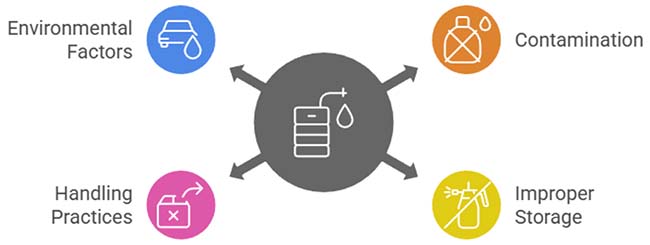
Quite often in our industry, we hear, “Oil is oil, or grease is grease,” but after reading this article, I’m sure you will agree that those words are a very big misrepresentation. This is why training is so important for our teams. We want to ensure we all understand why we’re not leaving the oil drums out in the rain and pouring them into our equipment!

This will lead to water getting into the oil drums. Then, we include the water in our equipment alongside our oil, which will change the oil’s viscosity, possibly leech out some of the additives being used for protection, and can act as a catalyst for further, rapid degradation of the oil.

This simple storage and handling concept can cost our company unplanned downtime and loss to production, but by adequately training our teams to understand lubrication and some of the best practices, we can transform our facilities into world-class lubrication sites. The only way to do this is as a team working together to achieve a goal that we all understand.


Find out more in the full article, "Lubrication Explained: Types, Functions, and Examples" featured in Precision Lubrication Magazine by Sanya Mathura, CEO & Founder of Strategic Reliability Solutions Ltd.