Air is inert, so it shouldn’t affect your oil, right?! This is a concept that many people get wrong or don’t fully understand. Air in your oil can literally cost your facility millions of dollars in damage if it is not treated or removed from your system early.
It can affect the compressibility of your oil, its thermal behavior, and the oxidation stability of hydraulic and drivetrain systems, leading to degradation or efficiency loss. With reduced efficiency, overall production will decline, which can negatively impact the profitability of your operations. Before we dive into the ways it can affect your system, we need to understand the basics.
The Four States of Air in Oil
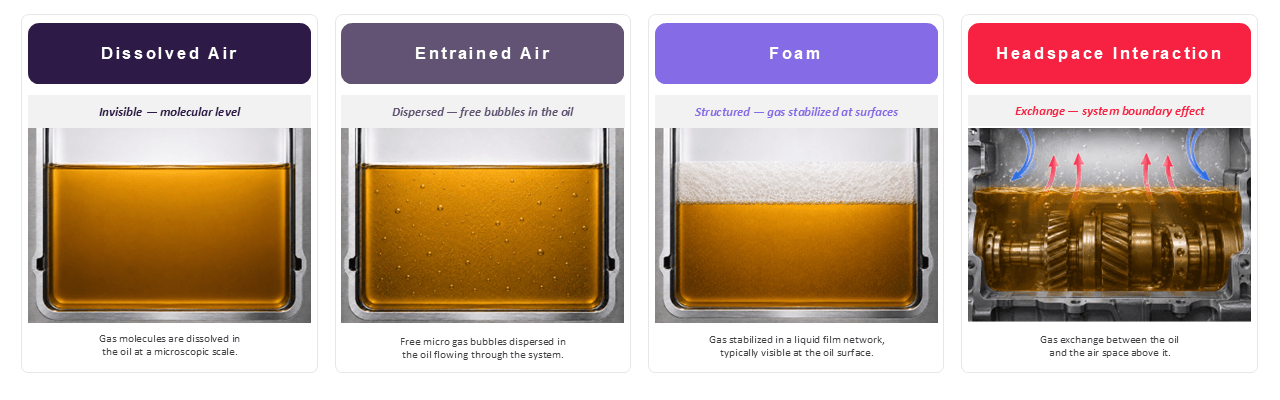
Air can exist in four states within your oil and machine. As shown in Figure 1, these include;
- Dissolved air
- Entrained air
- Foam
- Headspace interaction
Each of these states can affect your system differently, as shown in the table below, and will have corresponding sources of ingression.
Reliability Meaning for Various States of Air
| State | Reliability Meaning | Typical Sources |
| Dissolved Air – this usually represents 8-12% of dissolved air at atmospheric pressure | Affects solution chemistry.
Can come out of solution when pressure, temperature or shear conditions change. Often a hidden source for future entrained air. |
Equilibrium with headspace air usually in the sump, make up oil (when oil is added to the sump), storage, temperature or pressure changes. |
| Entrained Air | Reduces effective bulk modulus (compressibility).
Has a big impact on control stability, efficiency, and thermal behaviour. Drives cavitation and microdieseling risk. Even with a 0.5% volume of air, this can triple the risk of varnish. Controllability of valves gets affected. Maximal suction height of pumps is reduced dramatically. |
Suction leakage, vortexing, return-line splash, churning, gear mesh aeration, system design. However, strong pressure reductions lead to de-aeration of the dissolved air. |
| Foam | Indicates strong surface activity or contamination.
Can reduce effective oil volume, impair heat transfer and promote aeration carry-over. |
Surface active additives, detergents, contaminants, high turbulence, agitation. |
| Headspace Interaction | Drives how much air enters or leaves the oil over time. Influenced by temperature, pressure, ventilation and oil level. | Breathers, vents, temperature cycles, pressure changes, low oil level. |
For each of the states above, air affects the reliability of your equipment. It is critical to identify the state of air in your oil so it can be removed before it begins to affect your system. Typically, maintenance teams pay attention to air in oil only when it is visible (foaming) or when it demands their attention through noisy interactions. By this time, teams have lost the opportunity to remove the air while it is in its more benign state.
How Does Air Get Into Oil?
When we think about air getting into our oil, we generally think of openings or mechanical areas that allow it to enter. However, air can enter our system in several ways. It is also worth noting that air already exists in the oil at equilibrium, where it will leave the oil according to Henry´s law.
Air can become entrained (or trapped) in the oil through various mechanisms such as return-line splash, vortex formation, suction-side leakage, tank dynamics, free-surface interaction, or churning in gearboxes and drivetrains. When entrained, it can cause damage to your equipment if not detected in time.
Changes in operating regimes can also influence whether air stays in the oil or gets forced into it. This is usually seen with changes in pressure, temperature, or shear conditions. Within your system, your oil can experience a load transition, a change in oil level, or return flow, all of which can influence the volume of air that remains in or enters your oil.
Even after identifying the source of air ingress, it is imperative that it be removed from your system. While air in oil does not usually get the attention it deserves, it will demand that attention if it goes unresolved or remains in your system.
Find out more in the full article, "Air in Oil: The Reliability Variable Many Programs still treat too late" featured in Reliable by Sanya Mathura, CEO & Founder of Strategic Reliability Solutions Ltd, David Placzek, Dr. Lukas Hafner