Category: Storage & Handling of Lubricants

Oil Consolidation Reimagined: The 5S Method for Smarter Lubrication Practices

When we walk into a pharmacy, there are thousands of items. Some of them do the same job but have different names and price points, while others are specialty items designed to solve a particular problem at a slightly elevated price point. Some of these may not be readily available in all pharmacies. Machinery lubricants adopt a similar type of pattern.

There are various OEMs on the market that all produce finished lubricants. Some of the majors are Shell lubricants, ExxonMobil, Total, and Castrol, while there are other niche producers who handle very specific markets. Like the pharmacy, where numerous choices solve the same issue, we have machinery lubricants from different suppliers who meet most of the standard specifications or specialty-grade products.

Each supplier will have a proprietary blend that comes from an invested amount of Research and Development into their product to produce something that meets international equipment specifications and regulatory standards.

Does this mean that one product is better than the other, or does it mean that all hydraulic oils (for instance) are the same? This depends on the application.

The hydraulic oil used to top up the compactor of a garbage truck with several leaks will not be the same hydraulic oil that we use for a critical hydraulic system in a power plant, which requires fire-resistant oil. We can also compare the engine oil used for a 40-year-old regular car to that of the engine oil used in a McLaren race car on race day.

Different applications have varying risks associated with them, as well as performance expectations; this is what sets certain lubricants apart.

The 5S Methodology

While some may be familiar with the 5S methodology of lean principles, this may be the first time others have heard of its existence. In essence, these principles help to maintain quality standards within the workplace. As per (ASQ, 2024), 5S is a quality tool derived from 5 Japanese terms used to create a workplace suited for visual control and lean production. The 5 pillars and their translations are listed in Table 1 below.

Table 1: 5S definitions (ASQ, 2024)

We can use these principles to adopt a leaner approach to lubricant consolidation in our facilities. This way, we ensure that our operators have a clean, manageable workplace when handling lubricants. The 5S method can give us a better overall view of what happens in our lubricant storage areas.

Storage and Handling & Advancements in Hydraulic oils

Hydraulic systems have smaller clearances than many. As such, it is imperative that these oils be kept clean and free from any debris. Most hydraulic components have a required ISO 4406 rating that should be met to ensure that the oils do not allow foreign particles to enter as these can easily clog the clearances and cause the system to stop working.

Chevron Lubricants produced a document that compiles some ISO 4406 codes for various types of industrial off highway equipment, which also includes the hydraulic standards. It noted the recommended ISO Cleanliness for John Deere hydraulic Excavators can be ≤23/21/16, this can be found here (Chevron Lubricants, 2015).

Hydraulic oils should be pre-filtered before being placed in your equipment even though there are filters on the inside of the equipment by reducing the amount of contamination entering the system from the onset, you can ensure a longer life for your hydraulic oil. Hydraulic oils should also be stored in closed containers not those that are left open to the atmosphere!

Advancements in Hydraulic Oils

According to (Fitzpatrick & Thom, 2021), the hydraulic oil market was approximately worth USD 77.5 billion by the end of 2021. Mobile hydraulics account for 65% of the market while industrial equipment represents 35% of the market. Clearly, the larger market share exists for mobile hydraulics. However, OEMs are also moving towards smaller oil sumps with longer oil drain intervals that can impact on the volume of hydraulics needed periodically.

Changes by OEMs also impact the formulation of hydraulic oils. For instance, if a smaller sump is used then, the hydraulic oil must now be able to cool faster, transport the same (or larger) force and maintain the intended viscosity of operation while being under greater stress. In these cases, the additive packages involving the antiwear, thermal stability, viscosity index improvers, defoamants and dispersants must be formulated to work in unison without compromising the other.

There have been changes in additive technology that allow for larger tolerances for various characteristics but while additives are evolving, the refining of base oils is also trying to keep up. With all of these evolutions, the chemical composition of hydraulic oil today vastly differs from one created in the 1950s. The requirements of hydraulic oil have also greatly evolved, forcing these changes in formulation.

Hydraulic oils today need to provide longer oil drain intervals, better stick/slip characteristics, increased efficiency, improved conductivity and wear performance and an added level of sustainability. Formulators need to create hydraulic oils that can adhere to these characteristics while also not infringing on regulatory requirements. This makes hydraulic oils one of the most powerful types of oils because they must conform to these requirements while also transferring force from one place to another.

References

Chevron Lubricants. (2015, January 24). Chevron Lubricants Latin America. Retrieved from Chevron Lubricants: https://latinamerica.chevronlubricants.com

Fitzpatrick, A., & Thom, M. (2021, November 08). How the Global Hydraulic Fluid Market Is Changing—And What It Means for the Future. Retrieved from Power Transmission Engineering: https://www.powertransmission.com/blogs/1-revolutions/post/189

Mang, T., & Dresel, W. (2007). Lubricants and Lubrication Second Edition. Weinheim: WILEY-VCH.

Pirro, D. M., Webster, M., & Daschner, E. (2016). Lubrication Fundamentals, Third Edition Revised and Expanded, ExxonMobil. Boca Raton: CRC Press, Taylor & Francis Group.

Find out more in the full article, "Are Hydraulic oils the most Powerful oils?" featured in Equipment Today Magazine by Sanya Mathura, CEO & Founder of Strategic Reliability Solutions Ltd. 

How Do We Prevent Contamination?

Contamination exists all around us, but we must prevent its intrusion into our lubrication systems to help keep our machines alive for a longer period. Some simple steps can be performed to help reduce levels of contamination. Also, lab tests can identify the presence of contaminants.

Storage & Handling

Unfortunately, this is the area in which many of the contaminants enter the lubricant. There is no discrimination in this area because all solids, liquids and gases can easily contaminate the lubricant.

Some best practices to follow are to first ensure that all lubricants are properly labeled and that everyone on the team knows the different uses for each lubricant. While this may seem simple, some people think that “oil is oil,” and any oil can work. Educating them on the differences and their effects of being mixed is critical to ensuring that they don’t get mixed up (or used as a contaminant to another lubricant).

Typically, with construction equipment, a lot of smaller sumps do not require a full pail of oil or may require an odd volume of oil. This often means that new unused oil either remains in the original packaging or is transferred to a holding container. If the new oil remains in the original packaging the user should ensure that the packaging remains sealed after use; is airtight (not to allow any other particles in); and stored in a cool, dry place.

If it is decanted into another container, this container needs to be:

  • Clean (not previously used for another oil, not “cleaned” using fuel or some other substance)
  • Properly capped (to prevent any contaminants from entering)
  • Kept in a cool, dry place

Filtration

While this may seem trivial, lots of users assume that their new lubricants meet the required cleanliness standards for their machines. This is not true. New lubricants can be dirty and should be filtered before use. The filtration specification will vary depending on the cleanliness required for your machine.

For instance, the cleanliness specification for a hydraulic machine will be different from that of the engine oil specifications because hydraulics have closer clearances. Although many machines contain system filters which will also catch some of the contaminants, it is always a best practice to filter all lubricants before placing them in your system.

Oil Analysis

Oil analysis is not a likely method to prevent contamination, but it can inform end users of the presence of contaminants. Because of this benefit, it should be used to monitor the level of contaminants in a lubricant and trend their increase or decrease over time. This can spot whether a leak in the system, if a correlation between wear and contaminants exists or an anomaly is present in the system.

The tests that should be used to identify the presence of contaminants include:

  • Viscosity (to determine if there is change in this value)
  • Fourier transform infrared spectroscopy
  • Elemental (to identify wear metals, additives and contaminants)
  • Karl Fischer or crackle for the presence of water or fuel

Elemental analysis can easily help identify the presence of wear metals or contaminants, but it can also identify the presence of additives that are not representative of the oil in use. This is a good way of identifying the presence of an incorrect lubricant or solution that may have been used during a top up for that component.

Example

A mixed fleet operator began noticing that the jobs allocated to the excavation crew were taking twice as long as usual, and the costs associated with those jobs for materials also increased. He decided to tag along with the site manager for one of these projects to understand the escalation of the hours and costs.

At the site, the project began smoothly and ran as it should for the first two weeks. Afterwards, he noticed that the equipment began experiencing some downtime on the site. Typically, this occurred on the day after the site maintenance crew carried out their lubricant top ups.

The lubricants were being stored in the elements close to a makeshift shed that held some other necessary tools. The maintenance crew did not have smaller containers to decant the oils for the hydraulic equipment, so they used their disposed soda bottles to “help.” Any lubricant that remained in the bottle was left open to the atmosphere, and then this was topped up by the new lubricant.

Unknowingly, these users were contaminating their oil before placing it in the machines. This led to the unplanned downtime and extra resources, such as more oil, filters and hours for the mechanic. Immediately, proper storage and decanting containers were purchased. The onsite staff was trained in using these containers, which were also color coded to avoid the mixing of different lubricants.

The allocated time for these jobs returned to normal. In addition, the costs associated with the materials decreased because they no longer had to purchase extra oil to make those oil changes when the equipment shutdown.

Contamination can have a significant impact on the downtime of your equipment but can be easily prevented by using proper storage and handling techniques and monitoring the presence/absence of particles through oil analysis.

References

SKF, (June 6, 2024). Solutions for Contamination. Retrieved from SKF: https://www.skf.com/group/industries/mining-mineral-processing-cement/insights/solutions-for-contamination.

Is Oil Contamination Affecting the Performance of Your Equipment?

Often, the particles we don’t see are the ones that affect us most. For instance, we can’t see bacteria or germs but those can easily get into our body and make us sick. Something similar occurs with our equipment and the lubricants which are used to help them work more efficiently. SKF notes that contamination and ineffective lubrication are responsible for 51% of bearing, coupling, chain and other machine component failures in equipment.

Logically, if we control the amount of contamination, we can control the number of failures and all the resulting consequences, such as unscheduled downtime and rush expenses (for called out or specialized labor and parts). In this column, we explore how contamination can impact the performance of your equipment, ways to combat contamination and some examples.

What Is Contamination?

Contamination is anything that is foreign to the environment. For machinery lubricants, these are usually classified in three main groups: Gases, liquids and solids. When speaking about gases, this can be air or other gases (such as ammonia or methane) that encounter the lubricant. For liquids, this includes water, fuel or any other liquid that can enter the lubricant, particularly other lubricants or liquids that can be added knowingly or unknowingly. Lastly, solids can mean dirt (from outside the process), metals (from inside the machine) or any other solid particle in the lubricant.

Gases

Gases are the most unsuspected forms of contamination since many people believe that a gas will not affect the lubricant or by extension the machine. However, if air gets trapped in a closed loop system, this can lead to foaming (if the oil makes its way to the surface) or to microdieseling if it remains entrained in the oil.

With foaming, this typically occurs in gearboxes or equipment that are subjected to high churn rates of oil. Foam can settle at the top of the oil and cause the lubricant to not form a full film to separate the contacting surfaces. As such, this can lead to wear of the equipment.

On the other hand, microdieseling or the entrainment of air in the system can also prove to be dangerous because the trapped air bubbles can give rise to temperatures in excess of 1,000°C if they move between different pressure zones. This will lead to oil degradation, often producing some coke or tar insoluble as final deposits. Additionally, this trapped air/gas can also advance to cavitation inside the equipment.

Additionally, if the gas trapped is not air but a catalyst to a chemical reaction, this can incite further or more rapid degradation of the oil making it no longer able to protect the equipment. Therefore, identifying the presence of unwanted gases in your lube oil systems or preventing their entry in the first place is important.


Liquids

Liquids are trickier than gases because they somehow seem to enter the lubricant more easily or get mixed in unknowingly. When a liquid enters a lubricant, it can directly impact the viscosity of the lubricant, either increasing it or decreasing it. In either of these cases, this can be detrimental to the equipment.

If the lubricant’s viscosity increases above the essential value, then the machine will demand more energy to execute its required functions. This will directly impact its efficiency and energy consumption. On the other hand, if the lubricant’s viscosity decreases outside of the essential value, then the lubricant may not be able to adequately protect the contacting surfaces. Therefore, this increases the amount of wear that may occur on the inside of the machine.

Typically, water and fuel are the most common culprits of liquid contamination. These can easily get into your lubricants through poor storage and handling practices. Water can increase the viscosity of your lubricant and cause some additives to drop out of it, reducing its level of protection. Fuel will decrease the viscosity and possibly add to the fire risk of the system. Both can severely damage your equipment.

Another common culprit is the mixing of different types of oil. On an average day, things are busy, and people can get confused and pick up the wrong oil to perform a top up on a system. If we add gear oil or hydraulic oil to an engine oil system, we can have a catastrophe! These oils would have different viscosities, and their additive packages (or even base oils) may not be compatible. This can cause the equipment to stop working, leading to unplanned downtime and then exorbitant resources to get the machine operating again.

Solids

Solids can easily get into our equipment either from the outside or the inside. If there are openings to allow solids to enter then they will. However, sometimes solids enter our lubrication systems without us knowing. This can happen through poor storage and handling practices.

Once solids enter the system, they can:

  • Increase the viscosity of the oil
  • Increase the amount of wear occurring inside the equipment
  • Act as a catalyst (depending on their nature)
  • Block smaller clearances causing unwanted downtime in the equipment

Typically, solids are usually dirt, which can enter from outside the equipment. However, these hard particles can cause some metal to be damaged on the inside the equipment which can then lead to the metal being a catalyst for another degradation mode.

Some solids are formed inside the equipment as deposits. These deposits can occur if another contaminant (liquid, gas or another solid) enters the system and reacts with the oil to produce them. As such, these deposits may clog injectors, other valves or tight clearances causing the equipment to malfunction.

ICML 55 – the revolution in the lubrication sector

icml_stds

What is ICML 55?

ICML 55 is revolutionizing the lubrication industry! It is so exciting to be around at this time when it has started its implementation. For those who aren’t aware of ICML 55, here are a couple of notes on it.

ICML 55 was born out of ISO 55000 which speaks to Asset Management. From this standard, 3 standards were developed to guide the lubrication industry since no previous standards existed within the lubrication industry.

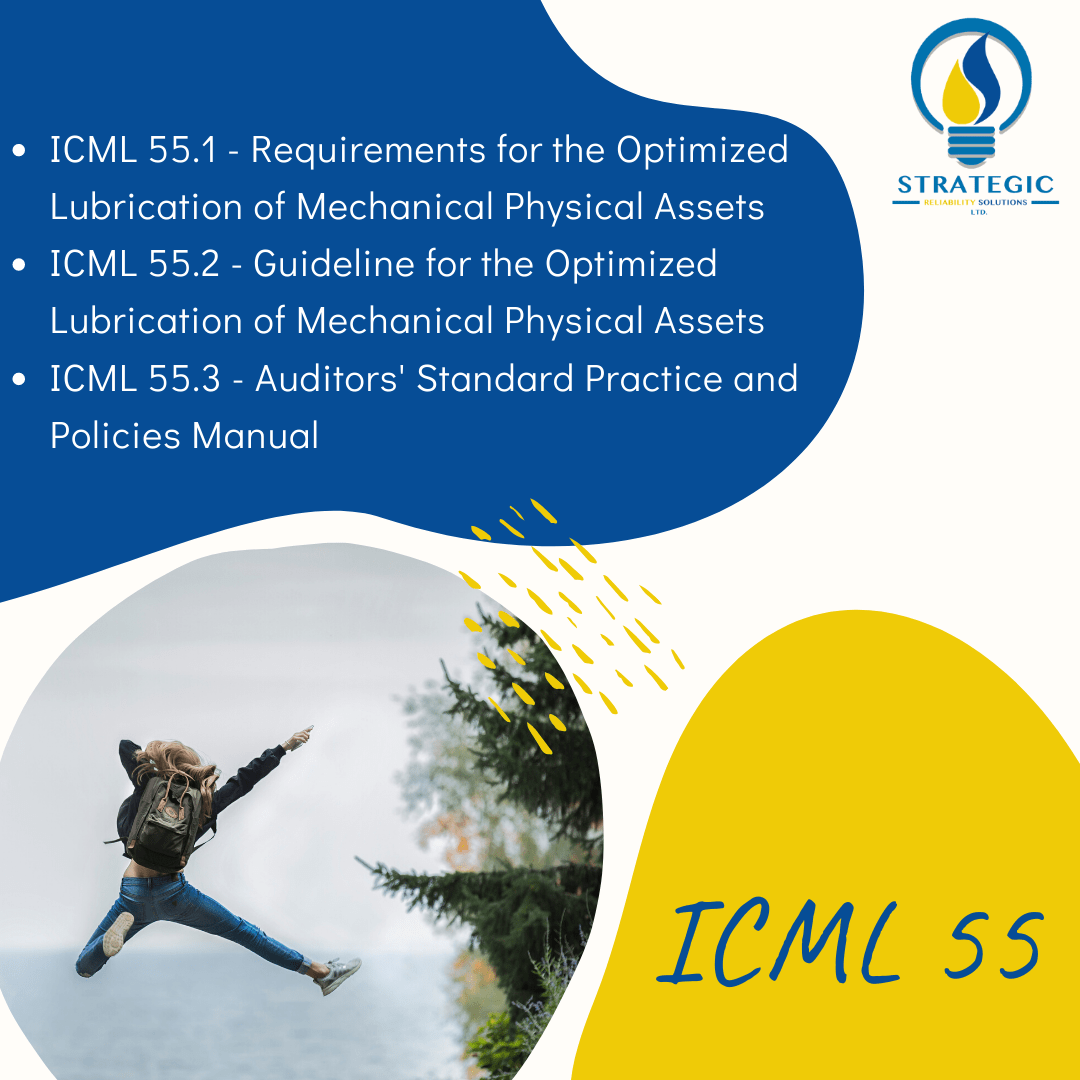
  • ICML 55.1 - Requirements for the Optimized Lubrication of Mechanical Physical Assets
  • ICML 55.2 - Guideline for the Optimized Lubrication of Mechanical Physical Assets
  • ICML 55.3 - Auditors' Standard Practice and Policies Manual

ICML 55.1 has already been completed, while 55.2 should be done at the end of this year and 55.3 scheduled for 2020.

These are exciting times!

Here’s the official press release:

https://info.lubecouncil.org/2019/04/04/icml-introduces-icml-55-asset-management-standards-mle-engineer-certification/

While ICML 55.1 was only launched in April of this year (2019), it is a standard that the lubrication industry has been in need of for several years. It addresses the “Requirements for the Optimized Lubrication of Mechanical Physical Assets”.

What exactly are the assets covered? Here they are:

  • Rotating & Reciprocating Machines, Powertrains, Hydraulic Systems and lubricated subcomponents
  • Assets with lubricants that reduce friction, wear, corrosion, heat generation or facilitate transfer of energy
  • Finished products from API categories I-V
  • Non Machinery support assets (Personnel, policies, procedures, storage facilities and management)
icml_55

There are also fluids and assets which are NOT covered:

  • Fuels, coolants, metal-working fluids, pastes, fogging agents, preservative fluids, coating materials, heat-transfer fluids, brake fluids, cosmetic lubricants
  • Solid lubricants (e.g., powders and surface treatments used as coating rather than to reduce friction between surfaces in motion)
  • Additives independent of the finished lubricant
  • Electrical transformer oils and anti-seize compounds
  • Fluids and materials derived from a petroleum or petroleum-like base
  • Fluids that do not serve a lubrication function
Photo Credit: https://info.lubecouncil.org/icml-55-standards/

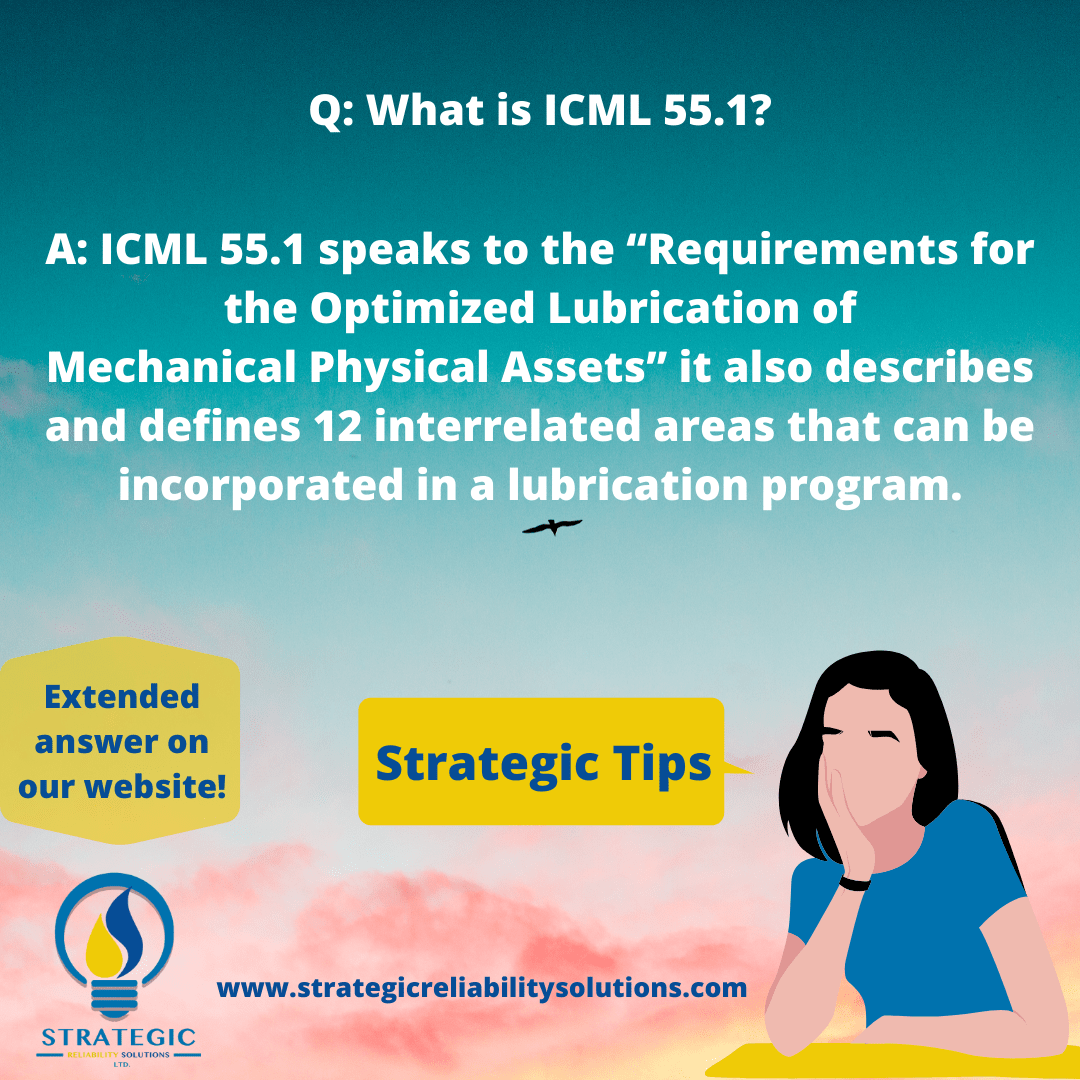
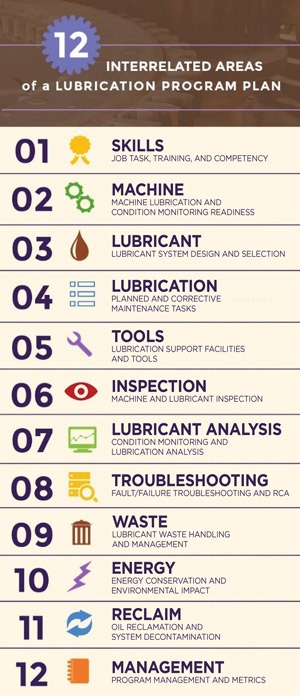
ICML 55.1 speaks to the “Requirements for the Optimized Lubrication of Mechanical Physical Assets” it also describes and defines 12 interrelated areas that can be incorporated in a lubrication program. This has never been officially documented before, nor has any standard been published as a guideline for lubrication programs.

The 12 areas are outlined below:

  1. SKILLS: Job Task, Training, and Competency
  2. MACHINE: Machine Lubrication and Condition Monitoring Readiness
  3. LUBRICANT: Lubricant System Design and Selection
  4. LUBRICATION: Planned and Corrective Maintenance Tasks
  5. TOOLS: Lubrication Support Facilities and Tools
  6. INSPECTION: Machine and Lubricant Inspection
  7. LUBRICANT ANALYSIS: Condition Monitoring and Lubrication Analysis
  8. TROUBLESHOOT: Fault/Failure Troubleshooting and RCA
  9. WASTE: Lubricant Waste Handling and Management
  10. ENERGY: Energy Conservation and Environmental Impact
  11. RECLAIM: Oil Reclamation and System Decontamination
  12. MANAGEMENT: Program Management and Metrics

As per ICML's website, here's a list of people that the new standard can benefit:

Photo Credit: https://info.lubecouncil.org/icml-55-standards/


Check out the ICML 55 standards today and apply it to your organization!

Written by Sanya Mathura, CEO & Founder of Strategic Reliability Solutions Ltd. 

What’s the Difference between Shelf Life vs Service Life?

What the difference between Shelf Life and Service Life?

There’s a major difference between Shelf life and Service life especially when it concerns lubricants!

No one wants to put expired lubricants into their equipment! This can cause unexpected failures which can lead to unplanned downtime which can continue to spiral down the costly path of unproductivity!

shelf_life_service_life

Shelf Life

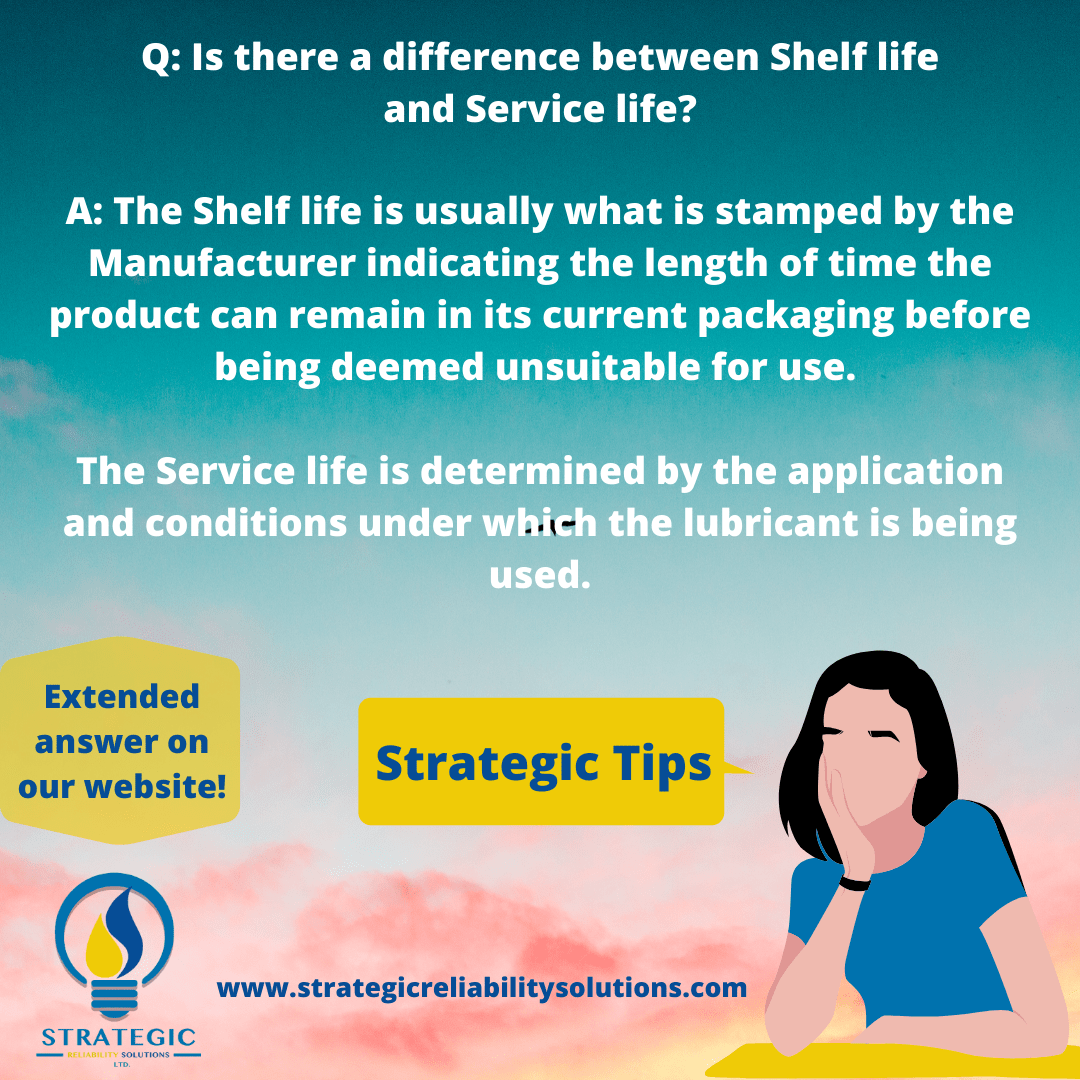
The Shelf life is usually what is stamped by the Manufacturer indicating the length of time the product can remain in its current packaging before being deemed unsuitable for use. These can typically be found on the packaging.

Service Life

The Service life however is determined by the application and conditions under which the lubricant is being used. Usually, estimated running hours / mileage are given by the equipment manufacturer in the maintenance section of the manual. (Condition monitoring can also be used to determine appropriate service intervals.)

However, how will someone know if the product has deteriorated while still in its original packaging?  What should someone typically look for?

Above are some tips for identification of deterioration in lubricants. Take a note of these for the next time you are unsure of the integrity of your lubricants.

Written by Sanya Mathura, CEO & Founder of Strategic Reliability Solutions Ltd. 

Conditions that affect lubricants

What conditions affect lubricants?

How are your lubricants currently stored?

Are you storing lubricants under the correct conditions?

These questions have come up a dozen times during audits and countless warehouse meetings!

conditions
Conditions that affect lubricants

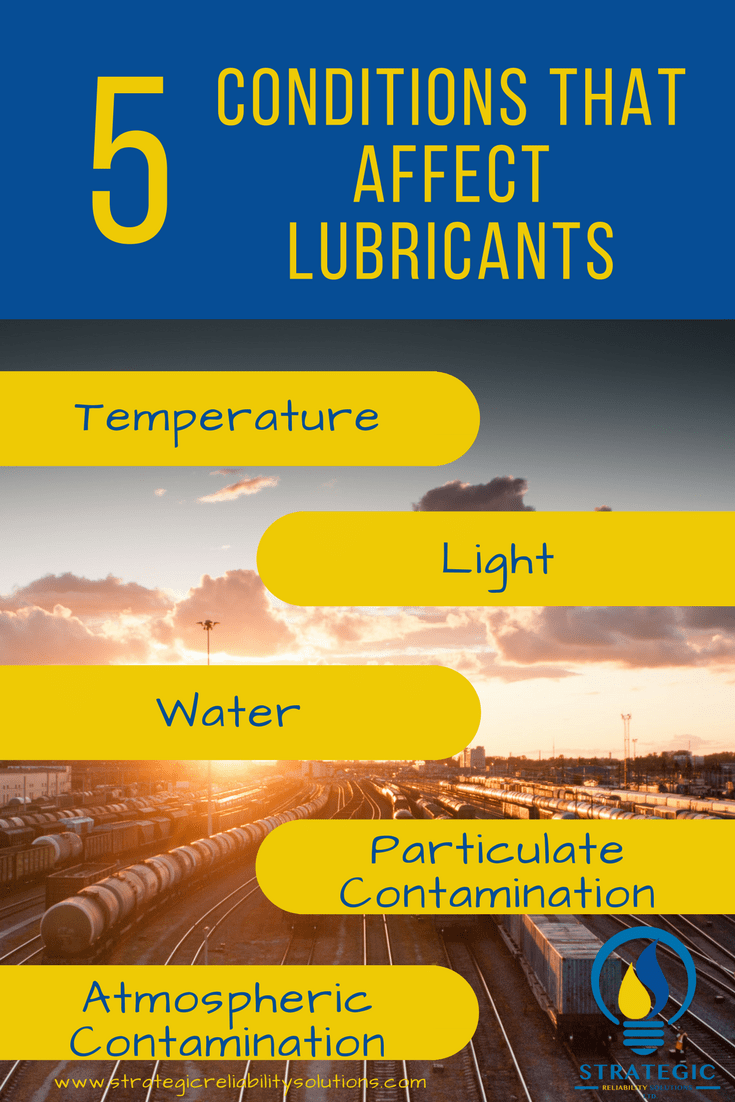
To answer these questions, there are five main conditions that can affect lubricants. We have detailed them along with the effects of these conditions on the lubricant.

  • Temperature – if incorrect can lead to oxidation. For every 10C rise in temperature above 40C the life of the lubricant is halved.
  • Light – too much can lead to oxidation especially for light sensitive lubricants such as transformer oils. Hence the reason that most packaging is opaque.
  • Water – this usually works with additives to cause their depletion or contamination of the product. Water in any lubricant is bad (especially for transformer oils as they are involved in the conduction of electricity.
  • Particulate contamination – contamination can occur by air borne particles if packaging is left open or if dirty containers/vessels are used to transfer the lubricant from its packaging to the component.
  • Atmospheric contamination – this affects viscosity and promotes oxidation and can occur if packaging is left open. For instance, if a drum is not properly resealed or capped after usage or the most common practice of leaving the drum open with the drum pump on the inside.

Different types of lubricant degradation

Why is it important to know the types of lubricant degradation?

It’s important since it helps us to figure out why or in some instance how, the lubricant degraded! Usually degradation is the change that occurs when the lubricant can no longer execute its five main functions:

  • the reduction of friction
  • minimization of wear
  • distribution of heat
  • removal of contaminants and
  • improvement of efficiency.


lubricant_fails
Types of lubricant Degradation Mechanisms

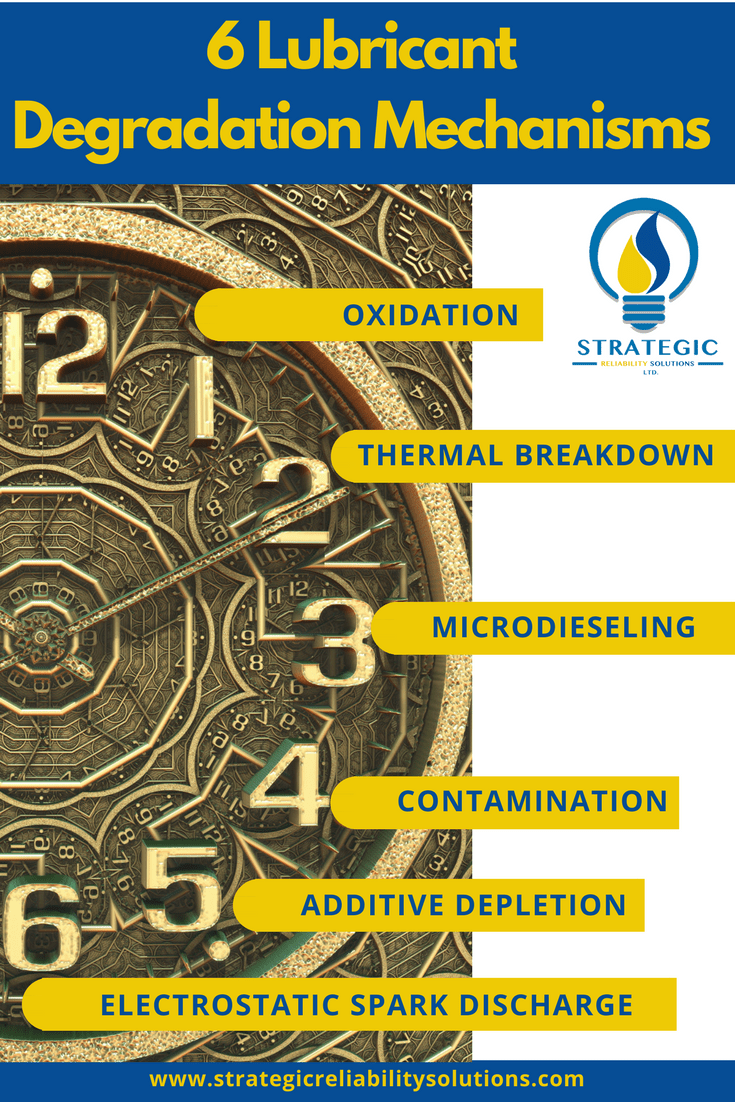
There are 6 main types of Lubricant Degradation as detailed below. Each type produces various by products which can enable us to understand the reason for the degradation and eliminate that / those reasons.

Here are the 6 main types of Lubricant Degradation:

1. Oxidation
2. Thermal Breakdown
3. Microdieseling
4. Additive Depletion
5. Electrostatic Spark Discharge
6. Contamination

As discussed, each mechanism produces distinct results which help us in their identification! Check out our article on why lubricants fail for more info!

Written by Sanya Mathura, CEO & Founder of Strategic Reliability Solutions Ltd. 

Colour Coding

What is the importance of Colour Coding?

Quite often when we are correcting or helping companies set up their lubrication storage areas, we get asked a lot of questions regarding colour coding.

Colour_coding

Ideally, the concept of colour coding is to allow field personnel to easily identify and associate particular lubricants with their applications.

However, like most things in reliability, this can be customized to suit your organization. There are no hard and fast rules of using only yellow to represent hydraulic oils.

What if we had someone that was colour blind?

Usually, when we start colour coding lubricant storage containers, we include symbols and actual names of the lubricant. This helps to assist personnel in having a 3 point verification system.

First they can verify the colour, then the symbol and of course the name of the lubricant.

Names are crucial! Especially for varying viscosities (such as gear or hydraulic oils). For instance all gear oil would have the same colour and symbol but you wouldn’t want to put an ISO 100 gear oil in a gearbox suited for ISO 680.

Written by Sanya Mathura, CEO & Founder of Strategic Reliability Solutions Ltd. 

Lubrication Audit?

Audits usually get people nervous! They are worried about what the auditor may or may not find. When we perform lubrication audits, we’re trying to ensure that your equipment is using exactly what it should to perform efficiently.

Why is that necessary? We’ve found that in most organizations, there may have been a time when the OEM recommended lubricant was not readily available and a substitute was used instead. Once the substitute has been used, it magically becomes the recommended lubricant for the rest of the life of the component.

However, if proper checks were not done initially, then the component could be using the wrong lubricant for most of its life. This can contribute to downtime and replacement of parts before their actual useful life has been reached.

Once, we found a gearbox using an ISO 680 gear oil when it should have used an ISO 320 oil. This gearbox used the wrong oil for 30 years! It greatly impacted the efficiency of the gearbox and they experienced numerous breakdowns throughout its life but they never understood or dared to look at the lubricant.

Always ensure that you have the OEM recommended lubricants for your components!

Written by Sanya Mathura, CEO & Founder of Strategic Reliability Solutions Ltd.