By Sanya Mathura (Strategic Reliability Solutions Ltd) & Neil Conway (Spectrolytic)
In our last article we focused on the question of whether oil analysis was still relevant today? While this is an age-old process, the benefits of oil analysis still continue to live on today although the methods involved have significantly evolved since its inception. In this article, we will do a deeper dive into the traditional methods of oil analysis versus some of the new cutting-edge technologies which exist today and whether we may see a replacement of one method over the other or a union moving forward.
If you’ve ever performed an oil analysis you know that this process follows certain standards which are listed in the report. These standards govern the world of oil analysis and form the basis of how these tests are executed. There are committees dedicated to revising these standards to ensure that they are still relevant to the applications of today, one such committee falls under the ASTM body (American Society for testing and Materials).
Equipment has changed over time where oil sumps have become smaller but now produce more power. Oils are under more stress as they are expected to perform at higher temperatures under elevated environmental conditions and still protect the equipment. Global oil manufacturers work together with OEMs (Original Equipment Manufacturers) to ensure that the oils developed can work with their components in these increasingly harsher conditions. But what constitutes an oil “working properly”?
This is where oil analysis / sample testing plays a crucial role. Oil analysis tests have been standardized through authorized committees to ensure that the same test can be performed in different parts of the globe using the same procedures. This ensures that there can be a fair comparison of the results of these tests across the globe. These tests should also be repeatable (or get the same results every time they are performed).
Typically, these tests are usually carried out in a laboratory environment, using state of the art equipment to achieve / maintain the required standards. However, sample taking, sample shipping and other human factors often result in misleading and / or extremely delayed reporting of the results. This is where emergent technology can alleviate some of these challenges.
With the many advancements in Artificial Intelligence, Machine Learning and the advent of countless different sensors on the market, the question arises, “Is Oil Analysis still relevant today?”. Granted that these advancements have significantly transformed the industry, we need to recognize that they are here to help evolve what we already do and not necessary replace it.
These advancements build upon the foundations of the techniques of oil analysis. With artificial intelligence and machine learning, we can train models to interpret oil analysis data and trigger alerts accordingly but there should always be a human present to overview these. In the real world, not every situation has occurred or been recorded yet hence the models do not have that particular data to learn from nor can they make decisions about it since it simply doesn’t exist in their “brain”.
Humans can “think outside the box” and formulate patterns or trends which may not be triggered by the models simply because these models have not been taught these patterns. Hence it is important to always have a human in the loop and not rely solely on these models especially when million-dollar decisions can be negatively initiated with the wrong interpretations.
Lately, sensors have gained more traction and a wider adoption as they can be integrated into warning systems to alert users to potential deviation from known characteristics of the oil. However, as noted above, sensors rely on data sets to compare the information and on some form of capacitance which must be converted into a signal before it can be interpreted.
With lab equipment performing the actual tests, there is a higher rate of accuracy plus the added advantage of having humans review the results for discrepancies before sending off the report. While sensors can be the first warning system for some users, lab equipment should be utilized for those more precise tests which require a higher level of accuracy.
In essence, oil analysis remains very relevant today. However, it has significantly evolved over the last few decades. Today, oil analysis can achieve a higher efficiency level with the integration of the advancements in technology (AI, machine learning and sensors) and other available monitoring technologies. Together, these should all be used to create a greater impact on improving the reliability of the machines.
Just as oil analysis is similar to blood testing, we can think of our bodies as a critical machine with various components which need to be monitored. If we get a fractured bone, a blood test will not help us to assess if the bone is broken or can be repaired. In this case, we may need an x-ray. Similarly, with machines, there are various types of tests to determine different aspects to be monitored.
Typically, oil analysis can provide the operator with insight into whether there has been any internal damage to the equipment in the form of wear particles which can be quantified. As with most condition monitoring methods, being able to trend the patterns over time helps the operators to identify if wear is occurring at an increased rate or whether the oil is degrading.
On the other hand, other technologies such as vibration analysis or ultrasound analysis or even thermography are not able to detect the presence of molecules. These other types of analyses focus on alignment, or other mechanical issues as they occur and can trend them over time. However, oil analysis can accurately detect the presence or absence of contaminants or additive packages which could affect the health of the oil and by extension that of the machine.
Oil analysis should not be used as the only technology in your condition monitoring artillery. Other technologies can be used alongside oil analysis to provide the user with a more comprehensive overview of the health of the asset. For instance, if the oil analysis discovered high wear, the next step would be to identify where the wear was coming from. Perhaps in this case, one of the other technologies could identify a misalignment or other mechanical issue which could be the source of this wear. Thus, these technologies should be used to work together to achieve better reliability for their asset owners.
The P-F curve is one that is used throughout reliability to demonstrate the point at which a component is expected to have a functional failure. There are many variations of the PF curve, and different monitoring technologies can be placed in specific orders accordingly. However, it remains dominant that oil analysis is among the top three techniques used for early detection of failure.
Oil analysis can be used to detect the presence of contaminants, metals and other molecules at a microscopic level and quantify these appropriately. Most OEMs (Original Equipment Manufacturers) publish their acceptable standards for various tests (usually standardized tests by some accredited body such as ASTM) and have these available to laboratories around the world. When an oil analysis test is performed (as per the stipulated standards), the lab will compare the actual values to the expected values (from the OEM) and then provide some guidance to the user on possible steps forward.
Every lab will have a specific format for reporting the results of your oil analysis (similar to the labs for reporting on blood samples). Typically, the actual value is shown and then there may be an expected range for the various characteristics or just an indication of whether the actual value falls outside of the range (on the higher or lower end of the scale).
Bureau Veritas, 2017, gives an example of a report and all of the variables involved here:
While this is their reporting standard, other labs will have a different format, but the tests will all conform to the same internationally recognized standard. As such, if oil is tested in the United States (as per a particular standard) and then tested in Italy (as per the same standard) then there can be some comparisons of these results. However, one must also be aware of the types of instruments being used and their calibration as this can account for slight differences in test results. As such, oil analysis provides a global standard for which equipment performance can be compared across regions.
For those not familiar with oil analysis, it can be likened to performing blood tests for the human body. Oil in our machines is often compared to the blood in our bodies. Blood circulates throughout the body taking important blood cells with food and oxygen in it to the various organs, similarly oils follow this behaviour. However, oils transport additives which provide varying functions including reducing wear or friction or even preventing corrosion or oxidation to name a few.
When performing a blood test, we can test for a few things; the overall condition of the organs or we can test for specific things such as the presence of bad cholesterol. With oils, we do a very similar practice where we can test for the overall health of the machine or pinpoint exact components and look for distinct changes which are reflected in the characteristics of the oil.
Basically, oil analysis can help you to determine the condition of your oil (if it is degrading or if the additives have depleted such that it no longer protects the equipment) and the health of your asset as the oil can reflect if there is wear occurring in the components. As such, it can provide very useful information to help operators and maintenance personnel to plan effectively for any type of maintenance to be done on the components.
Each lubricant has a varying percentage of additives as not all lubricants are created equally. Lubricants are designed based on their application or use within the industry. For instance, an engine oil is typically composed of 30% additives, 70% base oil while turbine oils comprise 1% additives and 99% base oil.
Therefore, particular attention must be paid to getting the additive compositions to be just right for the application and ensuring that the additives can perform their functions.
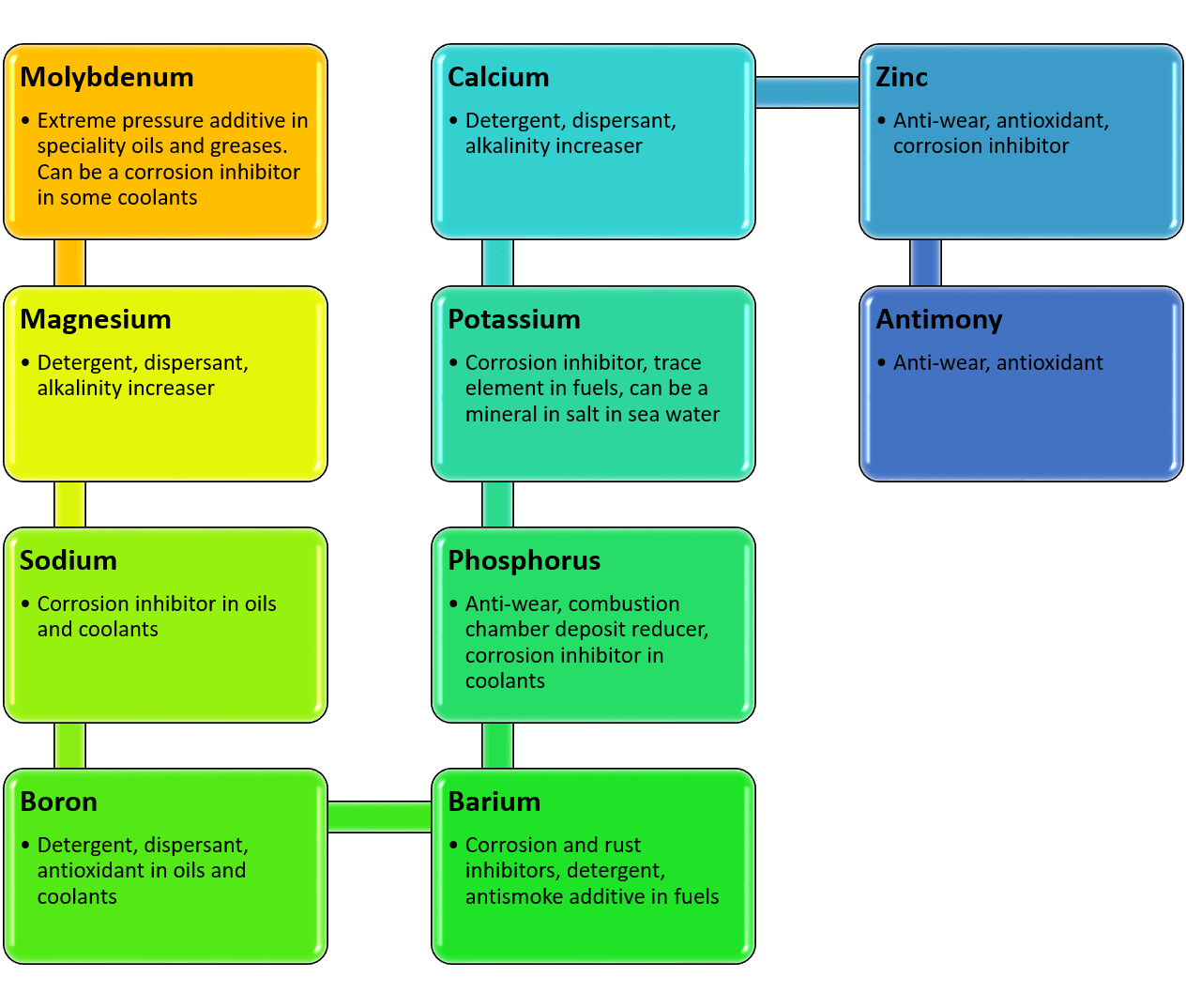
Each additive has a particular function and is used as per the application of the lubricant. We have adapted the following from Analysts Inc – Basic Oil Analysis which describes the purpose of some of the most commonly used additives in lubricants.
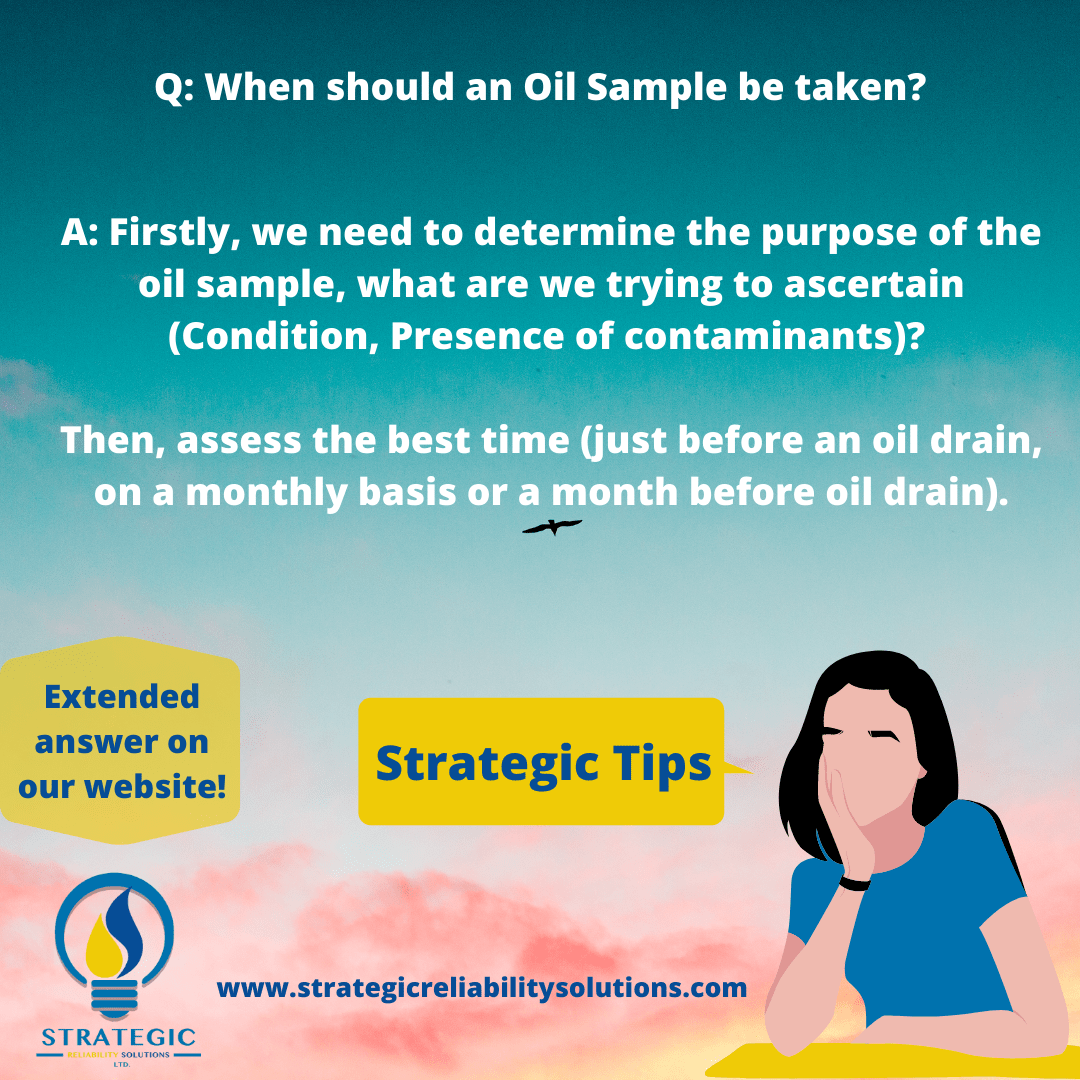
In used oil analysis, oil samples can be taken at any time, but one should always consider the insight that they are trying to gain before testing the sample. This is crucial in deciding the type of tests and the intervals at which they should be performed.
For instance, if we are testing the quality of the oil or we want to compare a fresh batch to a used one, then we can take a sample directly from the drum.
If we are trying to decide the rate at which the additives are being depleted or wear being accumulated then we can take a sample at different operating hours to trend the data. This method can work if we are trying to determine the most appropriate run time for a lubricant in particular conditions.
However, if we are trying to track the health of the components on a regular basis as part of our PM program then taking a sample at the end of the scheduled maintenance interval is desired.
Taking an oil sample from a component is like performing a blood test by the doctor. It helps us to understand what’s really happening. It can show us if there is excessive wear, contamination or lubricant degradation which allows us to identify its “health”. However, the correct tests need to be carried out to determine these conditions.
There must be a reason behind taking the oil sample, not just a random act. When trying to establish a trend regarding a particular aspect of the oil, this should guide your choice of tests otherwise we can end up paying for tests that do not add value.
Always ensure sound reasoning behind testing rather than just checking the box!
While taking an oil sample at the end of the scheduled operating hours is very convenient, is it truly efficient?
When a piece of equipment is scheduled for maintenance, it is usually taken out of service for a couple of hours to perform the assigned
maintenance tasks.
However, if an oil sample is taken a couple days in advance of the scheduled maintenance, then when the results return the maintenance team can be on the lookout for issues highlighted by the results.
For instance, if the value for iron was significant or rising then they can perform inspections for areas which may cause this type of wear and address this challenge while the equipment is offline.
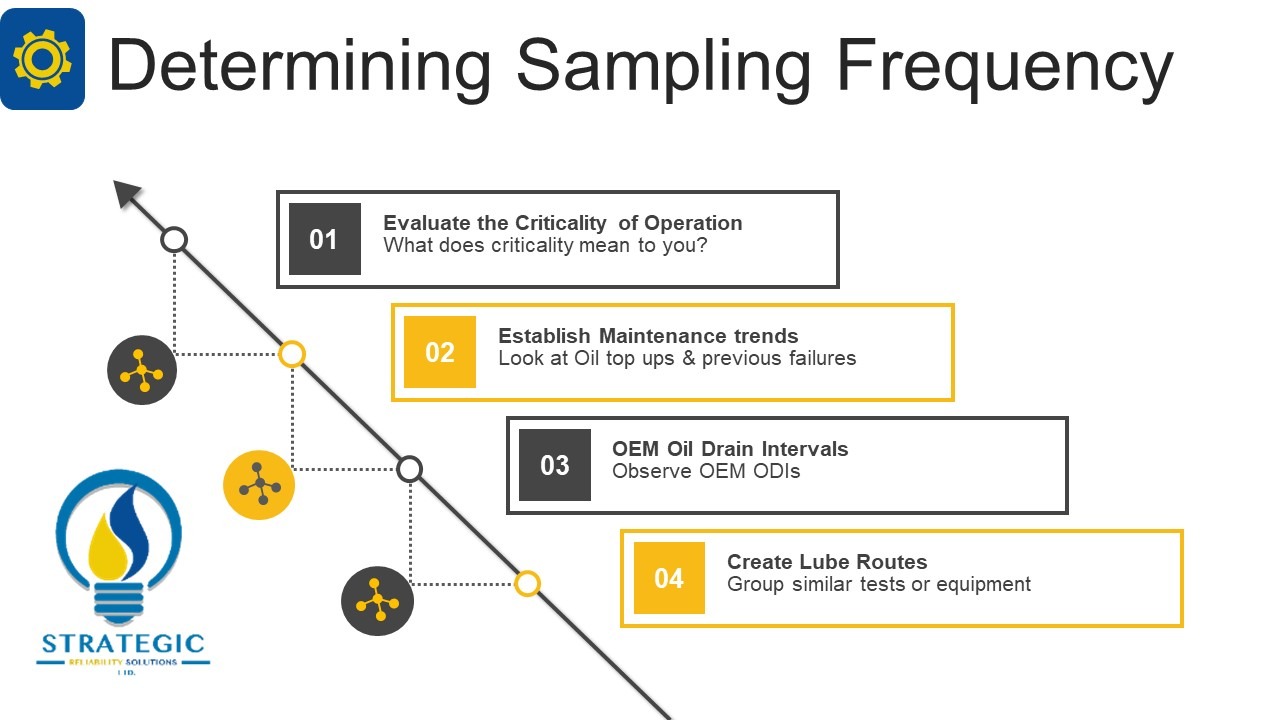
The graphic on the side can be used as a quick guide to determining when to take a sample.
Remember to always evaluate the reason behind establishing the sampling frequency before scheduling sampling.
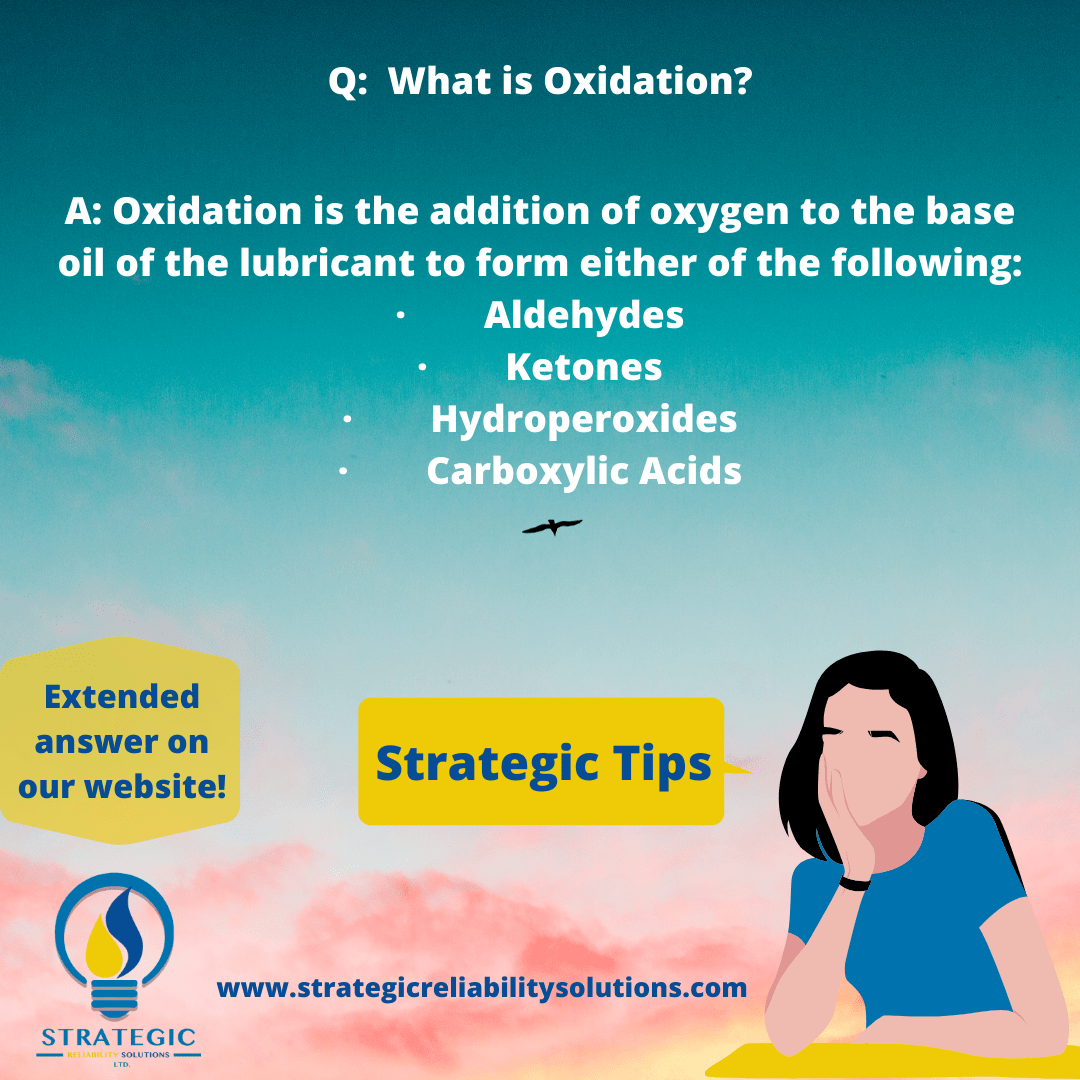
One of the major types of oil degradation is Oxidation. But what is it exactly, as applied to a lubricant?
Oxidation is the addition of oxygen to the base oil of the lubricant to form either of the following:
Aldehydes
Ketones
Hydroperoxides
Carboxylic Acids
Wow… too many chemical names right?! These help to pinpoint the conditions responsible and then we can address them accordingly. Each of these by products are produced by different types of reactions or in some cases different stages of the oxidation process. It is key to note the type of by product as it gives us a clue to the root of the issue through which oxidation occurs.
For instance, the presence of Carboxylic acids can result in the formation of Primary Amides which can lead to heavy deposits. Early detection of the Carboxylic acids can help us prevent this. Once we determine the source of oxidation to produce the carboxylic acids, we can in turn remove this from the system.
Oxidation Stages
Oxidation does not happen in an instant. Usually, it follows a series of events which eventually lead to oxidation. Like any process in life, there are different stages for Oxidation:
Initiation – Production of the free radical via the lubricant and catalyst.
Propagation – Production of more free radicals via additional reactions
Termination – Continuation of oxidation process after the antioxidants have been depleted or the antioxidant stops the oxidation process.
Results of Oxidation
Why is Oxidation bad for the lubricant? What can it ultimately result in?
Well, oxidation can result in the formation or lead up to the following:
Varnish
Loss of antifoaming properties
Additive depletion
Base oil breakdown
Increase in viscosity
Sludge
None of these are good for the lubricant!!!!!!!!! If you see any of these signs be sure to test for oxidation and identify the root cause for the introduction of oxygen in your system.
Oxidation Tests
Now that we know more about oxidation… what tests can be performed to prevent it?
There are 6 main tests that can be performed:
RPVOT (Rotating Pressure Vessel Oxidation Test)
RULER (Remaining Useful Life Evaluation Routine)
MPC (Membrane Patch Calorimetry)
FTIR (Fourier Transform Infrared)
Colour (ASTM D1500)
Acid Number (ASTM D974)
One must be careful in selecting which test to apply, this is heavily dependent on the type of lubricant and its application.
For instance, if we perform the RULER test and the antioxidant levels have depleted significantly, we can suspect that oxidation is occurring or has stopped. Charting the rate of antioxidant depletion, can determine the rate of oxidation. This can assist us to forecast the time remaining before antioxidants have been depleted and can no longer protect the base oil.
A lot of people get confused when reading the ISO 4406 rating. The rating specifies a range of the number of particles of certain sizes that can pass through 3 particular sized filters namely; 4micron, 6 micron and 14 micron filters respectively.
For instance; a rating of 13/11/8 indicates:
13 represents 40-80 particles over the size of 4um
11 represents a range of 10-20 particles over the size of 6um and
8 represents a range of 1.3-2.5 particles over the size of 14um.
These values are actually the number of particles per milliliter. It does not mean that you have 13, 11 or 18 particles only in your oil, it's much more than that!
There are different ratings for different levels of cleanliness.
If your numbers are really high (25/22/19) then there’s definitely a high level of contamination! (the full chart goes up to 28 and all the way down to 0).
Different components have different ISO cleanliness ratings. For instance, a roller bearing has a higher cleanliness target than a Variable Vane pump.
Understanding the ISO 4406 codes are crucial for determining the steps needed in “cleaning up” your system lubricants.
However, when we test for the cleanliness of an oil, there are a couple things that we need to consider:
When testing, we have exposed the oil to the elements (highly dependent on the method of sampling)
Results are not instantaneous (even with an onsite lab, there will be a timeframe between collecting the sample and processing it)
Since there are lag times involved, the value that is reported for the ISO4406 rating is never really truly representative of the oil. As such, when analysing the results of this test, it is important to consider that the actual value may potentially be higher than reported.
Quite often, when lubrication failures occur, the first recommended action is to change the lubricant. However, when the lubricant is changed, the real root cause of the lubricant failure has not been solved. As such, the cause of lubrication failure will continue to be present and may escalate further to develop other problems.
Essentially, this can cause catastrophic future failures simply because the root cause was not identified, addressed and eradicated. Moreover, the seemingly “quick fix” of changing the lubricant, is usually seen as the most “cost effective” option. On the contrary, this usually becomes the most expensive option as the lubricant is changed out whenever the issue arises which results in a larger stock of lubricant, loss in man hours and eventually, a larger failure which can cost the company at least a month or two of lost production.
In this article, we investigate lubricant failures in Ammonia plants and their possible causes. Some Ammonia plants have a developed a reputation for having their product come into contact with the lubricant and then having lubrication failures occur. As such, most Ammonia plant personnel accept that the process materials can come into contact with the lubricant and usually change out their lubricants when such issues occur. However, there are instances, where the ammonia is not the issue and plant personnel needed to perform a proper root cause analysis to determine the root cause and eradicate it. Here are a couple of examples of such instances.
Livingstone (1) defies the Lubrication Engineers Handbook in their description of ammonia as an inert and hydrocarbon gas that has no chemical effect on the oil, stating that this is incorrect. Instead, Livingstone (1) lists the number of ways that Ammonia can react with a lubricant under particular reactions such as;
ammonia being a base that can act as a nucleophile which can interact with any acidic components of the oil (such as rust/corrosion inhibitors)
reaction of ammonia with carboxylic acids (oil degradation products) to produce amides which cause reliability issues
transesterification of any ester containing compound to create alcohol and acids and the reaction of ammonia with oxygen to form NOx which is a free radical initiator that accelerates fluid degradation.
As such, one can firmly establish that ammonia influences the lubricant and can lead to lubrication failures should that be the cause of the lubricant failure.
The Use of Root Cause Analysis
Van Rensselar (2) quotes Zhou as saying the best method for the resolving varnish is to perform a root cause analysis. Wooton and Livingstone (3) also advocate for the use of root cause analysis to solve the issue of varnish. They go on to explain that the characterization of the deposit aids in determining the root cause of the lubricant degradation. As such, Wooton and Livingstone (3) have developed a chart to assist in deposit characterization as shown below.
Deposit Characterization graphic from Wooton and Livingstone (3)
Wooton and Livingstone (3) discussed that with the above figure, once the deposit can be characterized then the type of lubricant degradation can be more accurately identified. As such, the root cause for the lubricant degradation can now be firmly established thereby allowing solutions to be engineering to control and reduce / eliminate lubricant degradation in the future.
Case Studies
A case study from Wooton and Livingstone (3) was done with an Ammonia Compressor in Romania which experienced severe lubricant degradation. In this case study, they found that when the in-service lubricant was subjected to two standard tests namely MPC and RULER, both tests produced results within acceptable ranges. As such, there was no indication from these tests that the lubricant had undergone such drastic degradation as evidenced by substantial deposits within the compressor. Thus, it was determined that the deposits should be analysed as part of the root cause analysis.
For the deposits from the Ammonia compressor, Wooton and Livingstone (3) performed FTIR spectroscopy to discover that its composition consisted of mainly primary amides, carboxylic acids and ammonium salts. It was concluded that the carboxylic acids formed from the oxidation of fluid while in the presence of water.
In turn, the carboxylic acids reacted with the ammonia to produce the primary amides. These amides consisted of ammonium salts and phosphate. As such, the onset of carboxylic acids within the system eventually leads to the lubricant degradation. Thus, an FTIR analysisfor carboxylic acids was now introduced to this Ammonia plant as well as MPC testing to monitor the in-service lubricant.
Additionally, chemical filtration technology was implemented to remove carboxylic acids within the lubricant. These two measures allowed for the plant to be adequately prepared for lubricant degradation and avoid failures of this type in the future.
Another case study was done in Qatar with an ammonia refrigeration compressor which was experiencing heavy deposits due to lubrication degradation. For this Ammonia plant, high bearing temperatures and deposits were found on the bearing.
Upon investigation, it was realized that the lubricant had been contaminated externally and there was restricted oil flow to the bearings. After a FTIR was performed it was deduced that that the deposits were organic in nature and there were several foreign elements including high levels of carbon and primary amides.
From further root cause analysis, it was determined that the high temperatures observed were due to the lubricant starvation. Due to these high temperatures, oxidation initiated and with the high levels of contamination (mainly from ammonia within the process) this lead to degradation of the lubricant in the form of heavy deposits.
The bearing oil flow was increased and reduction in external contaminants were implemented. Oil analysis tests of Viscosity, Acid Number, Membrane Patch Calorimetry and Rotating Pressure Vessel Oxidation tests were also regularized in the preventive maintenance program. Thus, for this failure, some operational changes had to be made in addition to increased frequencies of testing. With these measures in place, there would be a reduced likelihood of future failures.
From the case studies mentioned, it can be concluded that ammonia systems have a higher possibility of undergoing lubricant degradation due to the contamination of the lubricant by ammonia gas / liquid due to its properties. However, it must also be noted that the ingression of ammonia into the lubrication system is not the only cause for lubrication failure.
Therefore, it is imperative that a proper root cause analysis be carried out to determine the varying causes for lubrication failure before the ingression of ammonia accepts full responsibility for any such failure.
References:
Livingstone, Greg (Chief Innovation Officer, Fluitech International, United States America). 2016. E-mail message to author, March, 08.
Van Rensselar, Jeanna. 2016. “The unvarnished truth about varnish”. Tribology & Lubrication Technology, November 11.
Wooton, Dave and Greg Livingstone. 2013. “Lubricant Deposit Characterization.” Paper presented at OilDoc Conference and Exhibition Lubricants Maintenance Tribology, OilDoc Academy, Brannenburg, Rosenheim, Germany, United Kingdom, January 22-24, 2013.