Tagged: strategic tips

What are some common misconceptions about Viscosity and Engine Oil Grades?

Common Misconceptions about Viscosity and Engine Oil Grades

Many people believe that “thicker” oil is better for their vehicle. This is the furthest thing from the truth! Over the years, engine sizes have been reduced dramatically. With this size reduction, we can infer that the clearances within the engines have also decreased. Hence, a “thicker” oil from 50 years ago will not suffice in a modern-day engine.

Think of trying to drink molasses with a thick (or wide) straw. This may be possible (although challenging), but if we swapped the thick straw for a thinner, narrower straw, the person would have to use significantly more force to pull up the molasses. A similar phenomenon occurs with engine oils.

In modern engines, the oil lines are narrower, so trying to force a heavier-weighted oil (such as straight 50) would put more pressure on the engine. This is where we begin to see leaks in the engine, particularly at the bottom of the sump near the seals, where the most pressure is exerted during start-up to pump the thicker oil to the top of the engine. However, if we used the correct viscosity of the oil, the engine would not be subjected to this amount of additional pressure. So “thicker” is not always better.

Another common misconception is that the number in front of the “w” in a multigrade oil represents the thickness of the oil, and if it’s zero, then it must be very thin! The number in front of the “w” for multigrade oils represents the viscosity of the oil at start-up conditions (typically 0°F or -17.8°C for Winter).

Hence, the lower the number, the faster the oil will flow at startup. As such, a 0w20 will get from the bottom of the sump to the top of the engine faster than a 20w50. In this case, the 0w20 will provide more protection during startup compared to the 20w50, as most wear occurs during this period.

On the other hand, the number behind the “w” indicates the viscosity at operating temperature. This is where a higher number may not always be agreeable, depending on the year of manufacture of your engine or the ambient conditions. When deciding which oil to use, both numbers (in front of the ‘w’ and behind the ‘w’) are important.


Find out more in the full article, "Engine oil types and how to choose the right one" featured in Precision Lubrication Magazine by Sanya Mathura, CEO & Founder of Strategic Reliability Solutions Ltd. 

What is API & ILSAC Certification?

API Certification

The American Petroleum Institute has a dedicated Engine Oil Licensing and Certification System (EOLCS), a voluntary license and certification program that authorizes engine oil marketers who meet the specified requirements to use their quality marks.

It is a cooperative effort amongst additive industries and vehicle and engine manufacturers such as Ford, General Motors, and Fiat Chrysler, which are represented by the Japan Automobile Manufacturers Association and the Truck and Engine Manufacturers Association. The performance requirements and test methods are established by vehicle and engine manufacturers, as well as technical societies and trade associations, including the ASTM, SAE, and the American Chemistry Council (ACC).

Figure 2: API’s Shield vs Starburst

While the API initially included designations for both gasoline and diesel specifications, it later established these as two separate classes. Gasoline engines designed for cars, vans, and light trucks were allocated to the “S” or Service category. On the other hand, diesel engines designed for heavy-duty trucks and vehicles fall under the “C” or Commercial category.

These standards have been in place since 1947 and regulate both gasoline and diesel engine oils. One of the major changes since 2020 is the introduction of 0w16 oils, which now have their certification mark, the “shield” instead of the traditional “starburst”.

What’s the main difference between ILSAC GF-6A & 6B?

Both are designed to provide protection against low-speed pre-ignition (LSPI), timing chain wear protection, improved high-temperature deposit protection for pistons and turbochargers, more stringent control of sludge and varnish, enhanced fuel economy, and protection of the emission control system for engines operating on ethanol-containing fuels up to E85. However, ILSAC GF-6B applies only to 0W-16 oils.

The current gasoline engine oil standard is API SP. This standard was introduced in May 2020 and is designed to protect against low-speed pre-ignition (LSPI), provide timing chain wear protection, enhance high-temperature deposit protection for pistons and turbochargers, and implement more stringent control of sludge and varnish.

API SP with Resource Conserving matches ILSAC GF-6A by combining API SP performance with improved fuel economy and enhanced emission control system protection for engines operating on ethanol-containing fuels up to E85.

Figure 3: API SP Service Donut

On the diesel side of things, there has been a slight break from tradition, as two new categories, CK-4 and FA-4, have been introduced. The main difference with these is the type of fuel used, specifically in terms of its sulphur concentration. CK-4 is ideally used for vehicles using diesel fuel with 500 ppm (0.05% weight) sulphur, while FA-4 is used for vehicles using diesel fuel with less than 15 ppm (0.0015% weight) sulphur, and they must be Xw30 oils.

Figure 4: API CK-4 Service Donut

CK-4 oils are used in high-speed four-stroke cycle diesel engines designed to meet 2017 model year on-highway and Tier 4 non-road exhaust emission standards, as well as previous models of diesel engines. They are formulated for use with diesel oils containing up to 500 ppm sulphur. However, if they are used alongside fuels containing more than 15 ppm sulphur, this can affect the exhaust after-treatment system durability or oil service drain interval.

They effectively sustain the durability of emission control systems, particularly when particulate filters and other advanced after-treatment systems are employed.

API CK-4 oils are designed to provide enhanced protection against oil oxidation, viscosity loss due to shear, and oil aeration, as well as protection against catalyst poisoning, particulate filter blocking, engine wear, piston deposits, degradation of low- and high-temperature properties, and soot-related viscosity increase.

FA-4 oils are specifically for certain Xw30 oils formulated for use in high-speed four-stroke cycle diesel engines designed to meet 2017 model year on-highway greenhouse gas emission standards. They are formulated for use in on-highway applications with diesel fuel sulphur content up to 15 ppm. These oils are blended to a high-temperature, high-shear (HTHS) viscosity range of 2.9cP – 3.2cP to assist in reducing greenhouse gas (GHG) emissions.

They are effective in sustaining the durability of emission control systems, particularly when particulate filters and other advanced after-treatment systems are employed.

API FA-4 oils are designed to provide enhanced protection against oil oxidation, viscosity loss due to shear, and oil aeration in addition to protection against catalyst poisoning, particulate filter blocking, engine wear, piston deposits, degradation of low and high-temperature properties, and soot-related viscosity increase. It is essential to note that FA-4 oils are not interchangeable or backward compatible with API CK-4, CJ-4, CI-4, CI-4 PLUS, and CH-4 oils.

An exhaustive list can be found here.

Figure 5: API FA-4 Service Donut

Find out more in the full article, "Engine oil types and how to choose the right one" featured in Precision Lubrication Magazine by Sanya Mathura, CEO & Founder of Strategic Reliability Solutions Ltd. 

What is Viscosity and how does that affect Engine Oil Grades?

Engine oil is a lubricating fluid designed to reduce friction and wear between moving parts inside an internal combustion engine, while also cooling, cleaning, and protecting components from corrosion and deposits.

While we may think that there are numerous car manufacturers globally, as of 2025, there are only slightly over 100 original equipment manufacturers (OEMs), but over 5,000 models. Whether it’s a luxury vehicle or a basic, functional one, they all require one thing to keep them running: lubricants (in the EV market, this can mean greases as opposed to traditional oils).

Parallel to the various models of vehicles, there are also numerous types of lubricants on the market, each designed specifically for different requirements. In this article, we will share some knowledge on the areas you need to be familiar with for these types of lubricants, and of course, what impacts they have on your vehicle of choice.

Understanding Viscosity and Engine Oil Grades

Before exploring the types of oils, it is essential to understand one of the most important characteristics of oil: its viscosity. This is what governs the engine’s functionality and, to some extent, dictates its performance.

engine-oil-vis

What is Viscosity?

Oil viscosity is the internal friction within an oil that resists its flow. It measures the oil’s resistance to flow and is one of the most important factors in lubricants. Viscosity is also defined as the ratio of shear stress (pressure) to shear rate (flow rate).

The SAE Viscosity Rating System

The SAE (Society of Automotive Engineers) developed viscosity grades to classify engine oils, enabling engine manufacturers and oil marketers to make recommendations and label their products accordingly. The SAE J300 is a series of two viscosity grades: one with the W and one without the W.

Monogrades with the letter “W” are defined by maximum low-temperature cranking and pumping viscosities and a minimum kinematic viscosity at 100°C. (Typically, this represents the start-up condition of an engine.)

Monogrades without the W are based on a set of minimum and maximum kinematic viscosities at 100°C and a minimum high temperature / high shear measured at 150°C and 1 million reciprocal seconds (s-1). (Typically, this represents the operating conditions of the engine when it is in use.)

Multiple viscosity grade oils or multigrades are defined by:

  • Maximum low-temperature cranking and pumping viscosities
  • A kinematic viscosity at 100°C that falls within the prescribed range of one of the non-W grade classifications
  • A minimum high temperature / high shear viscosity at 150°C and 1 million reciprocal seconds (s-1).

These represent the extremes of startup and engine operation.

The table below gives a summary of these.

Figure 1: SAE J300 revised January 2015. Source Widman International SRL

Find out more in the full article, "Engine oil types and how to choose the right one" featured in Precision Lubrication Magazine by Sanya Mathura, CEO & Founder of Strategic Reliability Solutions Ltd. 

The Influence of Lubricant Selection on Degradation

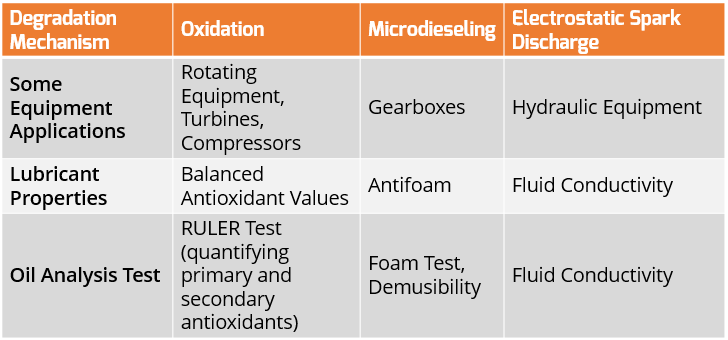
Guidelines should always be followed when selecting a lubricant for a particular application. OEMs will have specific criteria ranges for specialty applications that must be satisfied. Some general guidelines which should be considered can be summarized in the table below based on the listed mechanisms above.

Based on the three listed mechanisms above, one can identify that choosing a lubricant can impact the type of degradation which occurs during its lifetime. As such, when selecting lubricants, it is critical to note their applications and the conditions they will endure.

Having a history of lubricant failures for particular equipment can also assist in this regard by informing users of past failure trends. Therefore, when selecting a lubricant, operators can be more mindful of the properties which should not be compromised during the selection process.

The process of troubleshooting degradation in lubricants has been covered in detail in the book, “Lubrication Degradation – Getting Into the Root Causes” by Bob Latino and myself, published by CRC Press, Taylor and Francis.


Find out more in the full article, "How lubricant selection impacts degradation and machine failure" featured in Precision Lubrication Magazine by Sanya Mathura, CEO & Founder of Strategic Reliability Solutions Ltd. 

What are Food Grade Lubricants?

Food_grade

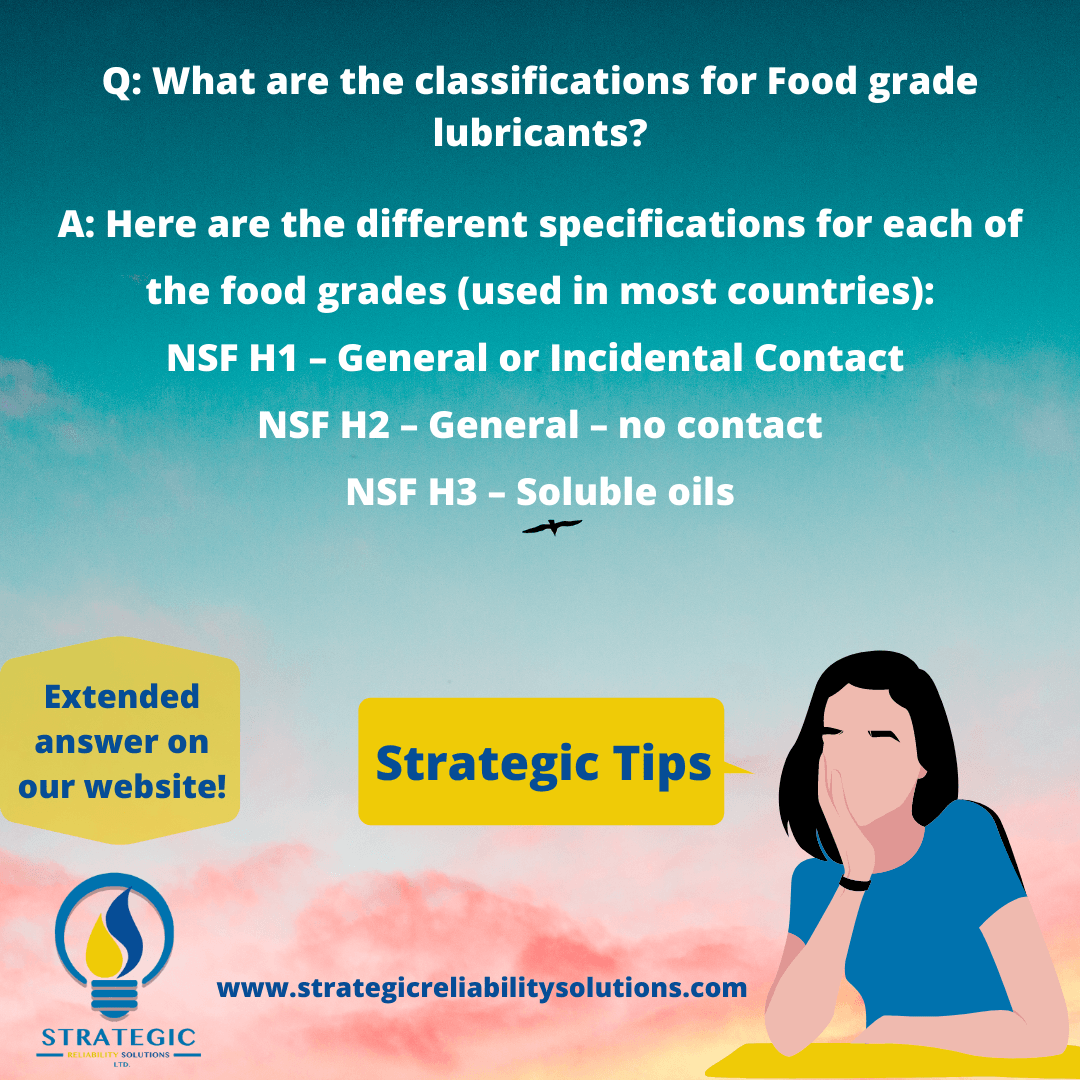
Q: What are the classifications for Food grade lubricants?

If you’ve ever dealt with food grade lubricants in the past, you would have noticed that not all food grade lubricants are made to the same standard. When we think about it from a manufacturing standpoint, we can understand the need for varying specifications.

For instance, in a facility there are components that will come into contact directly with the food while there are others that will never make contact with the product being produced for consumption. As with all specifications, the prices of the lubricants created for regular non-food grade usage will differ from those that are specifically designed for food grade usage.

NSF Standards

NSF International is the body responsible for protecting and improving global human health. They also facilitate the development of public health standards and provide certifications that help protect food, water, consumer products and the environment.

Here are the different specifications for each of the food grades (used in most countries)1:

NSF H1 – General or Incidental Contact

NSF H2 – General – no contact

NSF H3 – Soluble oils

NSF HX-1 – Ingredients for use in H1 lubricants (incidental contact) [usually additives]

NSF HX-2 – Ingredients for use in H2 lubricants (no contact) [usually additives]

NSF HX-3 – Ingredients for use in H3 lubricants (soluble contact) [usually additives]


Usually using a NSF certified lubricant goes hand in hand with an HACCP based food safety program (Hazard Analysis and Critical Control Points).


Here's a bit more info on the Categories and where they should be used3:

  • H1 - food grade lubricants used in food processing environments where there is a possibility of incidental contact.
  • H2 - non-food grade lubricants used on equipment and machine parts where there is no possibility of contact
  • H3 - food grade lubricants which are edible oils used to prevent rust on hooks trolleys and similar equipment.


ISO standards

There are ISO standards that govern food safety. These are;

ISO 22000 – developed to certify food safety systems of companies in the food chain that process or manufacture animal products, products with long shelf life and other food ingredients such as additives, vitamins and biocultures2.

ISO 21469 – specifies the hygiene requirements for the formulation, manufacture and use of lubricants that may come into contact with products during manufacturing2.


 References:

  1. Quick Reference Guide to Categories, NSF USDA. https://info.nsf.org/USDA/categories.html#H1
  2. International Regulations for Food Grade Lubricants. Richard Beercheck. Lubes N Greases Europe- Middle East-Africa. June 2014. https://d2evkimvhatqav.cloudfront.net/documents/nfc_int_regulations_food_grade_lubricants.pdf?mtime=20200420102000&focal=none
  3. Chemistry and the Technology of Lubricants Third Edition by Roy M. Mortier, Malcom F. Fox, Stefan T. Orszuilk (Editors), Chapter 8 Industrial Lubricants, C. Kajdas et al. Springer Dordrecht Heidelberg London New York. DOI 10.1023/b105569

Written by Sanya Mathura, CEO & Founder of Strategic Reliability Solutions Ltd. 

FZG Ratings

FZG

Q: What does FZG mean and why do gear oils have a rating?

FZG stands for “Forschungsstelle für Zahnräder und Getriebebau”, Technische Universität München (Gear Research Centre, Technical University, Munich), Boltzmannstraße 15, D-85748 Garching, Germany.

There are several FZG tests and these vary to establish different things. We will explore the two most common tests and what they mean.

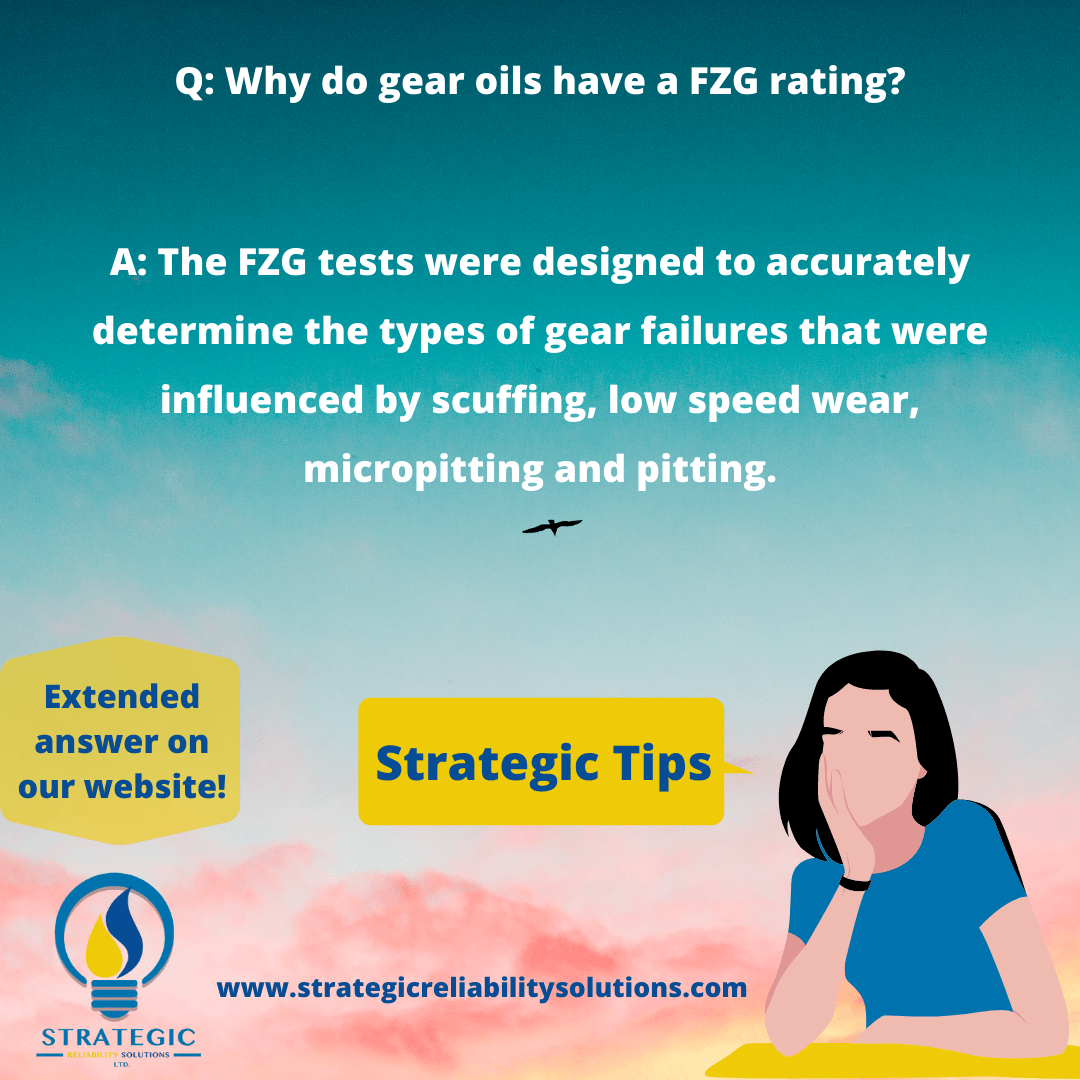
The FZG tests were designed to accurately determine the types of gear failures that were influenced by scuffing, low speed wear, micropitting and pitting1. While there are load other tests for gear oils (such as Timken OK test) these do not accurately identify the actual failure stages that gears experience.

FZG A/8.3/90

One of the most commonly used FZG test is the FZG A/8.3/90 according to DIN ISO 14635-1. This is mainly used for evaluating the scuffing properties of industrial gear oils2. What do the numbers in the test mean?

The “A” represents an A-type gear with Pinion face width = 20mm, center distance = 91.5mm, number of teeth (pinion) = 16, number of teeth (gear) = 24. These are used in the test and are loaded stepwise in 12 load stages between Hertzian stress of pC= 150 to 1800N/mm2.

The “8.3” represents the pitch line velocity of 8.3m/s in which the gears are operated for 15 minutes at each load stage.

The “90” indicates the starting temperature of the oil (90°C) in each load stage under conditions of dip lubrication without cooling.

After each load, the gear flanks are inspected for scuffing marks. However, the fail load stage is determined when the faces of all pinion teeth show a summed total width of damaged areas which is equal or exceeds one tooth width. In the gravimetric test, the gears are dismounted and weighed to determine their weight loss.


FZG A10/16.6R/90

The FZG A10/16.6R/90 on the other hand is used for automotive gear oils (GL4). It is the standard FZG gear rig test but the speed, load, load application and sense of rotation have been slightly altered.

The “A” represents an A-type gear however, these now have a reduced pinion face width to 10mm (from 20mm above).

The “16.6R” represents the increased speed of the pitch line velocity of 16.6m/s in which the gears are operated for 15 minutes at each load stage in a reversed sense of rotation.

The “90” indicates the starting temperature of the oil (90°C) in each load stage under conditions of dip lubrication without cooling.


FZG S-A10/16.6R/90

However, the FZG S-A10/16.6R/90 is the shock level test done for the GL5 oils. In this test the gears are directly loaded in the expected load stage and a PASS or FAIL is issued.


References:

  1. ISO 14635-1:2000 Gears- FZG test procedures- Part 1: FZG test method A/8,3/90 for relative scuffing load carrying capacity of oils.
  2. Test methods for Gear lubricants. Bernd-Robert Hoehn, Peter Oster, Thomas Tobie, Klaus Michaelis. ISSN 0350-350X GOMABN 47, 2,129-152 Stručni rad/Professional paper UDK 620.22.05 : 621.892.094 : 620.1.05

Written by Sanya Mathura, CEO & Founder of Strategic Reliability Solutions Ltd. 

What are the Flender Specs?

Flender

Q: Why should I use a Flender spec oil?

A lot of users ask about the need to use a Flender approved lubricant for their equipment! For a gear oil to be Flender approved1 in one of its units, the oil must be of CLP* quality according to DIN 51517-3 and motor oils must meet and ACEA Classification E2, API CF/SF. Additionally, it must meet the minimum requirements as per their specified “Proofs of performance / minimum requirements table” where the lubricants are tested at approved laboratories.

*CLP (according to DIN 51517-3)2 refers to an oil that contains additives which protect from corrosion, oxidation and wear in the mixed friction zone.

The manufacturer must also guarantee performance of the lubricant both for new oil and used oil up to a permissible range as per the following:

  1. Mineral oils (API I & II and ester oils) shall be 10,000 operating hours (2 years max)
  2. Mineral (API III) and Synthetic (PAO & PAG) oils shall operate for 20,000 operating hours (4 years max)
  3. All oil must produce the minimum requirements with an average operating temperature of 80°C

The following are a list of tests required by Flender which must produce specified minimum results:

  1. FZG Scuffing test in accordance with DIN ISO 14635-1 (A/8.3/90)
  2. FE8 rolling bearing test in accordance with DIN 51819-3 (D-7, 5/80-80)
  3. FVA micropitting test FV A 54 VII
  4. Flender oil Foam test in accordance with ISO 12152
  5. Compatibility with internal coating
  6. Compatibility with outer coating
  7. Filterability test FFT 7300 Rev.3
  8. Compatibility with liquid sealing component

Flender specifies the viscosity in the series to be tested for the minimum requirements.1


The Flender approval process ensures that the lubricant being used has been tested and can withstand some degree of micropitting, scuffing, foaming and is compatible with the surfaces in which it comes into contact. Thus, this makes the Flender approved lubricant more desirable for systems which place emphasis on the compatibility of all materials in the equipment (such as elastomers, paints etc). In conclusion, if you do have a Flender gearbox or equipment, it would be wise to use the Flender approved lubricant as they have gone the extra mile to ensure that the lubricant can protect your equipment.


Users can access a listing of approved Flender lubricants here: https://www.flender.com/en/lubricants


References:

  1. Specification for the gear oil approval for FLENDER Gear units (AS 7300) link
  2. Trends in Industrial Gear Oils by Jean Van Rensselar (STLE, Tribology & Lubrication Technology Magazine February, 2013) link

Written by Sanya Mathura, CEO & Founder of Strategic Reliability Solutions Ltd. 

Lubrication Regimes

Regimes

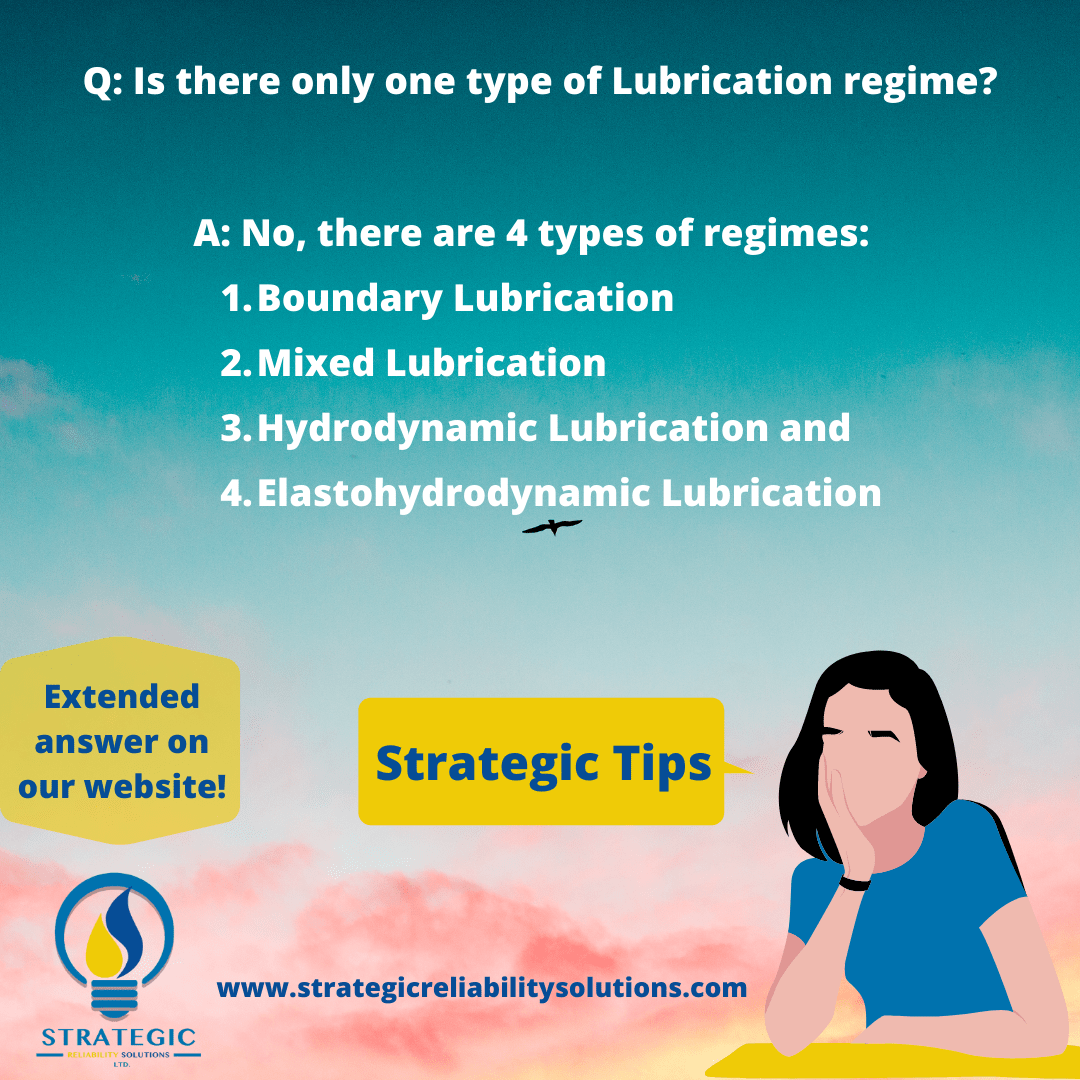
Q: Is there only one type of Lubrication regime?

There are actually 4 types of lubrication regimes that equipment can experience and each component usually experiences at least 3 within their lifetime!

As per Noria 2017, the four different types of lubrication are; Boundary Lubrication, Mixed Lubrication, Hydrodynamic Lubrication and Elastohydrodynamic Lubrication.

Essentially, the best type of lubrication regime is Hydrodynamic as it provides the most ideal environment for both the lubricant and the surface. However, there are instances where other types of regimes can exist due to a lack of lubricant or contaminants.

Most components experience Boundary Lubrication on start up where there isn’t a proper layer of lubrication between the two surfaces. As such, the asperities of the two surfaces touch and can create wear. When we look at surfaces under a microscope, we can see tiny asperities (which we can liken to sharp or jagged edges) which are prevalent along the surface.

Even though a surface may appear shiny and smooth, when we microscopically examine them, the actual surface has a lot of asperities. Imagine, if two rough surfaces were sliding against each other, like a piece of sand paper against a wall, eventually parts of the wall will be removed due to the asperities of both the sand paper and the wall.

As more oil is gradually introduced to the component, it begins to experience Mixed Lubrication. In this state, the oil film is still not fully formed and is a bit thicker in some places than others. There are some contact areas where the surfaces will still experience boundary lubrication as well as elastohydrodynamic or hydrodynamic lubrication.

During this period, wear occurs due to the areas that are still experiencing boundary lubrication. However, it can be considered a transition phase as the surfaces move from tone type of regime into another as the lubricant film gradually increases.

When the component is full immersed in the lubricant, it usually achieves Hydrodynamic Lubrication which allows for a full film to be formed between the two surfaces and there is no longer any contact with the asperities. This is one of the most ideal forms of lubrication as it greatly reduces the wear between the two surfaces and the oil film safeguards that these can easily slide over each other thus, decreasing the friction between them. In this type of lubrication, the oil wedge is maintained in all operating conditions and guarantees that the asperities of both surfaces do not interact with each other.

On the other hand, with Elastohydrodynamic Lubrication, something quite special occurs with the lubricant causing the component to deform slightly ensuring that the film is maintained between the two surfaces. This happens at the highest contact pressure and ensures that the asperities do not touch whilst maintaining the oil wedge.

This type of lubrication usually occurs when there is a rolling motion between two moving surfaces and the contact zone has a low degree of conformity (Noria. 2017). Essentially, Elastohydrodynamic lubrication occurs when the lubricant allows the contact surface to become elastically deformed while maintaining a healthy lubricant film between the two contact surfaces.


References:

Noria Corporation. 2017. Lubrication Regimes Explained. https://www.machinerylubrication.com/Read/30741/lubrication-regimes

Written by Sanya Mathura, CEO & Founder of Strategic Reliability Solutions Ltd. 

What are EALs?

EALs

Q: What makes a lubricant Environmentally Friendly?

There are many definitions of environmentally friendly. For instance, a lubricant can be environmentally friendly if it doesn’t pollute the environment which can either be understood as low toxicity or a reduced number of times that the oil is disposed.

However, there are three main factors which are considered when deeming a lubricant environmentally friendly2;

  1. Speed at which the lubricant biodegrades if introduced into nature
  2. Toxicity characteristics that may affect bacteria or aquatic life
  3. Bioaccumulation potential

Biodegradability

Biodegradability is defined as the measure of the breakdown of a chemical or chemical mixture by micro-organisms. It is considered at two levels namely;

  1. Primary biodegradation - loss of one or more active groups renders the molecule inactive with respect to a particular function
  2. Ultimate degradation – complete breakdown to carbon dioxide, water and mineral salts (known as mineralisation)3

Biodegradability is also defined by two other operational characteristics known as:

  1. Ready Biodegradability – occurs where the compound must achieve a pass level on one of the five named tests either, OECD, Strum, AFNOR, MITI or Closed Bottle3
  2. Inherent Biodegradability – occurs when the compound shows evidence in any biodegradability test.3


Toxicity

The toxicity of a lubricant is measured by the concentration of the test material required to kill 50% of the aquatic specimens after 96 hours of exposure (also called the LC50)1


Bioaccumulation

The term bioaccumulation refers to the build-up of chemicals within the tissues of an organism over time. Compounds can accumulate to such levels that they lead to adverse biological effects on the organism. Bioaccumulation is directly related to water solubility in that the accumulations can be easily soluble in water and not move into the fatty tissues where they become lodged.


Common Base Oils

There are three of the most common base oils that are Environmentally Acceptable2:

  1. Vegetable Oils
  2. Synthetic Esters
  3. Polyalkylene Glycols (PAGs)

These all have low toxicities and when blended with additives or thickeners for the finished lubricant, they should be retested to ensure that the additives / thickeners have not compromised the environmentally acceptable limits.


Labelling

Some lubricants can carry the “German Blue Angel Label” if all major components meet OECD ready biodegradability criteria and all minor components are inherently biodegradable.

Based on the requirements by Marpol, the International Maritime Organization (IMO) and current legislation from the European Inventory of Existing Commercial Chemical Substances (EINECS), a product may be considered acceptable if it meets the following requirements:

  • Aquatic toxicity >1000ppm (50% min survival of rainbow trout)
  • Ready biodegradability > 60% conversion of test material carbon to CO2 in 28 days, using unacclimated inoculum in the shake flask or ASTM D5846 test 1.


References:

  1. Lubrication Fundamentals Second Edition, Revised and Expanded. D.M. Pirro (Exxon Mobil Corporation Fairfax, Virginia), A.A. Wessol (Lubricant Consultant Manassas, Virginia). 2001.
  2. United States Environmental Protection Agency Office of Wastewater Management Washington, DC 20460. Environmentally Acceptable Lubricants. https://www3.epa.gov/npdes/pubs/vgp_environmentally_acceptable_lubricants.pdf
  3. Chemistry and Technology of Lubricants 3rd Edition, Chapter 1, R.M. Mortier, M.F. Fox, S.T. Orszulik)

Written by Sanya Mathura, CEO & Founder of Strategic Reliability Solutions Ltd. 

How many Groups of Base Oils are there?

Base_oil_groups

Q: How many Groups of Base oils are there?

There are 5 groups of base oils as defined by the American Petroleum Institute (API). However, between 2003-2010, the Association Technique de L’Industrie Européenne des Lubrifiants (ATIEL) (Europe) included Group VI - All polyinternalolefins (PiO).

Groups I-III are typically mineral oils while Groups IV-V are synthetic oils.

  • Group I: Solvent refined
  • Group II: Hydrocracked / Hydrotreated
  • Group III: Hydrocracked / Hydro-isomerized
  • Group IV: PAO Synthetics
  • Group V: All other Synthetics

Here is a table that shows the different groups.

Reference: Lubrication Fundamentals Second Edition, Revised and Expanded. D.M. Pirro, A.A. Wessol, Chapter 2.


Group I: <90% Saturates, ≥0.03% Sulphur, Viscosity Index: 80 to 120

These were characteristically the most popular initially since they were relatively inexpensive to produce (solvent refined) and used in non-severe, non-critical applications. This Group has more double bonds (carbon) which allows for an increase in stability of the carbon chain.


Group II: ≥90% Saturates, ≤0.03% Sulphur, Viscosity Index: 80 to 120

These are hydrocracked and higher refined. However, due to hydrocracking, the double bonds are reduced greatly which decreases the stability of the carbon chain. (A lot of turbine users would have noticed this change around 2010 when most Group I base oils were replaced by Group II base stock. These users saw increased varnish as the oils did not have the level of solubility that they did before!).

Group II+: (yes, this exists!) These have VIs of 110-120 with improved low temperature and volatility Characteristics.


Group III: ≥90% Saturates, ≤0.03% Sulphur, Viscosity Index ≥ 120

There is an argument that this group should be placed in the synthetic category. However, by definition, this group is the severely hydrocracked and highly refined crude oil which can be used in semi-synthetic applications as it has similar properties to that of synthetic oil.  These are also called synthesized hydrocarbons.

Group III+: These have VIs approaching (or in some cases exceeding) those of synthetic PAOs (some even go above 140). They are also very pure with almost non-existent levels of sulphur, nitrogen, aromatics and olefins. Typically, Gas to liquid base oils can be found in this group as it approaches the Group IV categorization.


Group IV: Polyalphaolefins – these are very stable, uniformed molecular chains where there is a reduction in the coefficient of friction. Most are formed through oilgomerisation.


Group V: Ester and other base stocks not included in Groups I-IV such as silicone, phosphate esters, PAGs, Polyol esters, Biolubes and Naphthenics.


References:

  1. Chemistry and Technology of Lubricants 3rd Edition, Chapter 1, R.M. Mortier, M.F. Fox, S.T. Orszulik)
  2. Lubrication Fundamentals Second Edition, Revised and Expanded. D.M. Pirro (Exxon Mobil Corporation Fairfax, Virginia), A.A. Wessol (Lubricant Consultant Manassas, Virginia). 2001.

Written by Sanya Mathura, CEO & Founder of Strategic Reliability Solutions Ltd.