Tagged: engineering

Measuring Oil Viscosity

The viscosity of oil is one of its most essential characteristics. Thus, it is important to understand how this is measured and quantified. There are two main types of viscosity, dynamic (or absolute) and kinematic viscosity.

The dynamic viscosity measures the force required to overcome fluid friction in a film and is reported in centipoise (cP) or in SI units Pascal Seconds (Pa s) where 1 Pa s = 10 P (Poise). It can also be considered the internal friction of a fluid. This is usually used for calculating elastohydrodynamic lubrication related to rolling element bearings and gears.

On the other hand, the kinematic viscosity of a fluid is the relative flow of a fluid under the influence of gravity. Its unit of measure is centistokes (cSt) which in SI units is mm2/s, 1cSt = 1 mm2/s. (Mang & Dresel, 2007).

Kinematic Viscosity = Dynamic Viscosity / Density

Other units of measure for viscosity include; Saybolt, Redwood, and Engler, but these are less widely used than the cSt or cP, especially for lubricants.

Oil Viscosity Grades and Standards

One of the best-kept secrets about viscosity is that a particular grade often represents a range. When oils are classified, one may see an ISO 32 or ISO 220 and believe that the oil will have this exact viscosity (32 cSt or 220 cSt). However, this is not the case.

There are three general classifications where viscosity grades have particular ranges based on the fluid type. The fluid may behave differently in each application, hence the need for these three scales. However, there is a chart that allows users to convert the various scales into the one needed.

Engine Oil Classification (SAE J300)

As per the Society of Automotive Engineers (SAE), the SAE J300 standard classifies oils for use in automotive engines by viscosities determined at low shear rates and high temperature (100°C), high shear rate and high temperature (150°C) and both low and high shear rates at low temperature (-5°C to -40°C) (Pirro, Webster, & Daschner, 2016).

Engine manufacturers have widely used this system to aid in designing lubricants suited for these applications. As such, oil formulators also adhere to these classifications when engineering lubricants.

One will note the use of the suffix letter “W” in some of the grades below. These oils are intended for low ambient conditions, whereas those without the “W” are intended for oils that will not encounter low ambient conditions.

These are commonly described as multigrade (where the “W” is found between two numbers) and monograde oils (where the “W” is at the end or the grade is identified by a number only) in the table below.

The table shows that the viscosities must fall within a particular range to be classified. For instance, a 5W30 oil should meet the specifications of:

  • Low temperature, Cranking viscosity of 6600 cP at -30°C
  • Low temperature, Pumping Viscosity Max with No Yield Stress of 60,000 cP at -35°C
  • Low shear rate Kinematic viscosity at 100°C should be between 9.3 -12.5 cSt
  • High Shear rate viscosity at 150°C Max at 2.9 cP

One will notice the range of 9.3 to 12.5 cSt (at 100°C). This is where oils can be blended to either end of this scale but still achieve the classification of a 5w30 oil.

Axle and Manual Transmission Lubricant Viscosity Classification (SAE J306)

As per the SAE recommended practice J306, automotive manual transmissions and drive axles are classified by viscosity, measured at 100°C (212°F), and by the maximum temperature at which they reach the viscosity of 150,000 cP (150 Pa s) when cooled and measured in accordance to ASTM D2983 (Method of Test for Apparent Viscosity at Low Temperature Using Brookfield Viscometer). (Pirro, Webster, & Daschner, 2016).

The table below shows that for an SAE grade of 190, the kinematic viscosity must fall within the range of 13.5 to 18.5 cSt at 100°C. While most viscosities tend to fall mid-range of these values, it also indicates that if the lubricant achieves 18 cSt at 100°C, it can still be classified at an SAE grade 90.

The most common multigrade lubricants within this grade fall within the 80w90 or 75w140 classifications.

Another factor for these types of lubricants is API GL4 or GL5 ratings. It must be noted that a GL5 lubricant is recommended for hypoid gears operating under high-speed, high-load conditions.

On the other hand, a GL4 lubricant is usually recommended for the helical and spur gears in manual transmissions and transaxles operating under moderate speeds or loads. These should not be used interchangeably as the GL5 lubricants tend to adhere to the surfaces and may cause more damage in a GL4 application.

Figure 5: Automotive Gear Lubricant Viscosity Classification. Source: Lubrication Fundamentals, Third Edition Revised and Expanded by Pirro D. M., Webster M., and Daschner E. pg 52

Viscosity System for Industrial Fluid Lubricants

This classification was jointly developed by the ASTM and STLE (Society for Tribologists and Lubrication Engineers). Initially, the system was based on viscosities measured at 100°F but converted to viscosities measured at 40°C.

ASTM D2422 and ISO 3448 are the references for this system. In this system, it is clearer to see the variances in the ranges of viscosities. In this case, the mid-point of the range is used as the ISO viscosity. To determine the range of any ISO viscosity, one can calculate ±10% of the mid-point value to get the minimum and maximum values of the range.

Figure 6: Viscosity System for Industrial Fluid Lubricants. Source: Lubrication Fundamentals, Third Edition Revised and Expanded by Pirro D. M., Webster M., and Daschner E. pg 52

All of these systems can be represented in the figure below, where it is easy to calculate the oil viscosity using another system:

Figure 7: Various viscosity systems in one chart.

Can Lube Oil Varnish be Eliminated? 

Varnish can be likened to cholesterol in the human body. It can build up in our arteries and eventually clog those, causing restrictions in blood flow to our heart which may lead to a heart attack.

Humans cannot simply change their blood to remove the cholesterol build-up. However, cholesterol is controlled through proper diet, exercise, and with some condition monitoring in the form of blood tests to help gauge the presence of it in the bloodstream. Similarly, a couple of approaches can be used to reduce the varnish build-up or eliminate it.

As per Livingstone et al. (2011), the lifecycle of varnish is critical. Particular attention should be paid to the double arrows between the stages of Solubility to Varnish formation in the figure below.

This means that even after varnish has been deposited, it can be solubilized back into the oil. This can only occur if conditions are met per Hansen’s Solubility principles where the solvent and degradation products meet using the three parameters of Polarity, Hydrogen Bonding, and Dispersive Forces as discussed in “The Hansen Solubility Principles and Its Relation to Varnish” (2022).

mechanisms-oil-varnish-formation

The Varnish Lifecycle as per Livingstone et al. (2011)

Varnish exists in various forms and can consist of differing compositions. Hence, it is essential to understand the characteristics of the varnish being formed in a system before attempting to eliminate it.

There are certain technologies, such as solubility enhancers or specifically engineered filtration media, which can be effective at removing lube oil varnish. However, this technology is heavily reliant on the type of varnish being formed and can be customized as per the system accordingly.

Solubility enhancers can solubilize the varnish back into the oil solution. When these deposits are reintroduced into the oil, they can be removed using resin-based filtration. In this method, the media is specifically designed to allow for the adsorption and removal of the varnish which presently exists in the oil.

When these methods are used together, they can prove quite effective and prevent manufacturing plants from experiencing unwanted downtime.

To summarize, it is of utmost importance to first understand the characteristics of the varnish being produced in your equipment before attempting to remove it from your system.

There is no cookie-cutter method to eliminate varnish from a system as it is a complex deposit. Similar to practices we observe with our bodies in the instances of cholesterol build-up, we can employ methods of dissolving the varnish and removing it while monitoring for possible recurrences in the future.


Want to read the entire article? Find it here on Precision Lubrication Magazine!


References:

Livingstone, Ameye, & Wooton. (2015.). Antioxidant Monitoring as Part of Lubricant Diagnostics – A Luxury or a Necessity? OilDoc, Rosenheim, Germany.

Livingstone, Overgaag, & Ameye. (2011). Advanced removal Techniques for Turbine oil Degradation Products. Powergen Milan.

Mathura, S. (2020). Lubrication Degradation Mechanisms (CRC Press Focus Shortform Book Program) (1st ed.). CRC Press.

The Hansen Solubility Principles and its Relation to Varnish. (2022, July 31). Fluitec International. https://www.fluitec.com/the-hansen-solubility-principles-and-its-relation-to-varnish/

What is varnish or oil degradation?

Varnish is a type of deposit that forms on the surface of equipment in lubrication systems. It is caused by the oxidation of the base oil and the buildup of additives in the oil over time, forming a sticky, varnish-like substance. Lube oil varnish can cause problems in equipment operation by clogging filters, reducing oil flow, and leading to valve sticking and pump failures.

Lube oil varnish is no stranger to the manufacturing industry. It constitutes the substance of most operators’ worst nightmares and plant managers’ ultimate fears. For those who have been in the industry for the last decade, varnish is the sticky subject that unites all facility departments.

It can cause an entire manufacturing plant to shut down while sending the finance department into a frenzy trying to balance production loss with incoming repair costs. In the fight against lube oil varnish, all teams need to work together to ensure that it can be managed and possibly eliminated from the system.


What Is Oil Degradation?

Before diving into the world of varnish, one must first understand how it forms and the circumstances which have led to its existence. Within the industry, the term varnish is used loosely to define any form of lubricant-derived deposit found in industrial.

However, oil can degrade by several mechanisms, which require various conditions for degradation—as such, using the term varnish to describe any deposit formed within a machine does not suggest its mechanism of formation.

The lubricant begins its degradation journey from the moment the lubricant enters the machine.

A lubricant is composed of base oil and additives, of which infinite combinations exist. Additives are carefully engineered to protect the base oil and the equipment. As such, they can become depleted over time, leading to the degradation of the lubricant.

This becomes concerning when the additive levels have depleted to a threshold where they can no longer protect the base oil or the machine. At this stage, degradation is the most serious concern because its rate is greatly accelerated.

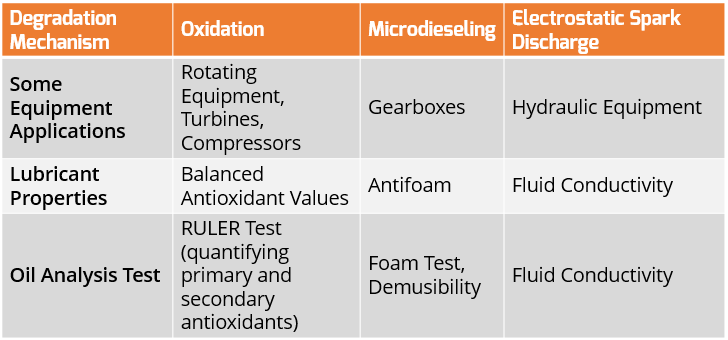
According to Mathura (2020), there are six major forms of degradation under which a lubricant can undergo. While some may argue that these can be grouped, some characteristics set these mechanisms apart.

Each mechanism has unique environmental factors which contribute to producing different types of deposits. It is critical to note that identification of the type of mechanism can assist operators in performing remedial works on their equipment to aid in preventing the formation of varnish.

Want to read the full article? Check it out here in the Precision Lubrication Magazine.

Varnish Badges of Honour

Varnish Badges_honour

Varnish is widely known as a primary culprit of equipment failure. This sticky enemy effectively finds its way into most of our equipment and causes operators, maintenance personnel and plant managers a series of nightmares. From unplanned shutdowns costing millions of dollars to sticking of servo valves on startup, or increases in bearing temperature, varnish usually announces its arrival. Once it has been found, there is typically a cause for panic but perhaps it just needs to be understood rather than feared?


The ICML VPR & VIM Badges

Recently (August, 2021), the International Council for Machinery Lubrication launched two new badges. These badges are, VIM (Varnish & Deposit Identification and Measurement) & VPR (Varnish & Deposit Prevention & Removal). These were created after the culmination of 3 years of work from the global varnish test development committee. It has been designed for those involved in all aspects of managing or advising lubricant programs especially those with the responsibility of recommending, selling or installing appropriate deposit control equipment or other mitigation strategies.

Most of the readers will already be familiar with my enthusiasm for understanding lubricant degradation. Thus, when these badges came out, I knew I had to secure them! While the requirements for taking the test suggest the possession of the MLT I or MLA I certification or 1 year of experience, I figured that my MLE certification would be an asset (as I haven’t gotten my MLT I certification yet, it’s on the list!). However, I wanted to make sure that I covered all of the elements in the BoK for both the VIM & VPR badges, so naturally I turned to the varnish guru himself, Greg Livingstone!


Fluid Learning – All the way!

Greg is the CIO at Fluitec but he’s also the facilitator for the ICML VPR & VIM badges. What a treat! If you’ve never heard the name Greg Livingstone then you’re obviously not in the lubrication field. Greg has penned hundreds of papers on varnish and can be thought of as the varnish guru since he has extensive experience in this area. It’s a no brainer that I chose Fluid Learning to get me up to speed on what I needed to know for these exams!

Greg was an amazing facilitator and not only covered information relevant to the BoK for the exams but gave students a full overview about everything you needed to know about varnish. These on demand sessions kept me scribbling notes and nodding to myself and saying, “Oh that’s what really happens!” He presents the information clearly and adds some much needed humour into the sessions. It was an absolute privilege having him as my tutor for these badges.


VPR & VIM- What you need to know!

Varnish Badges_need-to-know

VPR - Varnish & Deposit Prevention and Removal

The VPR badge ensures that candidates understand proactive methods and technologies which can be employed to reduce the degree of degradation. It is also designed to confirm that they can sufficiently evaluate combinations of technologies to prevent and remove varnish including the proper steps to set up and implement an effective varnish removal system.

The topics covered in the VPR include:

  • Problems associated with Varnish & Deposits (20%)
  • Factors affecting Breakdown (28%)
  • Proactive Methods that can be used to minimize oil breakdown (16%)
  • Methods / Technologies that can be used to remove oil breakdown products and/or prevent deposits (36%)

The complete BoK for the VPR badge can be found here.


VIM (Varnish & Deposit Identification & Measurement)

The VIM badge on the other hand is more ideally suited for personnel responsible for recommending suitable oil analysis tests and mitigation efforts related to the deposit tendencies of various in-service fluids (application dependent). They would also be responsible for monitoring and adjusting these strategies accordingly.

The topics covered in VIM include:

  • Problems associated with Varnish and Deposits (20%)
  • Varnish and Deposit Composition (24%)
  • How Breakdown Products / Contaminants become Deposits (24%)
  • Oil Analysis Techniques that can be used to gauge Breakdown and Propensity towards Deposit Formation (32%)

The complete BoK for the VIM badge can be found here.


Exam tips!

Varnish Badges_exam_tips

The actual exams for both the VPR & VIM are set at 45 minutes with 25 multiple choice questions. Candidates must achieve 70% grade to attain the badges. Currently, the fee for the exam is USD75. Since there were overlaps of the content and the exam durations weren’t that long, I decided to sit both exams in one day. I will only advise this for those who are comfortable with doing this as exam anxiety and all that comes along with it can be stressful!

Here are a couple tips for taking these exams:

  • Log into the system 30 minutes prior to your scheduled exam time. This allows you to clear your mind, settle yourself and gives you an extra 15 minutes to figure out where the email is with your credentials! If you can’t remember your password to login to the system, this also gives you enough time to get that reset and sorted before the actual exam time.
  • The session only opens 15 minutes before the appointed time. During this time, you will converse with the moderator as they do the checks of the room and your National Identification. The moderators will engage with you and ensure that you are sitting the correct exam.
  • Ensure you have your National Identification on hand (your passport can be used as well). As long as it has your picture and the expiration date on the same side, it will be acceptable. For the Trinidadians, do not use your National ID card as we have our pictures on the front with the information on the back (I used my Driver’s permit).
  • Candidates have the option of “Flagging” questions to come back to them later. This is a great tool to help you to mark those questions you want to return to or double check.
  • There is a timer in the screen layout which helps you to keep track of your time. 45 minutes passes very quickly when you’re running through the questions!
  • Exam results for these badges come back very quickly as much as within a few hours or one day depending on the time of your exam.

Why do you need these badges?

Varnish Badges_need-badges

As long as you work within the lubrication sector or interface with machines requiring lubrication, then you need to get these badges! Oil degradation occurs throughout the life of the lubricant whether it’s a small or large operation. By understanding how it degrades and ways to mitigate that degradation, you can save your equipment and avoid unwanted downtime. These badges were designed for the personnel in the field to allow them to make decisions regarding the lubricant and to empower them in taking steps to avoid degradation or mitigate it should the need arise. Consider it as getting your passport stamped by the ICML!

The courses offered by Fluid Learning are perfect for those seeking to understand lubrication deposits, what causes them and how they can be mitigated. While the content covered during these sessions align with the ICML VPR & VIM badges, they also add to a more holistic approach to varnish and deposits. Fluid Learning is an official ICML Training Partner and is currently the only one (of which I am aware) offering training prep for these badges. I highly recommend them for anyone seeking to learn more about or avoid sticky varnish situations. 

At the moment of writing this article, there are only 8 people globally who have acquired these badges from ICML. I am the first female in the world to attain these badges but I will not be the only female for very long. Varnish is an issue which affects us all and we need to understand it, so we can prevent it and keep our equipment safe. I hope to see many more candidates with these badges in the near future!

EALs?

EALs

Q: What makes a lubricant Environmentally Friendly?

There are many definitions of environmentally friendly. For instance, a lubricant can be environmentally friendly if it doesn’t pollute the environment which can either be understood as low toxicity or a reduced number of times that the oil is disposed.

However, there are three main factors which are considered when deeming a lubricant environmentally friendly2;

  1. Speed at which the lubricant biodegrades if introduced into nature
  2. Toxicity characteristics that may affect bacteria or aquatic life
  3. Bioaccumulation potential

Biodegradability

Biodegradability is defined as the measure of the breakdown of a chemical or chemical mixture by micro-organisms. It is considered at two levels namely;

  1. Primary biodegradation - loss of one or more active groups renders the molecule inactive with respect to a particular function
  2. Ultimate degradation – complete breakdown to carbon dioxide, water and mineral salts (known as mineralisation)3

Biodegradability is also defined by two other operational characteristics known as:

  1. Ready Biodegradability – occurs where the compound must achieve a pass level on one of the five named tests either, OECD, Strum, AFNOR, MITI or Closed Bottle3
  2. Inherent Biodegradability – occurs when the compound shows evidence in any biodegradability test.3


Toxicity

The toxicity of a lubricant is measured by the concentration of the test material required to kill 50% of the aquatic specimens after 96 hours of exposure (also called the LC50)1


Bioaccumulation

The term bioaccumulation refers to the build-up of chemicals within the tissues of an organism over time. Compounds can accumulate to such levels that they lead to adverse biological effects on the organism. Bioaccumulation is directly related to water solubility in that the accumulations can be easily soluble in water and not move into the fatty tissues where they become lodged.


Common Base Oils

There are three of the most common base oils that are Environmentally Acceptable2:

  1. Vegetable Oils
  2. Synthetic Esters
  3. Polyalkylene Glycols (PAGs)

These all have low toxicities and when blended with additives or thickeners for the finished lubricant, they should be retested to ensure that the additives / thickeners have not compromised the environmentally acceptable limits.


Labelling

Some lubricants can carry the “German Blue Angel Label” if all major components meet OECD ready biodegradability criteria and all minor components are inherently biodegradable.

Based on the requirements by Marpol, the International Maritime Organization (IMO) and current legislation from the European Inventory of Existing Commercial Chemical Substances (EINECS), a product may be considered acceptable if it meets the following requirements:

  • Aquatic toxicity >1000ppm (50% min survival of rainbow trout)
  • Ready biodegradability > 60% conversion of test material carbon to CO2 in 28 days, using unacclimated inoculum in the shake flask or ASTM D5846 test 1.


References:

  1. Lubrication Fundamentals Second Edition, Revised and Expanded. D.M. Pirro (Exxon Mobil Corporation Fairfax, Virginia), A.A. Wessol (Lubricant Consultant Manassas, Virginia). 2001.
  2. United States Environmental Protection Agency Office of Wastewater Management Washington, DC 20460. Environmentally Acceptable Lubricants. https://www3.epa.gov/npdes/pubs/vgp_environmentally_acceptable_lubricants.pdf
  3. Chemistry and Technology of Lubricants 3rd Edition, Chapter 1, R.M. Mortier, M.F. Fox, S.T. Orszulik)

Base Oil Groups

Base_oil_groups

Q: How many Groups of Base oils are there?

There are 5 groups of base oils as defined by the American Petroleum Institute (API). However, between 2003-2010, the Association Technique de L’Industrie Européenne des Lubrifiants (ATIEL) (Europe) included Group VI - All polyinternalolefins (PiO).

Groups I-III are typically mineral oils while Groups IV-V are synthetic oils.

  • Group I: Solvent refined
  • Group II: Hydrocracked / Hydrotreated
  • Group III: Hydrocracked / Hydro-isomerized
  • Group IV: PAO Synthetics
  • Group V: All other Synthetics

Here is a table that shows the different groups.

Reference: Lubrication Fundamentals Second Edition, Revised and Expanded. D.M. Pirro, A.A. Wessol, Chapter 2.


Group I: <90% Saturates, ≥0.03% Sulphur, Viscosity Index: 80 to 120

These were characteristically the most popular initially since they were relatively inexpensive to produce (solvent refined) and used in non-severe, non-critical applications. This Group has more double bonds (carbon) which allows for an increase in stability of the carbon chain.


Group II: ≥90% Saturates, ≤0.03% Sulphur, Viscosity Index: 80 to 120

These are hydrocracked and higher refined. However, due to hydrocracking, the double bonds are reduced greatly which decreases the stability of the carbon chain. (A lot of turbine users would have noticed this change around 2010 when most Group I base oils were replaced by Group II base stock. These users saw increased varnish as the oils did not have the level of solubility that they did before!).

Group II+: (yes, this exists!) These have VIs of 110-120 with improved low temperature and volatility Characteristics.


Group III: ≥90% Saturates, ≤0.03% Sulphur, Viscosity Index ≥ 120

There is an argument that this group should be placed in the synthetic category. However, by definition, this group is the severely hydrocracked and highly refined crude oil which can be used in semi-synthetic applications as it has similar properties to that of synthetic oil.  These are also called synthesized hydrocarbons.

Group III+: These have VIs approaching (or in some cases exceeding) those of synthetic PAOs (some even go above 140). They are also very pure with almost non-existent levels of sulphur, nitrogen, aromatics and olefins. Typically, Gas to liquid base oils can be found in this group as it approaches the Group IV categorization.


Group IV: Polyalphaolefins – these are very stable, uniformed molecular chains where there is a reduction in the coefficient of friction. Most are formed through oilgomerisation.


Group V: Ester and other base stocks not included in Groups I-IV such as silicone, phosphate esters, PAGs, Polyol esters, Biolubes and Naphthenics.


References:

  1. Chemistry and Technology of Lubricants 3rd Edition, Chapter 1, R.M. Mortier, M.F. Fox, S.T. Orszulik)
  2. Lubrication Fundamentals Second Edition, Revised and Expanded. D.M. Pirro (Exxon Mobil Corporation Fairfax, Virginia), A.A. Wessol (Lubricant Consultant Manassas, Virginia). 2001.

PAOs vs PAGs

PAO_vs_PAG

Q: What’s the main difference between PAOs & PAGs?

Let’s start off with definitions!

PAO: Polyalphaolefin

PAG: Polyalklene Glycol

While both are synthetic oils they are classified under different Groups of Base oils. PAOs have their own Base oil Group IV while PAGs fall into the Group V (catch all).

PAOs

PAOs are actually hydrogenated oligomers of an α-olefin and there are different methods of oligomerisation. Due to this process, PAOs have very good low temperature properties and the products are wax free! Additionally, their lower volatilities also allow them to operate over a wide temperature range. Usually, they can be used in a lot of versatile applications such as gearboxes, screw compressors, fans, motors and even automotive!

However, PAOs have a low polarity which gives rise to poor solvency of polar compounds and issues with seal performance.1

PAGs

On the other hand, PAGs can differ depending on their structure. For instance, Ethylene is water soluble while Propylene is not, however, neither are oil soluble. Both experience significant chemical reactions producing sludge like deposits when mixed with mineral oil.

Usually, their properties include a wide viscosity range, low pour points, good lubricity, low toxicity and non-flammable in aqueous solutions. PAGs are typically always found in fire-resistant hydraulic fluids as well as industrial gear oils, compressor lubricants, heat transfer liquids and metalworking fluids.1

Compatibility

Both products need to be tested for compatibility with mineral oils before any mixing occurs. Additionally, most lubricant suppliers deem PAOs & PAGS as “filled for life” solutions which last for a longer time compared to mineral oils. Typically, the purchase of these products are more expensive than mineral oils, however if one looks at the cost of waste disposal and reduced downtime (due to decreased shutdowns for oil changes) the overall cost of the lubricant is by far less than that of mineral oil.


References:

  1. Chemistry and Technology of Lubricants 3rd Edition, Chapter 2, R.M. Mortier, M.F. Fox, S.T. Orszulik

EasyRCA!

EasyRCA

Recently, most of our concerns stem around getting stuff done faster but wanting the same quality result. For instance, when loading a web page, we expect it to be loaded in one second and use the next five seconds to browse the content and find what we’re looking for. Let’s take a step back and think about loading a webpage ten or fifteen years ago, using a dial up internet connection. I can guarantee you that it took a lot longer than two minutes!

Much of this, “need for speed” has been integrated into our working life where we now have apps that can take vibration measurements in a couple of seconds whereas in the past it took a couple of hours and a few technicians to get the correct reading and then analyse it. The team at Reliability Center Inc, has realized this change in dynamics and are introducing a new tool that steps up to the plate in more ways than one!

The EasyRCA tool was recently launched to allow everyone access to an RCA tool that is (as the name implies) easy to use. The tool is very intuitive and requires minimal training. If a user can click the Enter key on the keyboard or hover above the icons then they can use the tool. The only thing that is required is a stable internet connection and a device with a decent battery life.

One of the first things that stand out with the tool is the use of colour and easy to understand icons! Most tools within the industry shy away from colour but the use of colour to highlight the types of roots (Physical, Human or Systemic) and the stage (Event, Mode, Hypothesis) allows the RCA tree to be easily distinguished and more appealing to the eye.

Figure 1: Snapshot of 5 Why analysis using the EasyRCA Tool

The next interesting feature is that the user can choose the type of analysis that they require! That’s right, the user can choose from the sturdy Causal Tree, to the ever popular 5 Why or the Fishbone (utilizing the 6M method). With each of these types of RCA, the user can add more boxes, move them around the page to group them better or even delete those that they deem irrelevant. The user has full control of the software!

Figure 2: Snapshot of the Fishbone Analysis (6M) using the EasyRCA Tool

If this wasn’t enough to allow easy manoeuvrability, there is even a little “brain” that lights up orange on the screen. This is the virtual assistant and will light up whenever it “thinks” that it can offer assistance through templates from the library. The templates in the library span 50 years of experience that have been built in to allow users a guide for completing RCAs.

Figure 3: Snapshot of the Analysis Assistant using the EasyRCA Tool

What about using the tool to print out a report? Of course the team at Reliability Center Inc thought about this! When performing an RCA, we need to provide a report to all involved! The EasyRCA Tool allows users to produce a report which is downloaded into Microsoft Word. This allows the user to make even more changes if necessary. This report includes all of the pictures / pieces of evidence that were attached during the hypothesis verification process.

Figure 4: Snapshot of the Table of Contents produced by the EasyRCA Tool

Another very cool feature is that it allows teams to work in real time! For instance, if we have team members scattered across the globe (or around the table), any change that is made by a team member is reflected instantly in all open applications of that particular project in the EasyRCA Tool. When we set up a project, tasks are assigned to team members (who are alerted via email). Thus, each team member can have access to the project, once they have been assigned.

Here’s a quick snapshot of a Causal Tree in the EasyRCA software:

Figure 5: Snapshot of a Pump Failure RCA utilizing a Logic Tree in the EasyRCA software

The EasyRCA Tool is like the baby brother to the PROACT RCA software and allows analysts with little training to adapt this tool and still get results that add value!  And, best of all, you can get started immediately.

Feel free to book a demo of the EasyRCA tool and check out the family of tools as they keep expanding to help better serve the industry!

Expired grease?

expired_grease

Are there any signs that my grease has expired?

There are a lot of signs to tell if grease has expired!

Some of the signs include:

  • Separation of the oil from the thickener
  • Change in the consistency of the NLGI grade.

Ideally, we should check the expiration date on the packaging and contact the lubricant manufacturer.

We must note that if the packaging has been removed or opened in some way, the expiration date may not be valid.

The expiration date on the product is the approximate shelf life of the product should the packaging remain intact and if stored in the recommended environment.

If these are compromised then the validity of the expiration date has also been compromised.

Outdoor Storage

storage

I have no room in the warehouse, can I store the oils outside until I get room?

It is never ideal to store lubricants outside exposed to the elements. However, there may be situations where this cannot be helped.

For instance, transformer oils are very sensitive to light and water.

If there is an option of at least storing one type of oil away from the elements, then this type of oil is at the top of the list.

If it has to be stored outside, then there are some measures that can be taken to ensure it is not compromised.

We can place a tarp over the product to ensure that the rain does not settle on the drums and they remain fairly dry.

They can also be stacked on pallets, so that they are not directly touching the ground. This way, water cannot enter the product.

Additionally, they can be stored such that the bungs are at a 9 or 3 o’clock position. In this position, if water falls on the top of the drum, it cannot accumulate by the bungs and seep into the product.

Once the packaging has been opened, the product can be considered open to contamination and anything that gets into the product will eventually get into the equipment.

Ideally, opened products should be stored in enclosed areas or have dedicated decanting systems.