Tagged: engineering

What is the ISO 4406 rating?

iso_4406_rating

Is the ISO 4406 rating important?

Yes, it is very important!

The ISO 4406 rating tells us the cleanliness level of our lubricant. It tells us the number of particles that can pass through a 4, 6 and 14 micron rating.

However, the value on the ISO rating does not represent the number of particles. On the contrary, it represents the range in which the number of particles can lie.


One key point to remember is that the rating will always change from the time that the sample was taken to the date that the results were processed.

Therefore, it is a good idea to use the sample result as a guide as estimate a bit higher for the real value of your lubricant.


Check out our article which goes into more detail about ISO 4406.


Matt Spurlock CLS, CMRP, MLE explains further about redefining the ISO code in his article entitled; "A Twist on Particle Evaluation: Redefining the ISO Cleanliness Code". 


Written by Sanya Mathura, CEO & Founder of Strategic Reliability Solutions Ltd. 

ISO-4406-chart

Filter rating

filter

Is the filter rating important?

Yes! It is very important.

Usually, the OEM of the equipment specifies the filter rating (and even the filter material in some cases). These ratings help us to keep out particles of larger sizes that may cause damage to the equipment either through wear or clogging of fine clearances.

Some filters allow us to monitor the differential pressure. This is the pressure between the outside of the filters and inside and as this approaches the warning limits, we know that a filter change is needed in the near future.

However, there are times when there is no warning and the filter goes into bypass. When a filter goes into bypass, this means that the filter is no longer keeping back the larger particles. This can be catastrophic for the equipment as a higher concentration of contaminants can now enter the system and damage it.

It is common practice to change the oil filter when the oil is being changed. In some instance, (especially depending on the environment), OEMs recommend changing the oil filters twice or more before the actual oil change.

Always consult with your owner’s manual about the maintenance practices before adopting your own.

Written by Sanya Mathura, CEO & Founder of Strategic Reliability Solutions Ltd. 

Synthetic vs Mineral

syn_min

Should I use a synthetic oil in my equipment or just stick to mineral?

Check with your OEM first.

There are some OEMs that require a synthetic to be used but others that prefer mineral oils.

Typically, a synthetic oil (in industrial applications) tends to have longer operating hours compared to that of a mineral oil.

As such, lots of companies prefer to use synthetic oils as it leads to cost savings in the long term.

However, there are times when mineral oils are more cost effective.

For instance, if the component has to undergo maintenance (where the oil has to be drained) every 500 hours then it would not make sense to have a more expensive oil that lasts for 2000hours.

Before choosing whether mineral or synthetic, we need to do a cost benefit analysis of using both and then make an informed decision. If we can see savings by switching to a synthetic (such as energy, fuel or manpower savings) then this is definitely the way to go.

Written by Sanya Mathura, CEO & Founder of Strategic Reliability Solutions Ltd. 

Can Viscosities be mixed?

mix_viscosities

Can I mix different viscosities of oils to get the viscosity that I want?

It can be done but this is not an ideal situation.

There are times when the only available viscosity is an ISO 46 (on a rig) but the equipment requires an ISO 68 and the new stock will not be delivered in time to avoid shutdown. Can the ISO 46 be used instead?

An ISO 46 oil is lighter in viscosity than an ISO 68 however, for most oils, there is a chart that depicts the viscosity of the oil at operating temperature. In these cases, one can consult this chart and determine if the viscosity at operating temperature will still fall within operating limits.

If we mix an ISO 46 with an ISO 68 oil we cannot be certain of where the new viscosity will fall especially if we do not know the ratios that are being used. There is a viscosity calculator that can help guide this decision available at: https://www.widman.biz/English/Calculators/Mixtures.html

This can be used as a guide and the actual values of the oil should be verified via oil analysis.


While this situation is not ideal, we need to remember that compatibility is also key.

As such, we should stick with the same line of lubricants that we being used. Typically, lubricant suppliers have the same formulation but change the viscosities for lubricants of the same line.


Written by Sanya Mathura, CEO & Founder of Strategic Reliability Solutions Ltd. 

Stop production?

equip_shutdown

I can’t shut down the equipment but I know the oil has degraded significantly. What can I do?

Tough decisions!!!

There are times when production cannot be stopped such as when an order has to be fulfilled in a manufacturing facility. Before a decision is made, we need to understand the risks of not stopping production.

Can prolonged production cause a reduction in the overall quality of the final product or will it damage the equipment from working outside of its stipulated hours?

If we absolutely cannot shut down the equipment but the quality of oil has degraded, we need to firstly understand why the oil is degrading (especially if this is outside of its regular working hours).

Next, we need to identify which property of the oil has degraded, is it that the viscosity has increased / decreased, or the antioxidant levels have depleted significantly? By identifying the property that has degraded, we can choose the best way of replenishing this property.


Methods

There are a few methods that can be employed when trying to get the lubricant back to a healthy state however, as indicated above it is dependent on the property that has been degraded.

Cleanliness – if the ISO 4406 value has been increasing significantly this can hamper the performance of the lubricant. The clearances that the lubricant has to pass through can become blocked or the surfaces can experience an increased rate of wear.

One simple method of improving the cleanliness is through a kidney loop filtration system. This is an external system where the oil can be filtered through a filter cart and returned to the system.

Usually, this is a very effective method but one should investigate why the cleanliness values have become so high. Is it that the lubricant is being contaminated by the system, a process within the system or external factors?


Antioxidant levels – usually in turbines, this value decreases quickly especially if there is the presence of oxidation. Some users try to add antioxidants to their lubricant to increase the values. This is NOT recommended!!!

The composition of most turbine oils is 1% additive, 99% base oil. By adding any additive directly to the lubricant, we will be throwing the lubricant off balance and may induce other issues such as coagulation (clogged clearances) if the additive did not react well to the initial additives in the lubricant.

One of the easier ways of increasing the antioxidant levels without shutting down the machine is referred to as sweetening.

This process involves removing a percentage of the used oil (lubricant in the system) and then refilling the sump with new lubricant. The ratios can vary depending on the desired change in the antioxidant levels. It is important to note that the same lubricant should be used to ensure compatibility of the lubricants during the sweetening process.

Additionally, lab tests should be done frequently to monitor the changes in the antioxidant levels. The frequency of lab tests is highly dependent on the result turnaround time and budget available.


Written by Sanya Mathura, CEO & Founder of Strategic Reliability Solutions Ltd. 


What does it mean if the TBN decreases?

TBN_drop

The TBN has dropped significantly, can I still use the oil?

The TBN (Total Base Number) is usually seen in diesel engines. Most modern (smaller) diesel engines have TBNs within the range of 9-15 (especially if they are using ULSD).

The TBN gets depleted when the acids in the oil start to increase.

Typically, higher sulphur levels in the fuel produce more acids. As such, as the sulphur level increases, so does the TBN level.

For instance, in power plants that use larger (older) diesel engines that require HSFO (High Sulphur Fuel Oil, 3.5% sulphur), the TBN of the lubricant can be as much as 50. Here are the different types of fuel and their sulphur ratings:

  • HFSO (High Sulphur Fuel Oil): 3.5%
  • LSFO (Low Sulphur Fuel Oil): 1.0%
  • ULSFO (Ultra Low Sulphur Fuel Oil): 0.1%


With IMO 2020, the cap has been placed on sulphur in fuel to 0.5% for marine vessels. While this cap has not yet been translated to land applications, due to the demand for HSFO declining there may be a shift to ULSFO in land based applications in the not so distant future.


Ideally, if your TBN level gets depleted by 50% then there is a cause for concern and the oil should be changed or topped up with new oil (depending on which is more convenient).

If your TBN levels get to 50% in a very short time, you may want to investigate the reasons behind the value dropping so significantly in such a short time (perhaps fuel dilution or thermal cracking?).

Always investigate the reasons behind unexpected results as these will continue to impact your lubricant in the future.

Can oils be mixed?

mix_oils

Can I mix hydraulic oils with engine oils?

Oils should never be mixed!

Every oil is designed with its application in mind. As such, they are blended with varying concentrations and types of additives. For instance, a typical engine oil has at least 30% additives while a turbine oil may have only 1% additive.

Hydraulic oils are designed for applications where power has to be transmitted through the lubricant. On the other hand, engine oils are designed to withstand varying temperatures (gasoline engines have a different temperature range compared to diesel engines. Diesel engines generally run at higher temperatures than gasoline engines).

Always pay particular attention to what the OEM recommends. Usually, the OEM will recommend that a lubricant meets a particular global standard (API SN or CK4). These standards were developed to ensure the best performance of an engine and should be adhered to when choosing lubricants.


Written by Sanya Mathura, CEO & Founder of Strategic Reliability Solutions Ltd. 

Recommended oil – Automotive

oil_car

What type of oil should I use in my car?

Always follow what the OEM recommends! A quick google search can help you find the required lubricant if you don’t have the owner’s manual.

Most modern vehicles use lighter weight oils compared to older vehicles. Let’s think about cars back in 1950. They were larger, with big engines. With a big engine, it would mean that the lines carrying the oil would be larger. Thus, a heavier oil (50 weight) would be the most appropriate.

Now, fast forward to cars today. The engines are smaller, (albeit with a lot more horsepower as well!). If the size of the engine has changed, then the size of the lines carrying the lubricant will change as well. These lines will get smaller. If the lines are smaller, then the liquid that has to flow through them, should be lighter (thinner).

We can use an analogy of a straw trying to pull up molasses.

With a large straw, we could pull up the molasses faster than with a thinner straw. This is similar to the older cars, they would have thicker “straws” (lines) that would have allowed them to adequately pump the lubricant.

In the newer cars, the straw has gotten thinner, so it can’t pull up the molasses anymore. If we tried to pull up water instead, it would definitely flow faster than the molasses and not have as much strain on the person pulling up the water (pump in the engine). Hence, lighter oils are used in modern cars.

Most recommendations can be found by contacting the OEM or even doing a bit of Google searching with the year of manufacture for the car and of course the model.

Written by Sanya Mathura, CEO & Founder of Strategic Reliability Solutions Ltd. 

Additives and their properties

Properties of Additives in Lubricants

add_calcium

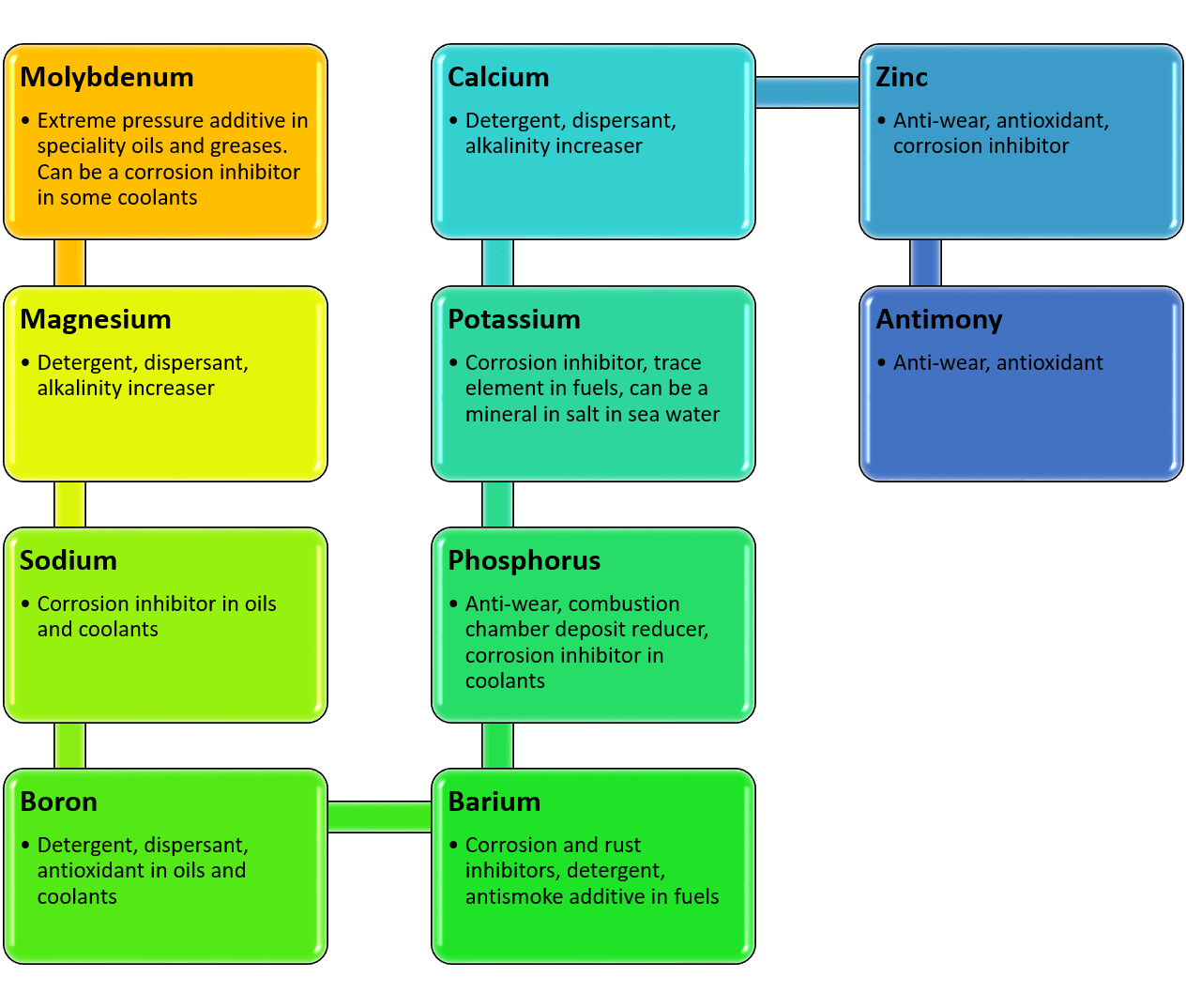
Each lubricant has a varying percentage of additives as not all lubricants are created equally. Lubricants are designed based on their application or use within the industry. For instance, an engine oil is typically composed of 30% additives, 70% base oil while turbine oils comprise 1% additives and 99% base oil.

Therefore, particular attention must be paid to getting the additive compositions to be just right for the application and ensuring that the additives can perform their functions.

Each additive has a particular function and is used as per the application of the lubricant. We have adapted the following from Analysts Inc – Basic Oil Analysis which describes the purpose of some of the most commonly used additives in lubricants.

additives

When should an oil sample be taken?

oil_sample

“When should an oil sample really be taken?”

In used oil analysis, oil samples can be taken at any time, but one should always consider the insight that they are trying to gain before testing the sample. This is crucial in deciding the type of tests and the intervals at which they should be performed.


For instance, if we are testing the quality of the oil or we want to compare a fresh batch to a used one, then we can take a sample directly from the drum.

If we are trying to decide the rate at which the additives are being depleted or wear being accumulated then we can take a sample at different operating hours to trend the data. This method can work if we are trying to determine the most appropriate run time for a lubricant in particular conditions.

However, if we are trying to track the health of the components on a regular basis as part of our PM program then taking a sample at the end of the scheduled maintenance interval is desired.

Taking an oil sample from a component is like performing a blood test by the doctor. It helps us to understand what’s really happening. It can show us if there is excessive wear, contamination or lubricant degradation which allows us to identify its “health”. However, the correct tests need to be carried out to determine these conditions.

There must be a reason behind taking the oil sample, not just a random act. When trying to establish a trend regarding a particular aspect of the oil, this should guide your choice of tests otherwise we can end up paying for tests that do not add value.

Always ensure sound reasoning behind testing rather than just checking the box!

While taking an oil sample at the end of the scheduled operating hours is very convenient, is it truly efficient?

When a piece of equipment is scheduled for maintenance, it is usually taken out of service for a couple of hours to perform the assigned
maintenance tasks.

However, if an oil sample is taken a couple days in advance of the scheduled maintenance, then when the results return the maintenance team can be on the lookout for issues highlighted by the results.

For instance, if the value for iron was significant or rising then they can perform inspections for areas which may cause this type of wear and address this challenge while the equipment is offline.

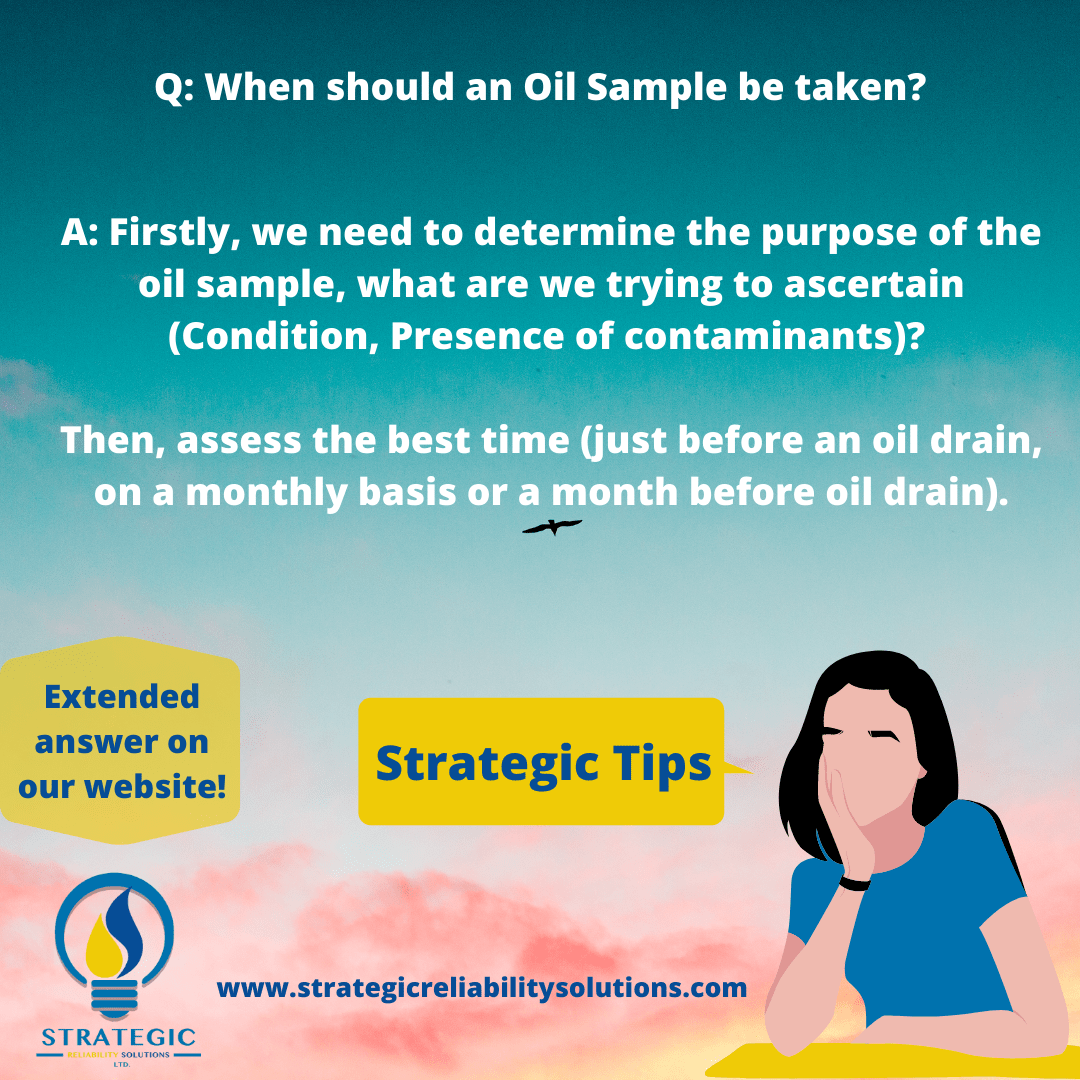
The graphic on the side can be used as a quick guide to determining when to take a sample.

Remember to always evaluate the reason behind establishing the sampling frequency before scheduling sampling.

sampling_freq