Tagged: storage and handling of lubricants

What’s the Difference between Shelf Life vs Service Life?

What the difference between Shelf Life and Service Life?

There’s a major difference between Shelf life and Service life especially when it concerns lubricants!

No one wants to put expired lubricants into their equipment! This can cause unexpected failures which can lead to unplanned downtime which can continue to spiral down the costly path of unproductivity!
shelf_life_service_life

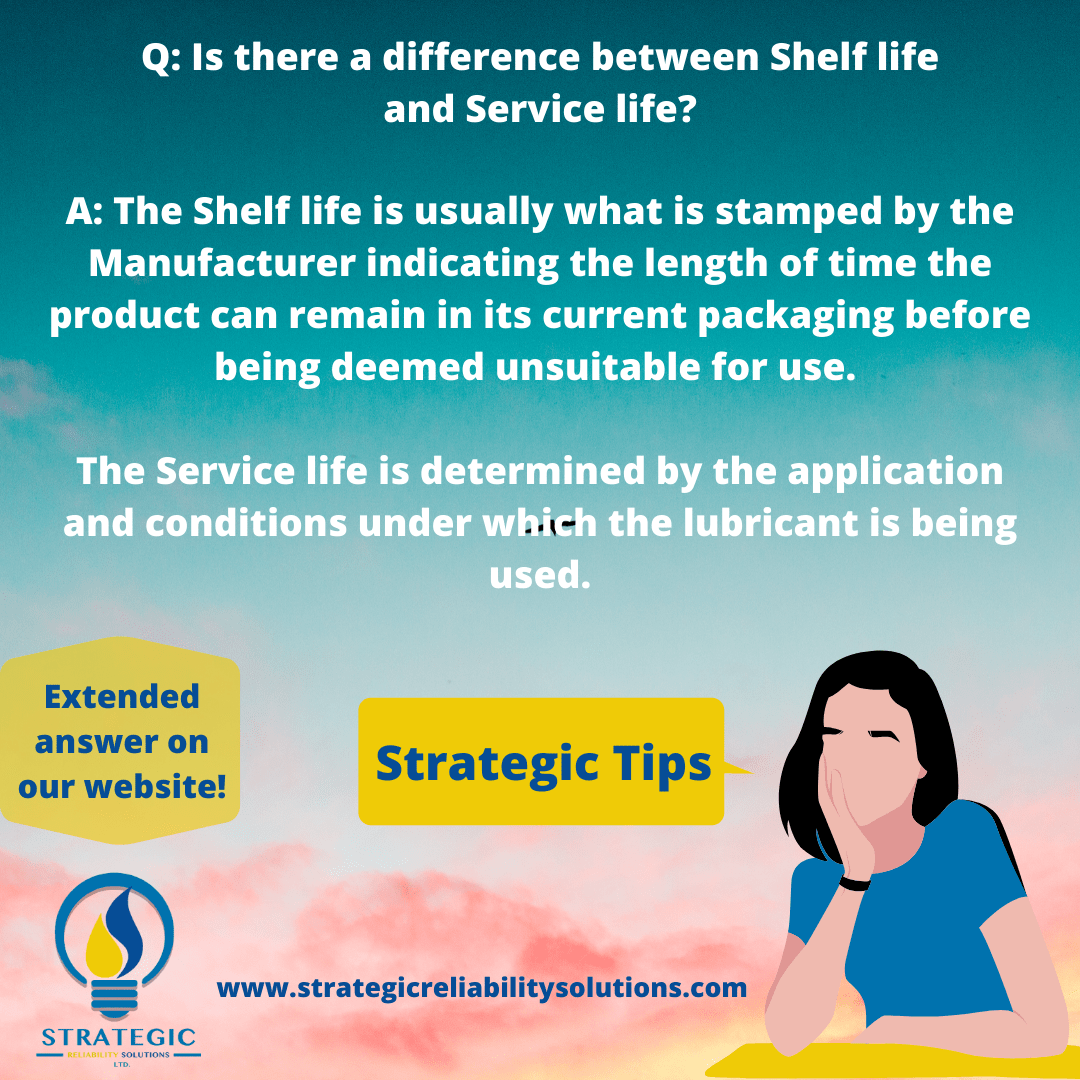
Shelf Life

The Shelf life is usually what is stamped by the Manufacturer indicating the length of time the product can remain in its current packaging before being deemed unsuitable for use. These can typically be found on the packaging.

Service Life

The Service life however is determined by the application and conditions under which the lubricant is being used. Usually, estimated running hours / mileage are given by the equipment manufacturer in the maintenance section of the manual. (Condition monitoring can also be used to determine appropriate service intervals.)

However, how will someone know if the product has deteriorated while still in its original packaging?  What should someone typically look for?

Above are some tips for identification of deterioration in lubricants. Take a note of these for the next time you are unsure of the integrity of your lubricants.

Written by Sanya Mathura, CEO & Founder of Strategic Reliability Solutions Ltd. 
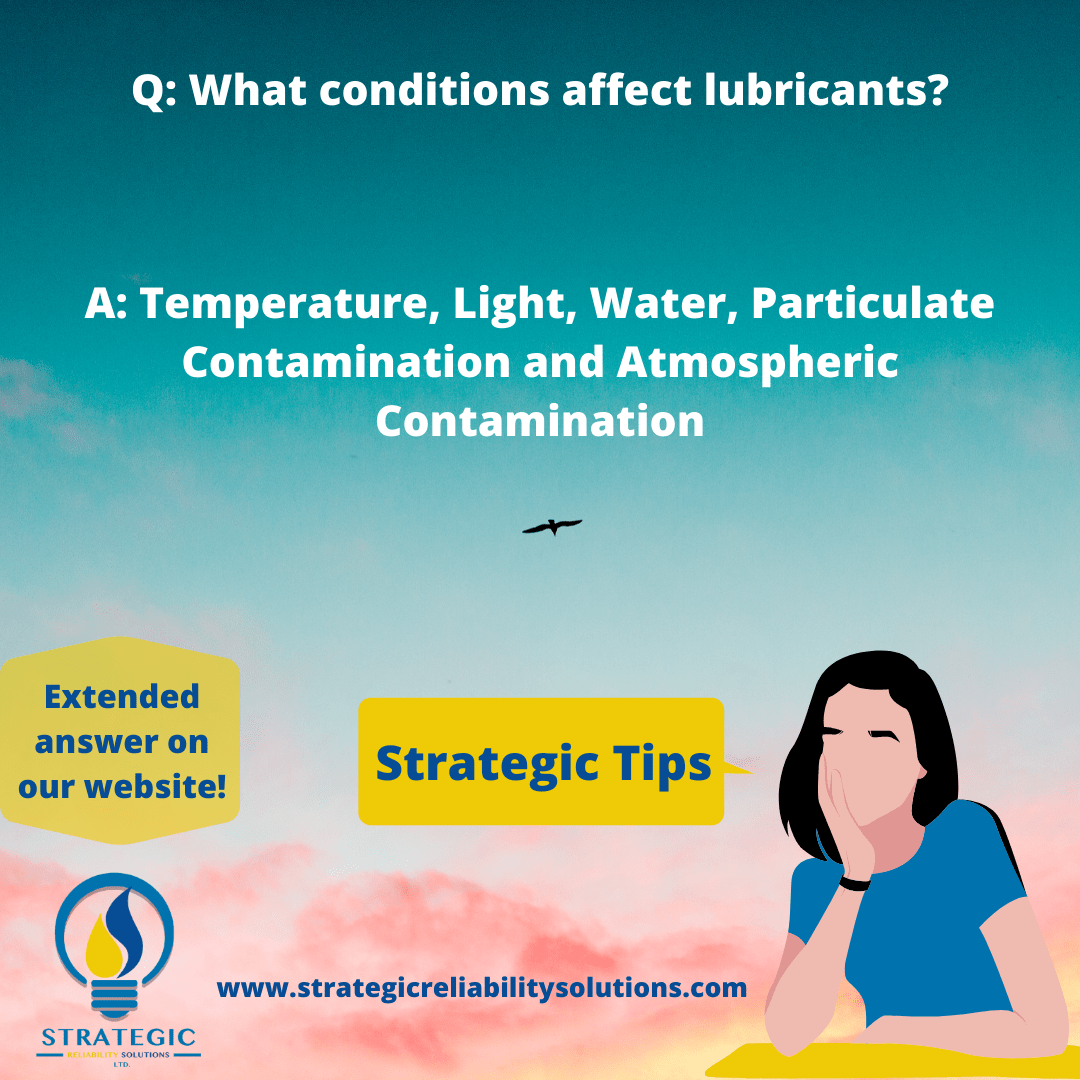
Conditions that affect lubricants

What conditions affect lubricants?

How are your lubricants currently stored?

Are you storing lubricants under the correct conditions?

These questions have come up a dozen times during audits and countless warehouse meetings!

conditions
Conditions that affect lubricants

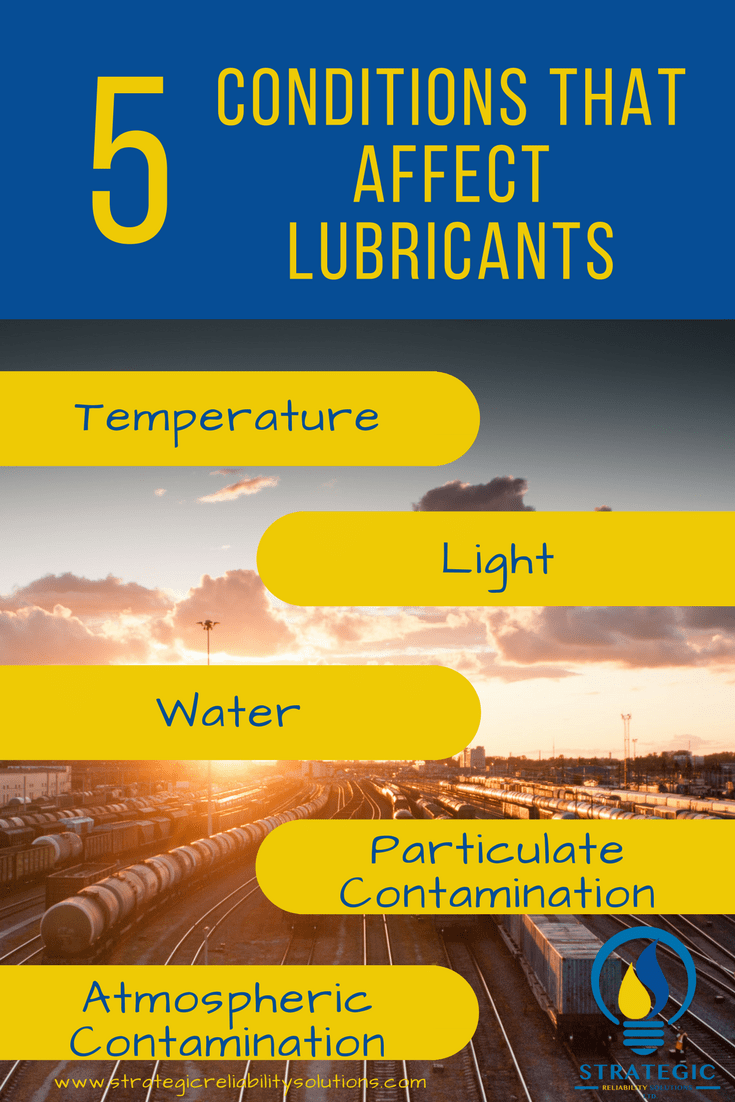
To answer these questions, there are five main conditions that can affect lubricants. We have detailed them along with the effects of these conditions on the lubricant.

  • Temperature – if incorrect can lead to oxidation. For every 10C rise in temperature above 40C the life of the lubricant is halved.
  • Light – too much can lead to oxidation especially for light sensitive lubricants such as transformer oils. Hence the reason that most packaging is opaque.
  • Water – this usually works with additives to cause their depletion or contamination of the product. Water in any lubricant is bad (especially for transformer oils as they are involved in the conduction of electricity.
  • Particulate contamination – contamination can occur by air borne particles if packaging is left open or if dirty containers/vessels are used to transfer the lubricant from its packaging to the component.
  • Atmospheric contamination – this affects viscosity and promotes oxidation and can occur if packaging is left open. For instance, if a drum is not properly resealed or capped after usage or the most common practice of leaving the drum open with the drum pump on the inside.

Different types of lubricant degradation

Why is it important to know the types of lubricant degradation?

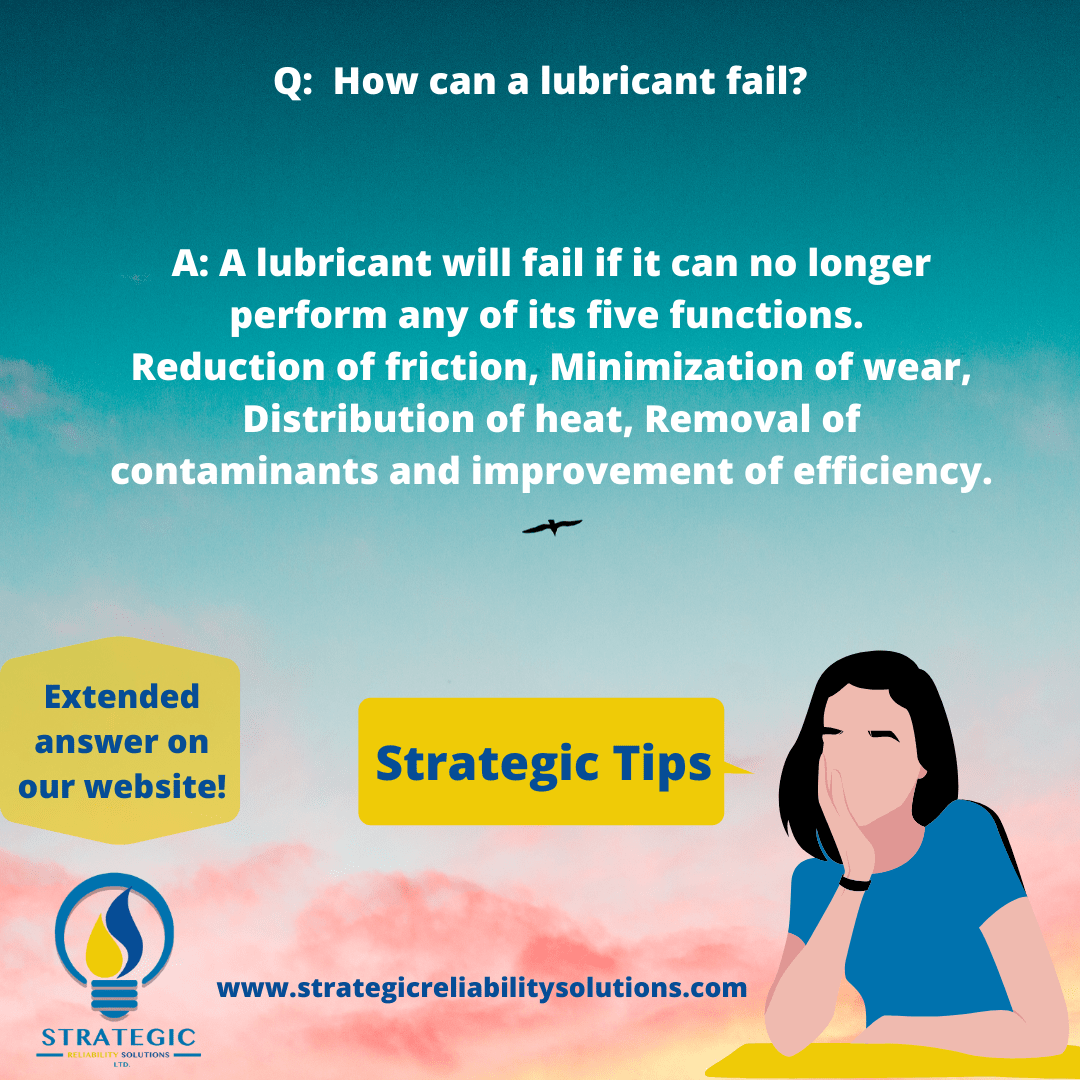
It’s important since it helps us to figure out why or in some instance how, the lubricant degraded! Usually degradation is the change that occurs when the lubricant can no longer execute its five main functions:

  • the reduction of friction
  • minimization of wear
  • distribution of heat
  • removal of contaminants and
  • improvement of efficiency.


lubricant_fails
Types of lubricant Degradation Mechanisms

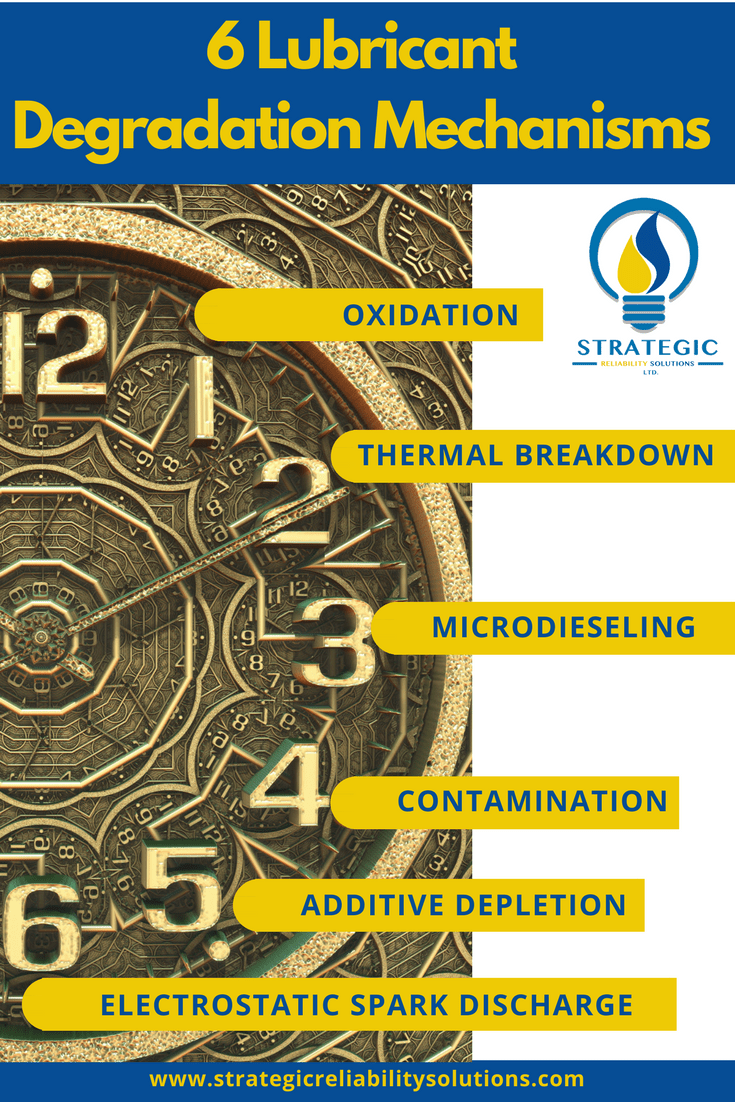
There are 6 main types of Lubricant Degradation as detailed below. Each type produces various by products which can enable us to understand the reason for the degradation and eliminate that / those reasons.

Here are the 6 main types of Lubricant Degradation:

1. Oxidation
2. Thermal Breakdown
3. Microdieseling
4. Additive Depletion
5. Electrostatic Spark Discharge
6. Contamination

As discussed, each mechanism produces distinct results which help us in their identification! Check out our article on why lubricants fail for more info!

Written by Sanya Mathura, CEO & Founder of Strategic Reliability Solutions Ltd.