Tagged: reliability

Multigrade vs Monograde

multi_mono

Why use multigrade instead of monograde oils?

A monograde oil does not provide the same level of protection on start-up as a multigrade oil.

With the multigrade oil, it is designed to reduce the time it takes to get from the bottom of the sump to the top of the engine (this is indicated by the number in front of the “w”).

However, the monograde oils have not been adapted for this type of technology. Thus, it takes longer to get to the top of the engine and to all the components compared to a multigrade oil.

Most wear occurs on start-up. Before we start the car on a morning, all of the oil is at the bottom of the sump, so it takes some time to get to the top and the other components. However, once we start the engine, all the parts will begin moving. If they are moving without any lubrication, then a significant amount of wear will occur!

Typically, when driving, we start the car, go to our destination and stop. Then come back and start the car again. During this time, the oil would have drained back to the bottom of the sump and now has to get back to the top. Before it gets to the components, these are still moving without lubrication, inducing wear! If we think of the number of times that we start and stop for the day (or for the month!), we will realize the amount of wear that we put our engines through.

Hence, this is one of the main reasons, that we choose multigrades over monogrades.


Written by Sanya Mathura, CEO & Founder of Strategic Reliability Solutions Ltd. 
What does the “w” stand for in oil?

w_oil

What does the “w” stand for in multigrade oils?

The “w” stands for winter.

Let’s go back a bit. We weren’t always as advanced in lubricant technology as we are today. For instance, if we left an ice tray filled with water on the table, what would happen? It would remain in that state of water. Now, if we placed that in the freezer, the water would turn into ice.

Similarly, before we advanced lubrication technology, there was one oil to be used for the Summer and one for the Winter. During the summer, the temperatures were higher and during the winter the temperatures were lower.

The “w” helps us to understand that this is the measurement related to how an oil flows at a cold temperature (or on start-up). It does not mean that you can only use an oil with a “w” in countries that experience winter!

The lower the number is in front of the “w”, the faster the oil flows on start-up. When we start our cars on a morning, all of the oil is at the bottom of the sump. It will take some time before the oil gets from the bottom to the top of the engine.

However, all of the parts in the engine are moving before they get the oil. Thus, it is critical to get the oil to them in the shortest time possible. The lower the number in front of the “w”, the faster the oil takes to get to the top of the engine (this will reduce the amount of wear that occurs).

Quick Tip: Zero (0) does not mean that there is no protection on start up, it means that it will get to the components faster than all the other grades (like a 0w20).


What about the number after the “w”?

This is the number that represents the viscosity of the oil at operating temperature. When the engine begins operating this is the viscosity that flows through all of the lines and components continuously. As we mentioned in an earlier post, the value has decreased in recent times (some going as low as 0w16!) due to the lines being thinner, which is ideal for lower viscosities.

Written by Sanya Mathura, CEO & Founder of Strategic Reliability Solutions Ltd. 
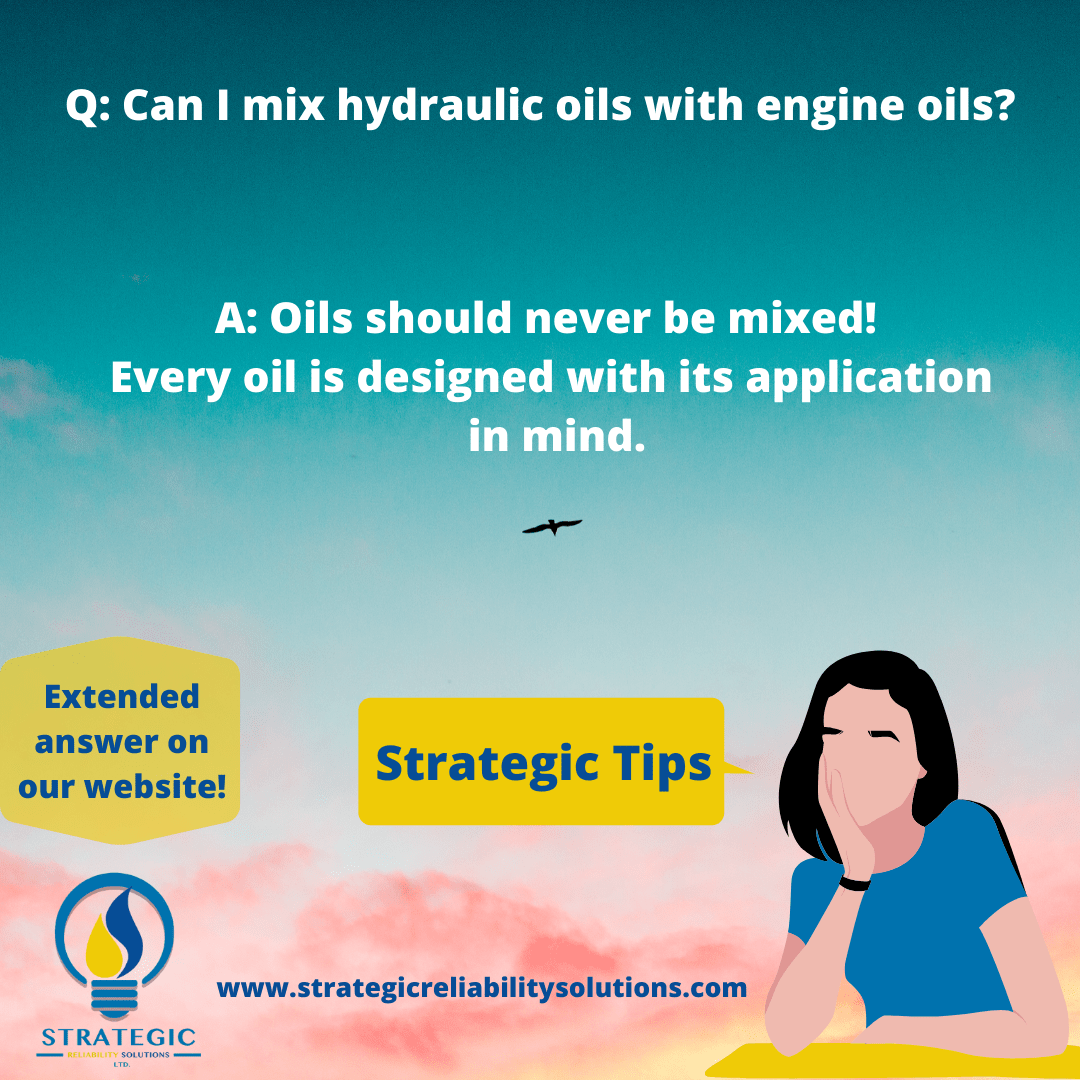
Additives and their properties

Properties of Additives in Lubricants

add_calcium

Each lubricant has a varying percentage of additives as not all lubricants are created equally. Lubricants are designed based on their application or use within the industry. For instance, an engine oil is typically composed of 30% additives, 70% base oil while turbine oils comprise 1% additives and 99% base oil.

Therefore, particular attention must be paid to getting the additive compositions to be just right for the application and ensuring that the additives can perform their functions.

Each additive has a particular function and is used as per the application of the lubricant. We have adapted the following from Analysts Inc – Basic Oil Analysis which describes the purpose of some of the most commonly used additives in lubricants.

additives

ICML 55 – the revolution in the lubrication sector

icml_stds

What is ICML 55?

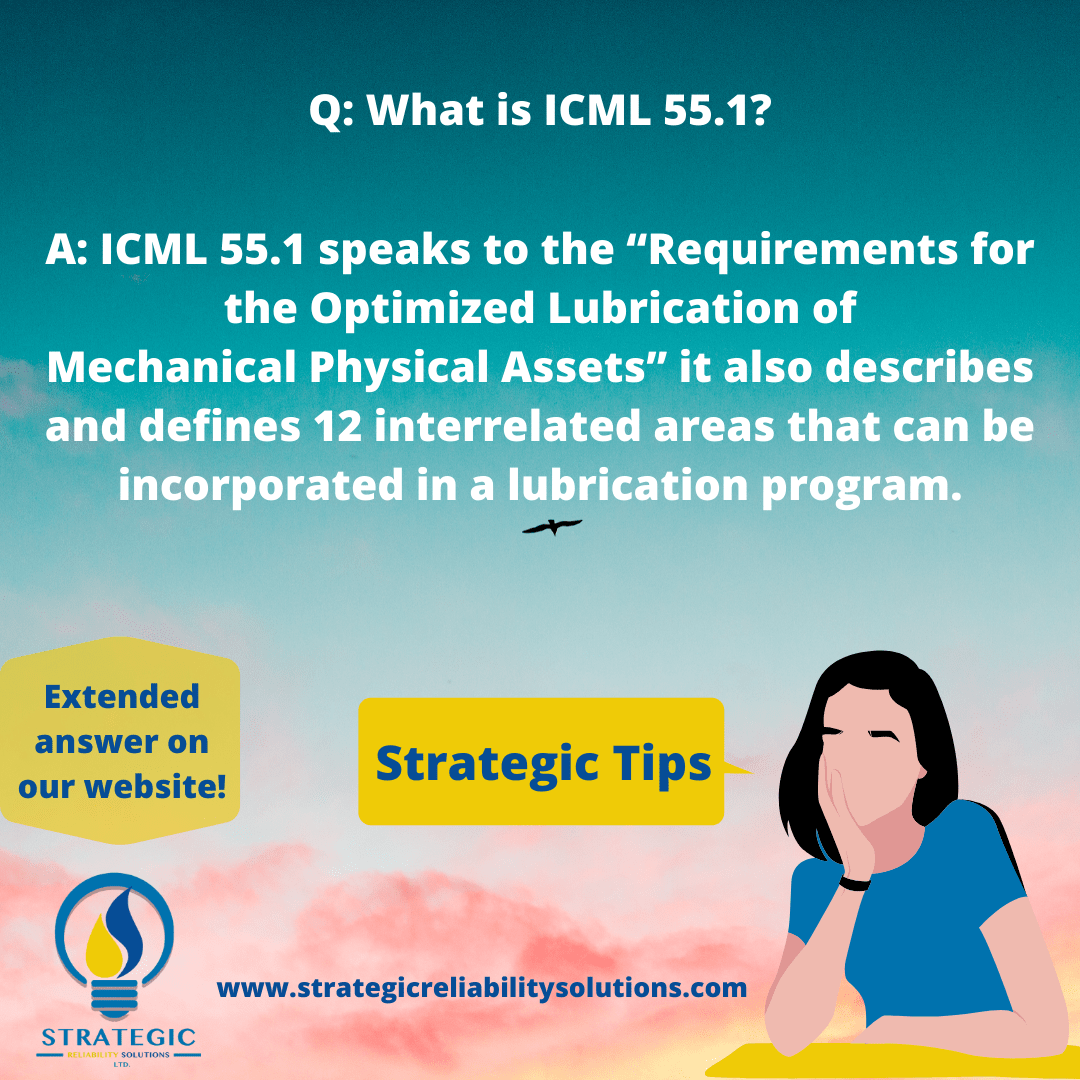
ICML 55 is revolutionizing the lubrication industry! It is so exciting to be around at this time when it has started its implementation. For those who aren’t aware of ICML 55, here are a couple of notes on it.

ICML 55 was born out of ISO 55000 which speaks to Asset Management. From this standard, 3 standards were developed to guide the lubrication industry since no previous standards existed within the lubrication industry.

  • ICML 55.1 - Requirements for the Optimized Lubrication of Mechanical Physical Assets
  • ICML 55.2 - Guideline for the Optimized Lubrication of Mechanical Physical Assets
  • ICML 55.3 - Auditors' Standard Practice and Policies Manual

ICML 55.1 has already been completed, while 55.2 should be done at the end of this year and 55.3 scheduled for 2020.

These are exciting times!

Here’s the official press release:

https://info.lubecouncil.org/2019/04/04/icml-introduces-icml-55-asset-management-standards-mle-engineer-certification/

While ICML 55.1 was only launched in April of this year (2019), it is a standard that the lubrication industry has been in need of for several years. It addresses the “Requirements for the Optimized Lubrication of Mechanical Physical Assets”.

What exactly are the assets covered? Here they are:

  • Rotating & Reciprocating Machines, Powertrains, Hydraulic Systems and lubricated subcomponents
  • Assets with lubricants that reduce friction, wear, corrosion, heat generation or facilitate transfer of energy
  • Finished products from API categories I-V
  • Non Machinery support assets (Personnel, policies, procedures, storage facilities and management)
icml_55

There are also fluids and assets which are NOT covered:

  • Fuels, coolants, metal-working fluids, pastes, fogging agents, preservative fluids, coating materials, heat-transfer fluids, brake fluids, cosmetic lubricants
  • Solid lubricants (e.g., powders and surface treatments used as coating rather than to reduce friction between surfaces in motion)
  • Additives independent of the finished lubricant
  • Electrical transformer oils and anti-seize compounds
  • Fluids and materials derived from a petroleum or petroleum-like base
  • Fluids that do not serve a lubrication function
Photo Credit: https://info.lubecouncil.org/icml-55-standards/

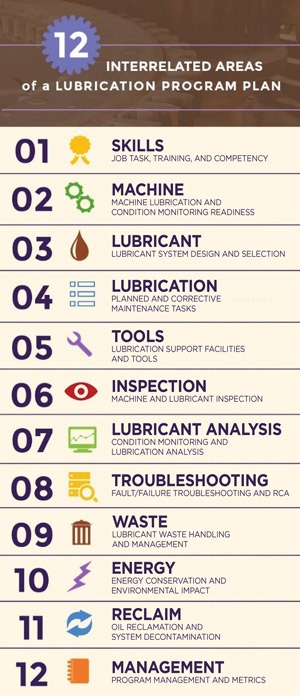
ICML 55.1 speaks to the “Requirements for the Optimized Lubrication of Mechanical Physical Assets” it also describes and defines 12 interrelated areas that can be incorporated in a lubrication program. This has never been officially documented before, nor has any standard been published as a guideline for lubrication programs.

The 12 areas are outlined below:

  1. SKILLS: Job Task, Training, and Competency
  2. MACHINE: Machine Lubrication and Condition Monitoring Readiness
  3. LUBRICANT: Lubricant System Design and Selection
  4. LUBRICATION: Planned and Corrective Maintenance Tasks
  5. TOOLS: Lubrication Support Facilities and Tools
  6. INSPECTION: Machine and Lubricant Inspection
  7. LUBRICANT ANALYSIS: Condition Monitoring and Lubrication Analysis
  8. TROUBLESHOOT: Fault/Failure Troubleshooting and RCA
  9. WASTE: Lubricant Waste Handling and Management
  10. ENERGY: Energy Conservation and Environmental Impact
  11. RECLAIM: Oil Reclamation and System Decontamination
  12. MANAGEMENT: Program Management and Metrics

As per ICML's website, here's a list of people that the new standard can benefit:

Photo Credit: https://info.lubecouncil.org/icml-55-standards/


Check out the ICML 55 standards today and apply it to your organization!

Written by Sanya Mathura, CEO & Founder of Strategic Reliability Solutions Ltd. 

When should an oil sample be taken?

oil_sample

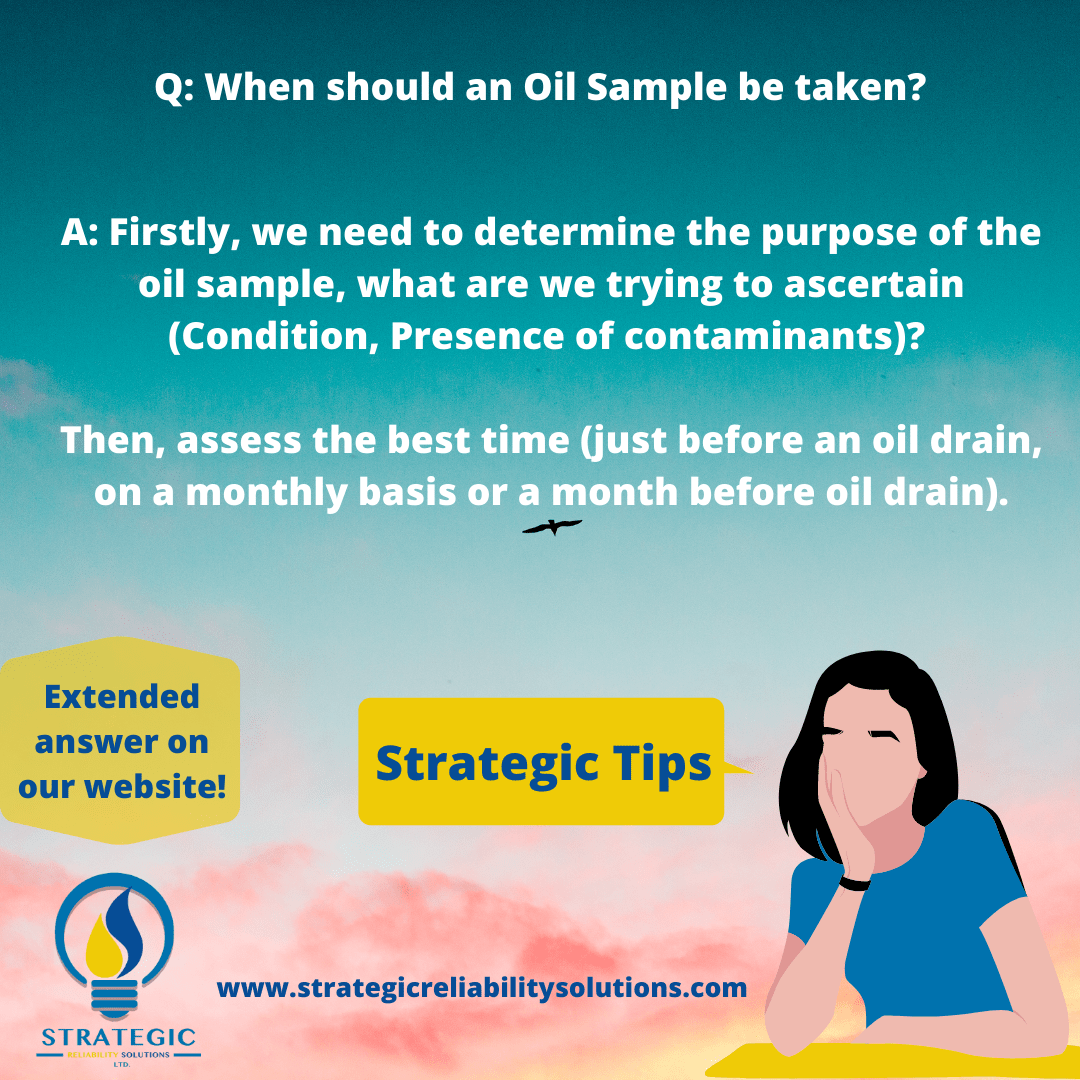
“When should an oil sample really be taken?”

In used oil analysis, oil samples can be taken at any time, but one should always consider the insight that they are trying to gain before testing the sample. This is crucial in deciding the type of tests and the intervals at which they should be performed.


For instance, if we are testing the quality of the oil or we want to compare a fresh batch to a used one, then we can take a sample directly from the drum.

If we are trying to decide the rate at which the additives are being depleted or wear being accumulated then we can take a sample at different operating hours to trend the data. This method can work if we are trying to determine the most appropriate run time for a lubricant in particular conditions.

However, if we are trying to track the health of the components on a regular basis as part of our PM program then taking a sample at the end of the scheduled maintenance interval is desired.

Taking an oil sample from a component is like performing a blood test by the doctor. It helps us to understand what’s really happening. It can show us if there is excessive wear, contamination or lubricant degradation which allows us to identify its “health”. However, the correct tests need to be carried out to determine these conditions.

There must be a reason behind taking the oil sample, not just a random act. When trying to establish a trend regarding a particular aspect of the oil, this should guide your choice of tests otherwise we can end up paying for tests that do not add value.

Always ensure sound reasoning behind testing rather than just checking the box!

While taking an oil sample at the end of the scheduled operating hours is very convenient, is it truly efficient?

When a piece of equipment is scheduled for maintenance, it is usually taken out of service for a couple of hours to perform the assigned
maintenance tasks.

However, if an oil sample is taken a couple days in advance of the scheduled maintenance, then when the results return the maintenance team can be on the lookout for issues highlighted by the results.

For instance, if the value for iron was significant or rising then they can perform inspections for areas which may cause this type of wear and address this challenge while the equipment is offline.

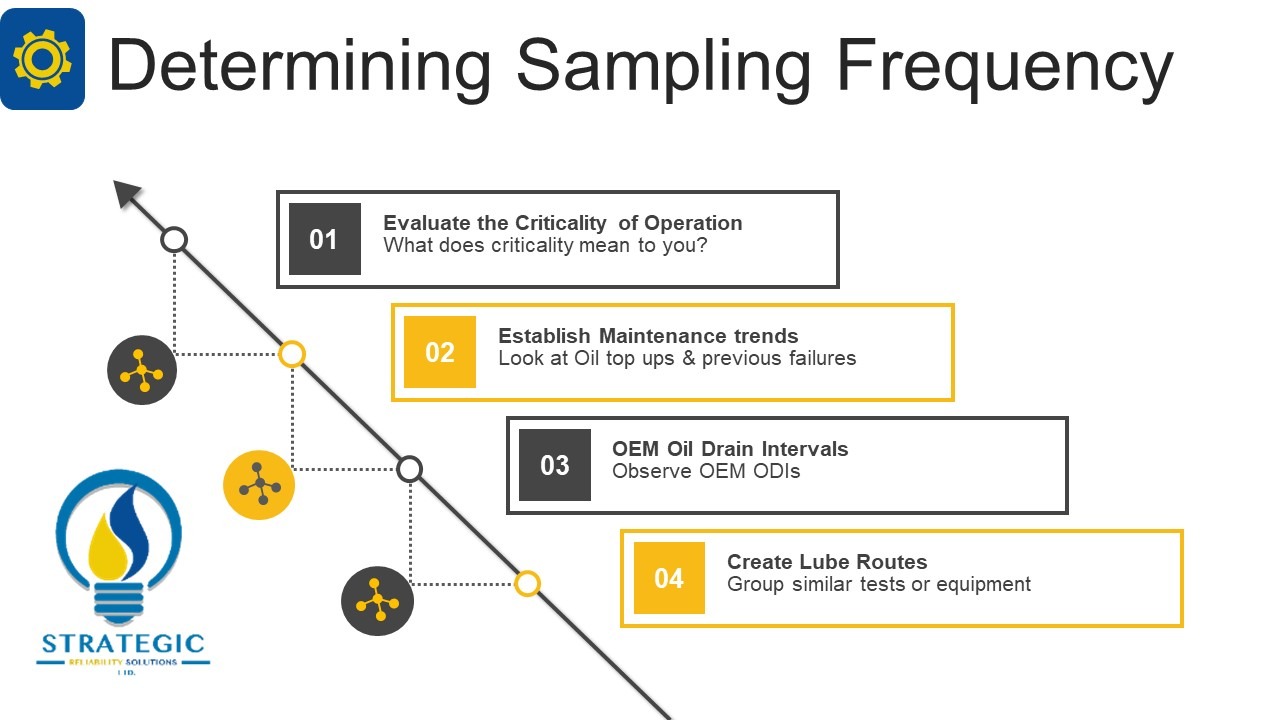
The graphic on the side can be used as a quick guide to determining when to take a sample.

Remember to always evaluate the reason behind establishing the sampling frequency before scheduling sampling.

sampling_freq

What’s the Difference between Shelf Life vs Service Life?

What the difference between Shelf Life and Service Life?

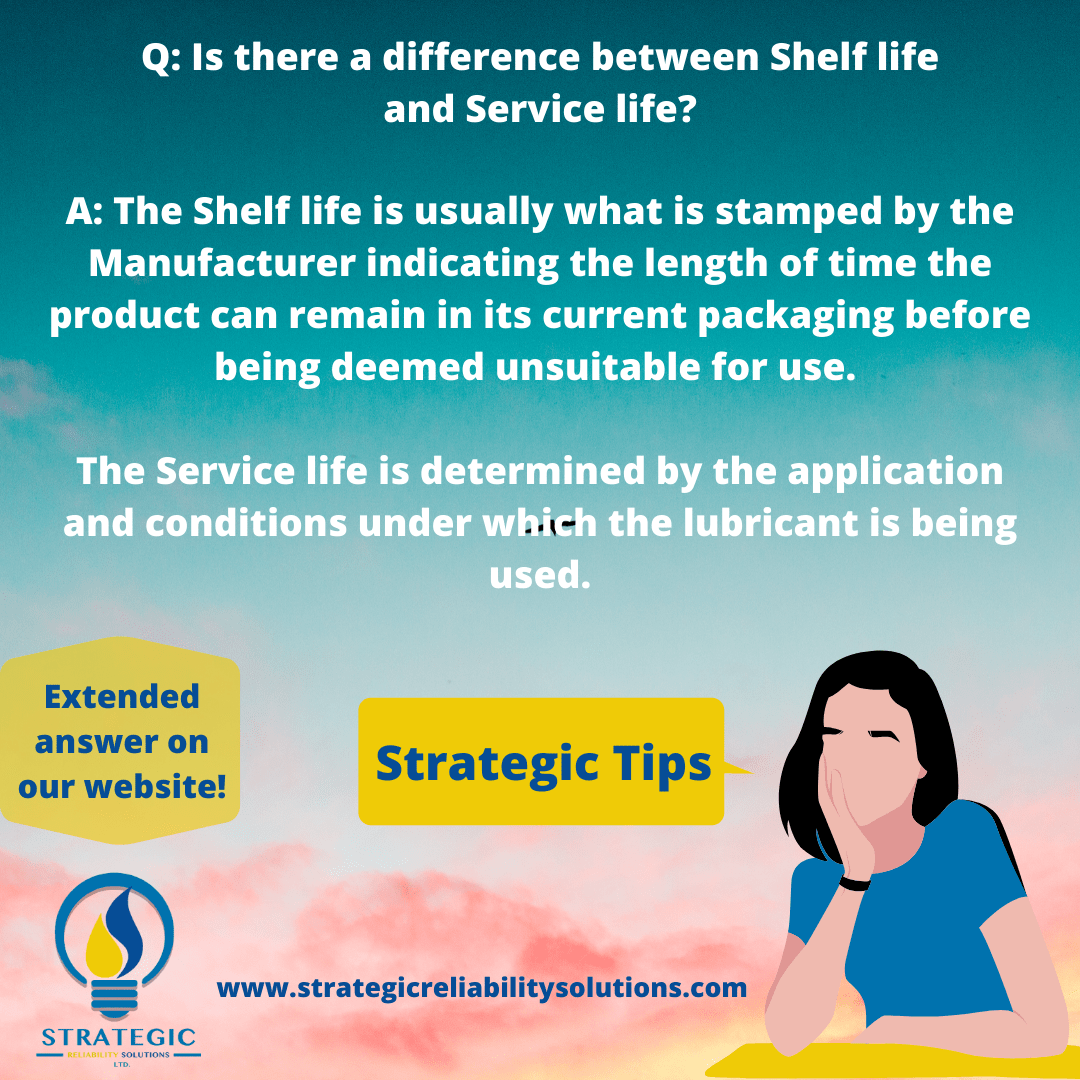
There’s a major difference between Shelf life and Service life especially when it concerns lubricants!

No one wants to put expired lubricants into their equipment! This can cause unexpected failures which can lead to unplanned downtime which can continue to spiral down the costly path of unproductivity!

shelf_life_service_life

Shelf Life

The Shelf life is usually what is stamped by the Manufacturer indicating the length of time the product can remain in its current packaging before being deemed unsuitable for use. These can typically be found on the packaging.

Service Life

The Service life however is determined by the application and conditions under which the lubricant is being used. Usually, estimated running hours / mileage are given by the equipment manufacturer in the maintenance section of the manual. (Condition monitoring can also be used to determine appropriate service intervals.)

However, how will someone know if the product has deteriorated while still in its original packaging?  What should someone typically look for?

Above are some tips for identification of deterioration in lubricants. Take a note of these for the next time you are unsure of the integrity of your lubricants.

Written by Sanya Mathura, CEO & Founder of Strategic Reliability Solutions Ltd. 

Conditions that affect lubricants

What conditions affect lubricants?

How are your lubricants currently stored?

Are you storing lubricants under the correct conditions?

These questions have come up a dozen times during audits and countless warehouse meetings!

conditions
Conditions that affect lubricants

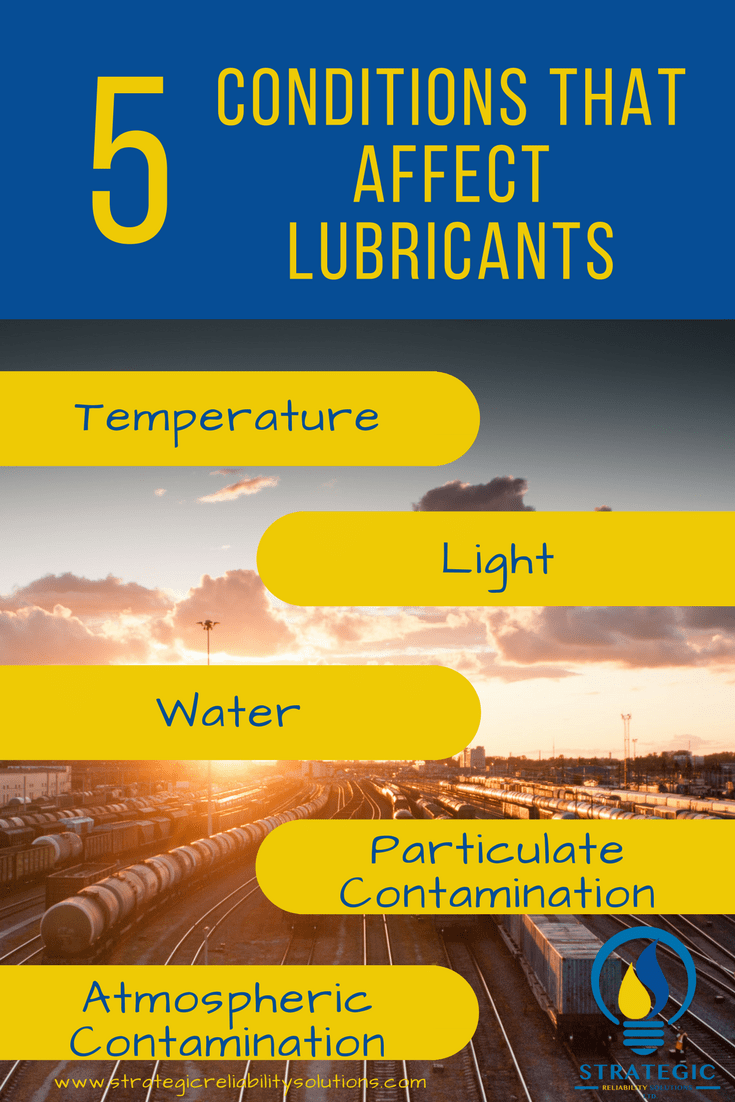
To answer these questions, there are five main conditions that can affect lubricants. We have detailed them along with the effects of these conditions on the lubricant.

  • Temperature – if incorrect can lead to oxidation. For every 10C rise in temperature above 40C the life of the lubricant is halved.
  • Light – too much can lead to oxidation especially for light sensitive lubricants such as transformer oils. Hence the reason that most packaging is opaque.
  • Water – this usually works with additives to cause their depletion or contamination of the product. Water in any lubricant is bad (especially for transformer oils as they are involved in the conduction of electricity.
  • Particulate contamination – contamination can occur by air borne particles if packaging is left open or if dirty containers/vessels are used to transfer the lubricant from its packaging to the component.
  • Atmospheric contamination – this affects viscosity and promotes oxidation and can occur if packaging is left open. For instance, if a drum is not properly resealed or capped after usage or the most common practice of leaving the drum open with the drum pump on the inside.

Different types of lubricant degradation

Why is it important to know the types of lubricant degradation?

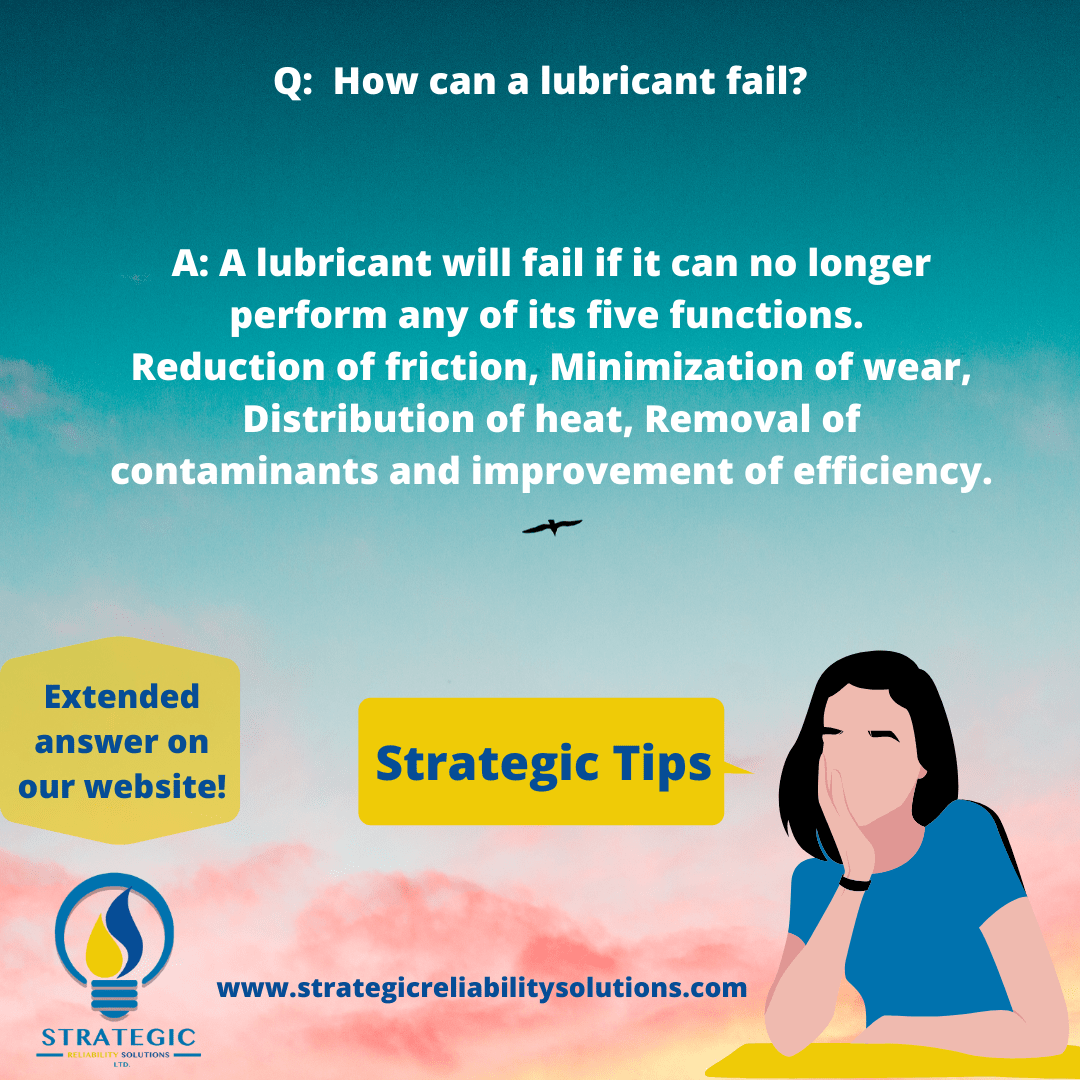
It’s important since it helps us to figure out why or in some instance how, the lubricant degraded! Usually degradation is the change that occurs when the lubricant can no longer execute its five main functions:

  • the reduction of friction
  • minimization of wear
  • distribution of heat
  • removal of contaminants and
  • improvement of efficiency.


lubricant_fails
Types of lubricant Degradation Mechanisms

There are 6 main types of Lubricant Degradation as detailed below. Each type produces various by products which can enable us to understand the reason for the degradation and eliminate that / those reasons.

Here are the 6 main types of Lubricant Degradation:

1. Oxidation
2. Thermal Breakdown
3. Microdieseling
4. Additive Depletion
5. Electrostatic Spark Discharge
6. Contamination

As discussed, each mechanism produces distinct results which help us in their identification! Check out our article on why lubricants fail for more info!

Written by Sanya Mathura, CEO & Founder of Strategic Reliability Solutions Ltd. 

Thermal Degradation vs Oxidation

What’s the difference between Thermal Degradation and Oxidation of a lubricant?

ox_vs_td

The two major differences are the contributory factors and the by products that are produced.

For oxidation, both oxygen and temperature are critical to the degradation of the lubricant however, in thermal degradation, the temperature of the lubricant exceeds its thermal stability (usually in excess of 200°C).

Oxidation usually occurs through the release of free radicals which deplete the antioxidants however, Thermal Degradation consists of polymerization of the lubricant.

Oxidation produces aldehydes, ketones, hydroperoxides, carboxylic acids varnish and sludge. On the other hand, Thermal Degradation produces coke as the final deposit.

Written by Sanya Mathura, CEO & Founder of Strategic Reliability Solutions Ltd. 
Microdieseling

microdieseling

What is Microdieseling?

Microdieseling is also called Compressive Heating and is a form of pressure induced thermal degradation.

The oil goes through 4 stages in this degradation process:

1. There is a transition of entrained air from a low pressure to a high pressure zone

2. This produces localized temperatures in excess of 1000°C

3. The Bubble interface becomes carbonized

4. The oil darkens rapidly and produces carbon deposits due to oxidation


The conditions required for microdieseling can be either:

  • Low flashpoint with LOW implosion pressure
  • Low flashpoint with HIGH implosion pressure

For a low flashpoint with a HIGH implosion pressure, this constitutes to ignition products of incomplete combustion such as soots, tars and sludge

However, for a low flashpoint with a LOW implosion pressure, adiabatic compressive thermal heating degradation occurs to produce varnish from carbon insolubles such as coke, tars and resin.

Written by Sanya Mathura, CEO & Founder of Strategic Reliability Solutions Ltd. 

stages_MD

Grease compatibility

comp_grease

Are all greases compatible?

We recently touched on greases being available in a wide variety based on application but the real question is, “Are all greases compatible?”

The short answer is, “No”.

All greases contain a thickener (which helps with its physical state). Thickeners vary depending on application (such as temperature, water resistance etc). As such, to verify whether two greases are compatible or not, Machinery Lubrication developed a Compatibility Chart based on thickener type.


You can determine the thickener type by looking at your Data Sheet or talking to your OEM.

Not all greases are compatible, so be careful when mixing greases!


Written by Sanya Mathura, CEO & Founder of Strategic Reliability Solutions Ltd.