Tagged: engineering

Conditions that affect lubricants

What conditions affect lubricants?

How are your lubricants currently stored?

Are you storing lubricants under the correct conditions?

These questions have come up a dozen times during audits and countless warehouse meetings!
conditions
Conditions that affect lubricants

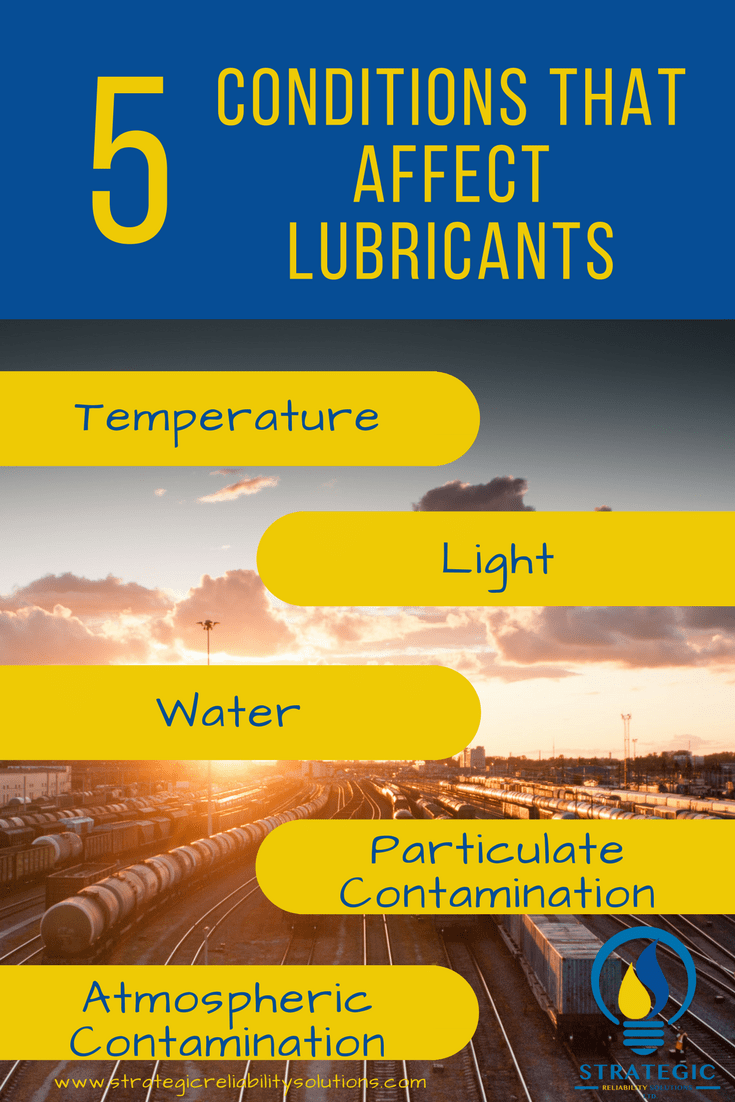
To answer these questions, there are five main conditions that can affect lubricants. We have detailed them along with the effects of these conditions on the lubricant.

  • Temperature – if incorrect can lead to oxidation. For every 10C rise in temperature above 40C the life of the lubricant is halved.
  • Light – too much can lead to oxidation especially for light sensitive lubricants such as transformer oils. Hence the reason that most packaging is opaque.
  • Water – this usually works with additives to cause their depletion or contamination of the product. Water in any lubricant is bad (especially for transformer oils as they are involved in the conduction of electricity.
  • Particulate contamination – contamination can occur by air borne particles if packaging is left open or if dirty containers/vessels are used to transfer the lubricant from its packaging to the component.
  • Atmospheric contamination – this affects viscosity and promotes oxidation and can occur if packaging is left open. For instance, if a drum is not properly resealed or capped after usage or the most common practice of leaving the drum open with the drum pump on the inside.

Different types of lubricant degradation

Why is it important to know the types of lubricant degradation?

It’s important since it helps us to figure out why or in some instance how, the lubricant degraded! Usually degradation is the change that occurs when the lubricant can no longer execute its five main functions:

  • the reduction of friction
  • minimization of wear
  • distribution of heat
  • removal of contaminants and
  • improvement of efficiency.


lubricant_fails
Types of lubricant Degradation Mechanisms

There are 6 main types of Lubricant Degradation as detailed below. Each type produces various by products which can enable us to understand the reason for the degradation and eliminate that / those reasons.

Here are the 6 main types of Lubricant Degradation:

1. Oxidation
2. Thermal Breakdown
3. Microdieseling
4. Additive Depletion
5. Electrostatic Spark Discharge
6. Contamination

As discussed, each mechanism produces distinct results which help us in their identification! Check out our article on why lubricants fail for more info!

Written by Sanya Mathura, CEO & Founder of Strategic Reliability Solutions Ltd. 

Microdieseling

microdieseling

What is Microdieseling?

Microdieseling is also called Compressive Heating and is a form of pressure induced thermal degradation.

The oil goes through 4 stages in this degradation process:

1. There is a transition of entrained air from a low pressure to a high pressure zone

2. This produces localized temperatures in excess of 1000°C

3. The Bubble interface becomes carbonized

4. The oil darkens rapidly and produces carbon deposits due to oxidation


The conditions required for microdieseling can be either:

  • Low flashpoint with LOW implosion pressure
  • Low flashpoint with HIGH implosion pressure

For a low flashpoint with a HIGH implosion pressure, this constitutes to ignition products of incomplete combustion such as soots, tars and sludge

However, for a low flashpoint with a LOW implosion pressure, adiabatic compressive thermal heating degradation occurs to produce varnish from carbon insolubles such as coke, tars and resin.

Written by Sanya Mathura, CEO & Founder of Strategic Reliability Solutions Ltd. 

stages_MD

Electrostatic Spark Discharge

ESD

What is Electrostatic Spark Discharge?

Electrostatic Spark Discharge is real and extremely common for turbine users!

Static electricity at a molecular level is generated when dry oil passes through tight clearances.

It is believed that the static electricity can build up to a point whereby it produces a spark.

There are three stages of ESD.

1. Static Electricity builds up to produce a spark – Temperatures exceed 10,000°C and the lubricant begins to degrade significantly.

2. Free radicals form – These contribute to the polymerisation of the lubricant

3. Uncontrolled polymerisation – Varnish and sludge produced (some may remain in solution or deposit on surfaces) which can also result in elevated fluid degradation and the presence of insoluble materials.

Grease Thickener Types

grease_thickener_app

Grease Thickener Properties

We keep speaking about each grease being different based on their thickener type. However, what are the properties that these thickeners give to the grease?

For instance, if I wanted to use a grease for a roller bearing in a very high temperature environment which should I choose?

Can a multipurpose grease work for that application?

Each area of application may be different and while multipurpose greases are widely used there are some areas where it doesn’t add much value. For example, if a heavy equipment operator uses a backhoe to dig into a river, the multipurpose grease can be easily washed off.

When the grease washes off quickly, the pins holding the bucket can become damaged. (The costs to repair or replace one of these pins are ridiculously high!) However, if he used a Calcium based grease, then there wouldn’t be an issue of water washout and the pins could have a longer life.

Above is a table indicating the various uses of greases based on the thickener types. Know your applications and their environments when choosing the right grease!


Written by Sanya Mathura, CEO & Founder of Strategic Reliability Solutions Ltd. 

Base oil viscosity of greases

base_oil_vis_grease

Importance of Base oil Viscosity in Greases

While we’ve focused on the variances in greases due to thickener types, we haven’t touched much on the differences in base oil viscosity.

With gear oils, we need the correct viscosity to allow the gears to turn at the required rate while still being lubricated. If the oil is too thick and the gears are high speed, then the gears will not be lubricated quickly enough and they can become damaged. Similarly, greases are made up of base oil with different viscosities.

Most greases use a viscosity of 220cSt (these are the multipurpose greases). However, greases for electric motors use a base oil viscosity of 100cSt. What’s the difference?

Well, if a multipurpose grease was used for an electric motor the energy used for that motor can be 100W however, if a grease with a base oil viscosity of 100cSt was used, the energy used could be reduced to 70W. Is this significant? Definitely YES!!!

On any manufacturing plant, there are at least 5 – 10 electric motors, in some cases there are 70 or more! If at least 25W were saved per motor per month then the company can a significantly reduced power bill at the end of the year!

Understand your applications before applying “any” grease!

Written by Sanya Mathura, CEO & Founder of Strategic Reliability Solutions Ltd. 

Grease Thickener Temperatures

grease_thickener_temp

Understanding Grease Thickener Temperatures

The grease thickener has a crucial role in deciding the environment in which a grease should be applied.

One of the major environmental conditions revolves around the operating temperatures that greases have to endure.

If the grease goes past its dropping point then it can turn into a liquid, leak out of its designated area and cause the element to be starved for lubrication. Not to mention the mess on the outside of the component after it has leaked out.


Each thickener has a range of operating temperatures. However, some consideration should be applied when designating areas for the application of the grease. As indicated above, a good rule of thumb is to ensure that the application range of the grease does not exceed the Dropping point - 50C. For example, a good operating range for a simple Lithium grease can be 175-50C = 125C. This still falls within the maximum service temperature for a grease with this thickener.

Pay careful attention to your operating temperatures when selecting your grease!

Written by Sanya Mathura, CEO & Founder of Strategic Reliability Solutions Ltd. 

Understanding NLGI

Does the NLGI grade matter?

Of course it does! That’s why it was invented and classed into different categories for various applications! NLGI stands for National Lubricating Grease Institute, they are composed of companies that manufacture and market all types of lubricating grease.

An NLGI grade can start at 000 (very fluid) to 6 (block like). However, there are different grades for different applications.

For instance, most trucks have a centralized lubrication system. As such, the grease needs to be almost fluid like to get to all the areas. In these cases, a “00” or even “000” grease may be used. However, the most common grade is a “2” grade which is seen frequently in cartridges, pails etc.  Some electric motors require a “3” grade grease instead of a “2”.

Here is a table that describes each of the grades, their applications and consistency.

Always check with your OEM to ensure that the correct NLGI grade is being used! Here is another graphic that likens these grades to more easily identifiable consistencies.

Grease colours

grease_colour

Is Grease Color important?

I’ve almost always heard my customers refer to the grease that they are using by its colour.They would say, “I’m using the blue grease.”

However, greases are not defined by their colour.

Colour is often added to grease to allow it to be easily identifiable within the field.

For instance, if a grease is coloured blue, it is easy to identify if it’s leaking or not (one way not to confuse the leak with an oil leak).

Some greases are coloured to ensure that the applicant uses it in the correct application.

For example, if a blue grease is a multipurpose grease then this ideally shouldn’t be used in the very high temperature area.

Most of the times, red greases are used for high temperature applications. Thus making it easy to identify if the correct grease is used in the right application.

However, one should note the colours of the greases being used in their facility and their applications before comparing them to that of another facility (which may be using a different grease manufacturer.)

Don’t define greases by their colours, define them by their applications!

Written by Sanya Mathura, CEO & Founder of Strategic Reliability Solutions Ltd. 

Different colours greases

Colour Coding

What is the importance of Colour Coding?

Quite often when we are correcting or helping companies set up their lubrication storage areas, we get asked a lot of questions regarding colour coding.

Colour_coding

Ideally, the concept of colour coding is to allow field personnel to easily identify and associate particular lubricants with their applications.

However, like most things in reliability, this can be customized to suit your organization. There are no hard and fast rules of using only yellow to represent hydraulic oils.

What if we had someone that was colour blind?

Usually, when we start colour coding lubricant storage containers, we include symbols and actual names of the lubricant. This helps to assist personnel in having a 3 point verification system.

First they can verify the colour, then the symbol and of course the name of the lubricant.

Names are crucial! Especially for varying viscosities (such as gear or hydraulic oils). For instance all gear oil would have the same colour and symbol but you wouldn’t want to put an ISO 100 gear oil in a gearbox suited for ISO 680.

Written by Sanya Mathura, CEO & Founder of Strategic Reliability Solutions Ltd. 

ISO 4406

A lot of people get confused when reading the ISO 4406 rating. The rating specifies a range of the number of particles of certain sizes that can pass through 3 particular sized filters namely; 4micron, 6 micron and 14 micron filters respectively.

For instance; a rating of 13/11/8 indicates:

  • 13 represents 40-80 particles over the size of 4um
  • 11 represents a range of 10-20 particles over the size of 6um and
  • 8 represents a range of 1.3-2.5 particles over the size of 14um.

These values are actually the number of particles per milliliter. It does not mean that you have 13, 11 or 18 particles only in your oil, it's much more than that!

There are different ratings for different levels of cleanliness.

If your numbers are really high (25/22/19) then there’s definitely a high level of contamination! (the full chart goes up to 28 and all the way down to 0).

Different components have different ISO cleanliness ratings. For instance, a roller bearing has a higher cleanliness target than a Variable Vane pump.

Understanding the ISO 4406 codes are crucial for determining the steps needed in “cleaning up” your system lubricants.


However, when we test for the cleanliness of an oil, there are a couple things that we need to consider:

  1. When testing, we have exposed the oil to the elements (highly dependent on the method of sampling)
  2. Results are not instantaneous (even with an onsite lab, there will be a timeframe between collecting the sample and processing it)


Since there are lag times involved, the value that is reported for the ISO4406 rating is never really truly representative of the oil. As such, when analysing the results of this test, it is important to consider that the actual value may potentially be higher than reported.


Matt Spurlock CLS, CMRP, MLE explains further about redefining the ISO code in his article entitled; "A Twist on Particle Evaluation: Redefining the ISO Cleanliness Code". 


Written by Sanya Mathura, CEO & Founder of Strategic Reliability Solutions Ltd.