Sometimes we can spend hours poring over technical data sheets, comparing oil performances, and finally selecting the “right” oil which aligns with the needs of our equipment. Then, within 2 months, the oil degrades, our machines shut down, and we have a bunch of maintenance repairs lined up. What went wrong? We clearly had the “right” oil in the equipment; everything should have worked beautifully. This is where the awareness of lubrication and its practices becomes critical.
Having the correct oil is only one part of the puzzle. Being able to deliver that oil in its purest, cleanest form to the machine is often one of the other pieces that go missing. Another piece is selecting the right oil, not just based on the sales guy’s advice, but on the actual operating conditions of your machine. In this article, we dive a bit deeper into ways you can align the right oil with the proper practices, or avoid the wrong ones, to help extend the life of your asset.

Spec Sheet vs Strategy
For this example, we will consider a turbine oil selection. If a customer wants to change the oil in their turbine, then they may consider the following:
- What are the OEM specifications that need to be met?
- Is this oil available from the local supplier?
- How does it compare to other oils on the market?
- Does the cost justify the value? (or will the purchasing department want something cheaper?
For most of these questions, engineers or the person tasked with selecting the oil can readily find the answers in the oil’s technical data sheet and by talking to their sales representative. But if we dive a bit deeper, are we selecting the right oil for the operating and environmental conditions? Let’s examine the selection of a turbine oil for the Siemens SGT 200 Gas turbine that meets the Siemens TLV 9013 04 specification.
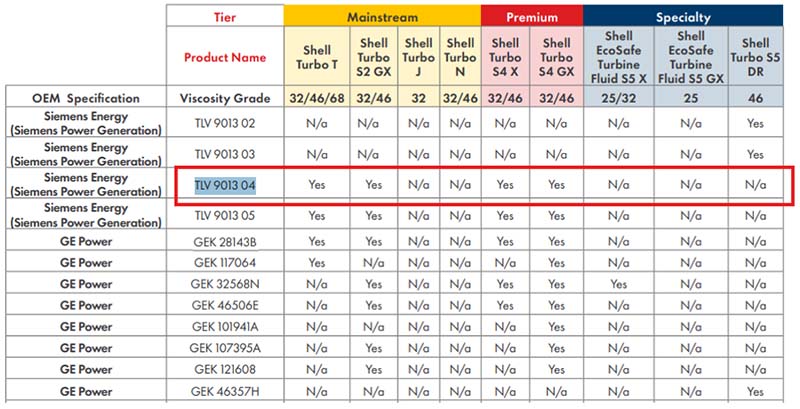
As seen in this document from Shell Lubricants, a few of their products meet that specification, namely Shell Turbo T, Turbo S2GX, Turbo S4X & Turbo S4GX.
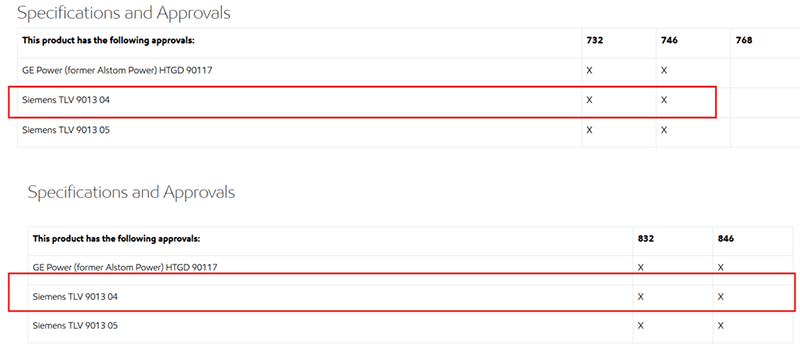
On the other hand, Mobil provides some solutions as well, namely, Mobil DTE 732, 746, or DTE 832, 846
Chevron also provides an option of Chevron GST as follows:
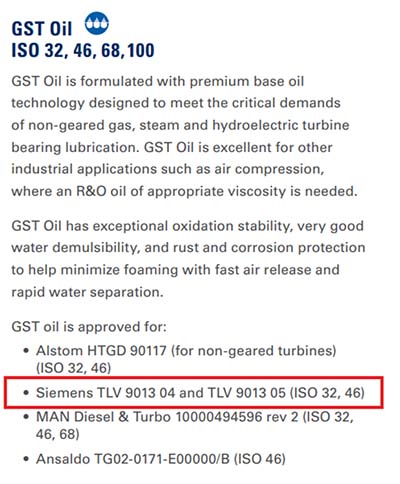
With so many options, how can one choose the “right” oil? They all meet the required Siemens specification, TLV 9013 04. This is where the data sheets, OEM manual, and knowledge of the equipment’s operating conditions play a crucial role.
As per the manual, there are preset conditions for temperatures and pressures, but if your actual system runs hotter (or production is being pushed a bit more), it is functioning outside the operating envelope.
The spec sheet tells you what the oil can do. Your operating conditions tell you what it must do.
Additionally, if your surroundings are harsh (close to the sea or in a corrosive environment, or in a non-ventilated area where heat can build up), these can place additional stress on the equipment. For these harsher conditions, a synthetic oil might be more appropriate than a mineral oil, albeit more expensive in terms of the initial investment.
The manual also specifies which tests/characteristics should be used to monitor the condition of the oil, namely: viscosity, particle count, water content, demulsibility, air release, foaming characteristics, RULER®, and MPC. Based on the performance of your current oil in the system, you can determine whether these values fluctuate toward the higher warning zones. This can also influence your decision about which oil to choose.
It’s not just about the right oil or one that aligns with OEM requirements. The selection should also be based on the environmental conditions of the oil and the equipment, and on whether the oil is suited to perform in these conditions. A mineral oil will not withstand the temperatures that a synthetic oil can for extended periods without degrading. Similarly, given the “right” conditions, synthetic oils can also degrade. By cross-examining your spec sheet, OEM manual, and actual conditions, you can determine the best-suited oil for your operations.
Find out more in the full article, "When 'Right oil, Wrong practice' still fails assets" featured in Precision Lubrication Magazine by Sanya Mathura, CEO & Founder of Strategic Reliability Solutions Ltd.