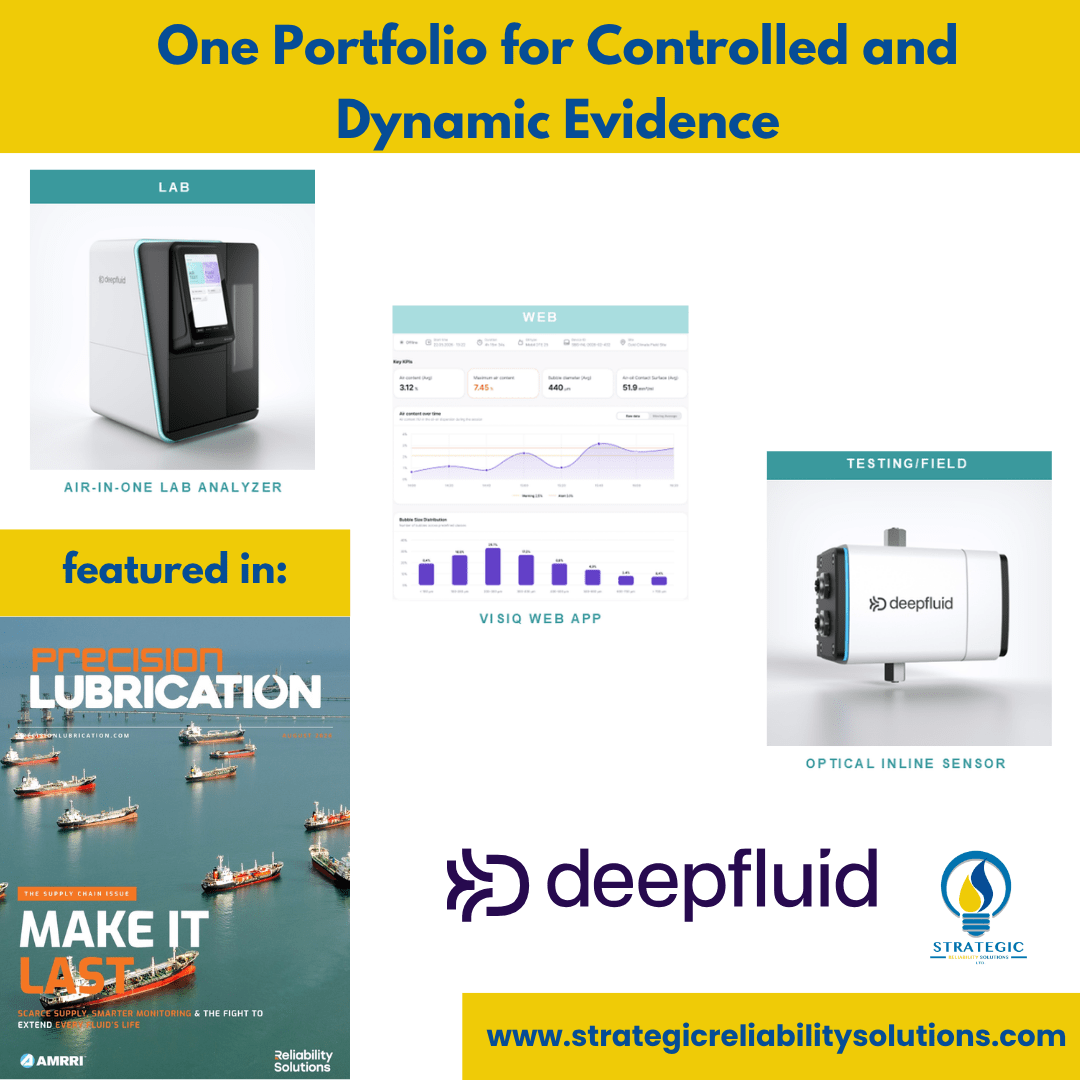
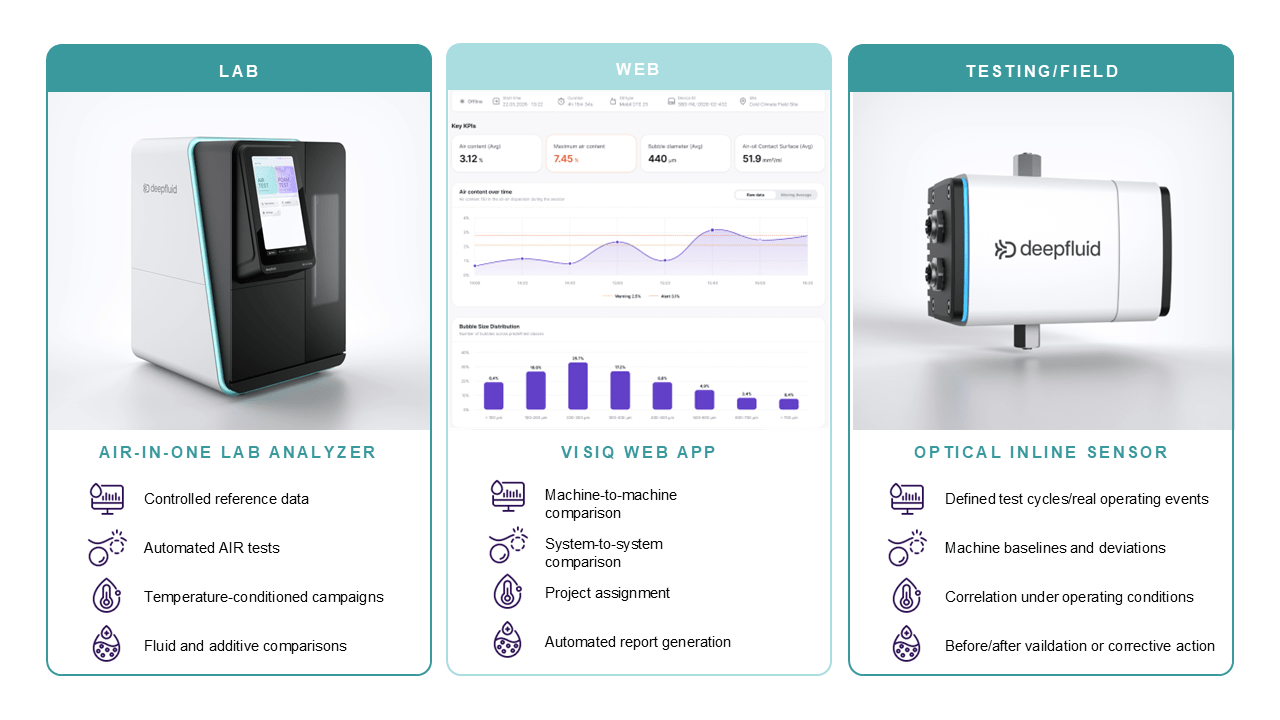
The Deepfluid portfolio applies this methodology through three connected solutions.
The Air-in-One Lab Analyzer establishes controlled references.
The Optical Inline Sensor captures dynamic behavior.
visiQ connects both into a comparable engineering process.
Deepfluid Air-in-One Lab Analyzer
The Deepfluid Air-in-One Lab Analyzer combines air release, foam, and time-resolved bubble behavior within one integrated and automated workflow.
Defined aeration, fluid handling, automated temperature conditioning, optical measurement, foam observation, data transfer, and cleaning can be connected into repeatable test sequences. A fully automated AIR test can capture the complete progression from baseline through Air Intake and Retention to Air Release.
Throughout this sequence, the system measures the physical development of the oil-air dispersion rather than only recording a final release time or foam volume, including Air Content, Bubble Size and Bubble Size Distribution, Bubble Count and Bubble Population, Oil-Air Interfacial Area, and time-resolved Intake, Retention, and Release behavior.
The Air-in-One Lab Analyzer also supports automated test campaigns. Lubricant and additive developers can compare fluid candidates, formulation variants, additive packages, antifoam concentrations, temperature profiles, or aeration durations using the same test logic and evaluation structure.
This makes it possible to investigate not only whether a fluid meets a defined air-release or foam specification, but also why different formulations produce different Air Intake, Retention, Release, and foam responses. Engineers can examine how the bubble population develops before visible foam forms, how much air remains dispersed after aeration stops, and how temperature or formulation changes influence the subsequent recovery.
The approach is not intended to replace standardized ISO or ASTM air-release or foam tests. These methods remain essential for reproducible specification checks and lubricant qualification. The Air-in-One Lab Analyzer adds a complementary, process-aligned R&D perspective that goes beyond a single pass/fail value.
It enables lubricant developers, test engineers, and technical decision-makers to investigate the mechanisms behind Air-in-Oil behavior, compare formulations under application-related conditions, and develop a more complete understanding of Air-in-Oil Contamination before it becomes a field troubleshooting issue.
Standardized tests confirm whether a requirement is met. The AIR workflow helps engineers understand how the result develops—and how that behavior translates from Lab to Field. It is not a replacement for the standardized tests but rather a tool to understand Air-in-Oil Contamination from an R&D perspective.
Deepfluid Optical Inline Sensor
The Deepfluid Optical Inline Sensor transfers the AIR Framework into dynamic test and operating environments.
Instead of recording only a single air-content value, it can capture complete Intake, Retention, and Release behavior over defined time windows. Engineers can observe when a bubble population begins to form, how rapidly it develops, which size classes dominate, how much air remains dispersed after the operating state changes, and how quickly the system returns toward its baseline.
This adds a time-resolved view of transient events. A load change, speed ramp, thermal transition, pressure drop, component-switching event, or start-stop cycle can be evaluated as a complete AIR sequence rather than as an isolated data point.
The sensor can be used in representative inline or bypass configurations, subject to application-specific review. All device configurations have also been developed for demanding high-pressure applications above 150 bar.
When bubble-level data are combined with temperature, pressure, speed, load, flow, efficiency, vibration, or noise, the measurement supports direct comparison between fluids, components, machine variants, and operating conditions. It can also be used to verify whether a design change or corrective action altered the measured Air Intake, Retention, or Release behavior.
The sensor does not automatically diagnose a root cause. It records how the dispersed air phase responds to a defined event, operating state, or intervention and provides evidence for a more focused engineering assessment.
visiQ by Deepfluid
visiQ by Deepfluid provides the common comparison and reporting layer.
Devices and measurement sessions can be assigned to projects, enabling structured data management across development programs, test campaigns, and field investigations. Evidence Snapshots remain linked to the corresponding measurement points and operating context.
The platform supports machine-to-machine, system-to-system, component-to-component, fluid and formulation, and before-and-after comparisons.
For example, the same machine and lubricant can be evaluated under different ambient conditions or load cycles. Conversely, different components can be compared under the same operating profile, or similar machines can be benchmarked across locations. This helps engineering teams distinguish more systematically between fluid-related, component-related, system-related, and environment-related differences.
visiQ also supports automated reporting, reducing the effort required to compile recurring test results, before-and-after comparisons, and structured project summaries.
Find out more in the full article, "From Lab Insight to Field Action: How Air-in-Oil Diagnostics can support better Troubleshooting" featured in Precision Lubrication Magazine by Sanya Mathura, CEO & Founder of Strategic Reliability Solutions Ltd, David Placzek, Dr. Lukas Hafner