Deepfluid’s direct measurement system can be used not only to analyze the interaction between oil and air during operation but also to monitor the overall system behavior and the reliability of the installed components.
The leak-tightness of hydraulic circuits is essential and critical for the safe operation of these systems. Leaks can allow air and particles to be drawn into the system under negative pressure and oil to be forced out of the system under positive pressure. The presence of air significantly alters operating behavior by changing viscosity, density, fluid level, and lubricating film thickness. These factors can lead to damage such as pitting, scuffing, and micro-dieseling.
If an operator or service technician frequently inspects an application’s oil tank—either directly or through large sight glasses—high air content can be detected by significant cloudiness in the oil.
However, if the application’s oil tank is located in a hard-to-reach position, operates autonomously, or is only accessed during shutdown, such extreme conditions are detected very late, in the laboratory—if at all—before costly damage occurs. This is the case with the operation of wind turbines. Although speed, torque, temperature, particle content, and potential oil leaks are detected, suction-side air ingress, for example, cannot be detected.
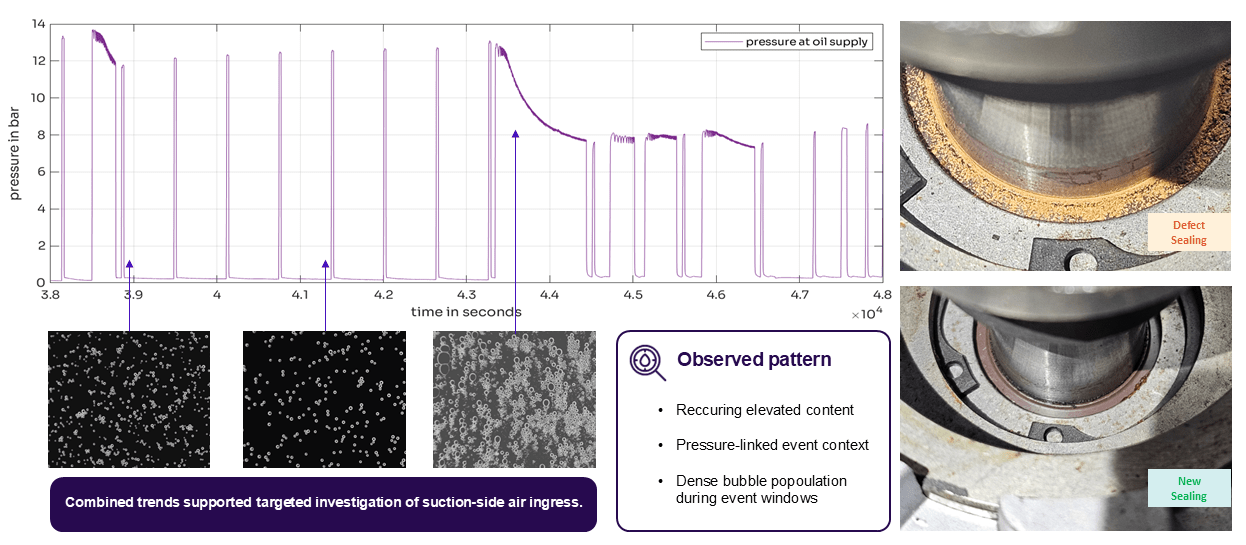
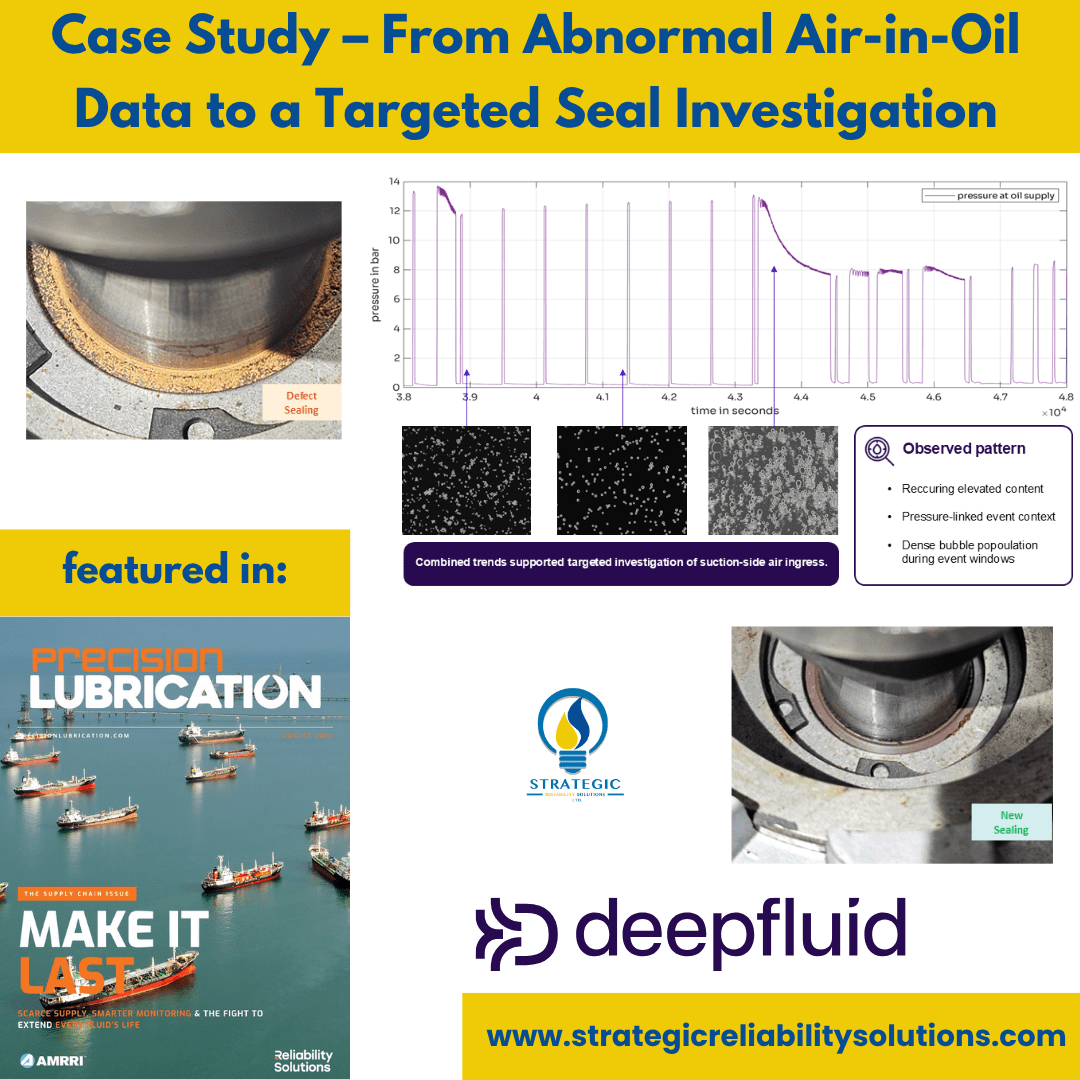
In the case study presented, a defective shaft seal was detected through direct measurement on a supply pump for the injection lubrication system of a wind turbine, based on an iteratively and periodically occurring very high air content and loud noise. A minor issue that can have serious financial consequences.
Risks posed by excessive air content and their costs, using a 2.5 MW turbine as an example:
- Higher operating temperature, which requires additional cooling
- Increased cooling capacity (between 4.9 kW and 9.4 kW) due to reduced thermal conductivity (0.14 W/(mK) → 0.125 W/(mK)), costing between 7k€ and 10k€ per year
- Change in friction conditions in conjunction with increased cooling capacity: 43k€–82k€ per year
- Risk of faster oil aging due to accelerated oil oxidation and thermal oil oxidation: 1 additional oil change (24k€–60k€)
- Total mechanical failure of the main gearbox renders the entire system uneconomical.
In this component, there was persistently high air content which we are able to identify and link to abnormal ingress of air into the lubrication system. However, we also saw the pressure drop during pump operation. This was an indicator for suction-side or sealing-related air ingress. We also noticed a dense bubble population which indicates critical oil-air dispersion under operating conditions. There was a deviation from a similar gearbox indicating that this was a system-specific malfunction rather than normal behaviour.
If these were not identified at this early stage, the equipment would run the risk of micro-dieseling, cavitation, oxidation and temperature increase. This would lead to mechanical damage in the gearbox or oil supply components, eventually leading to reduced lubrication reliability and accelerated wear.
Find out more in the full article, "From Lab Insight to Field Action: How Air-in-Oil Diagnostics can support better Troubleshooting" featured in Precision Lubrication Magazine by Sanya Mathura, CEO & Founder of Strategic Reliability Solutions Ltd, David Placzek, Dr. Lukas Hafner