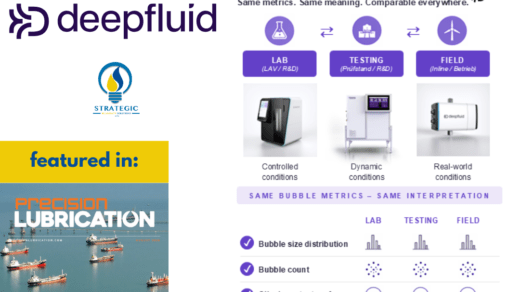
Typically, oil condition monitoring is performed through standardized laboratory tests at specified intervals. A representative sample is taken on-site from the system being monitored and analyzed in the laboratory under controlled conditions. This allows for a detailed analysis of numerous parameters that reflect the condition of the oil, such as viscosity, density, and air release behaviour in accordance with DIN ISO 9120.
However, when the sample is pulled from the equipment, it must travel some distance to the lab. During this transit, the oil sample may lose some characteristics that defined the system in which it was operating. While this does not corrode the integrity of the sample, it may not define an accurate representation of system conditions.
In the laboratory, it is not possible to correlate the oil’s interaction with the system’s behavior, which is characterized by constantly changing process conditions such as pressure, temperature, flow rates and air-contents. As these process conditions change, the measurable properties of the oil also change proportionally, and these properties directly determine the efficiency and service life of both the system and the oil. Comprehensive monitoring of the system’s condition can therefore only be achieved through laboratory analysis in conjunction with field measurements.
This approach allows for direct measurement of how the oil interacts with the equipment and generates data points that were previously unthinkable. This enables operators to make predictions that can extend the service life of the oils and make plant operations more efficient or less prone to errors.
What Gets Measured
It is well known that, during the operation of hydraulic systems and transmissions, air is inevitably though unintentionally mixed into the oil. The air content alters the oil’s properties by creating a multiphase mixture, thereby influencing measurable operating parameters in both the short term (efficiency, NVH, temperature) and the long term (oxidation, additive depletion, oil aging).
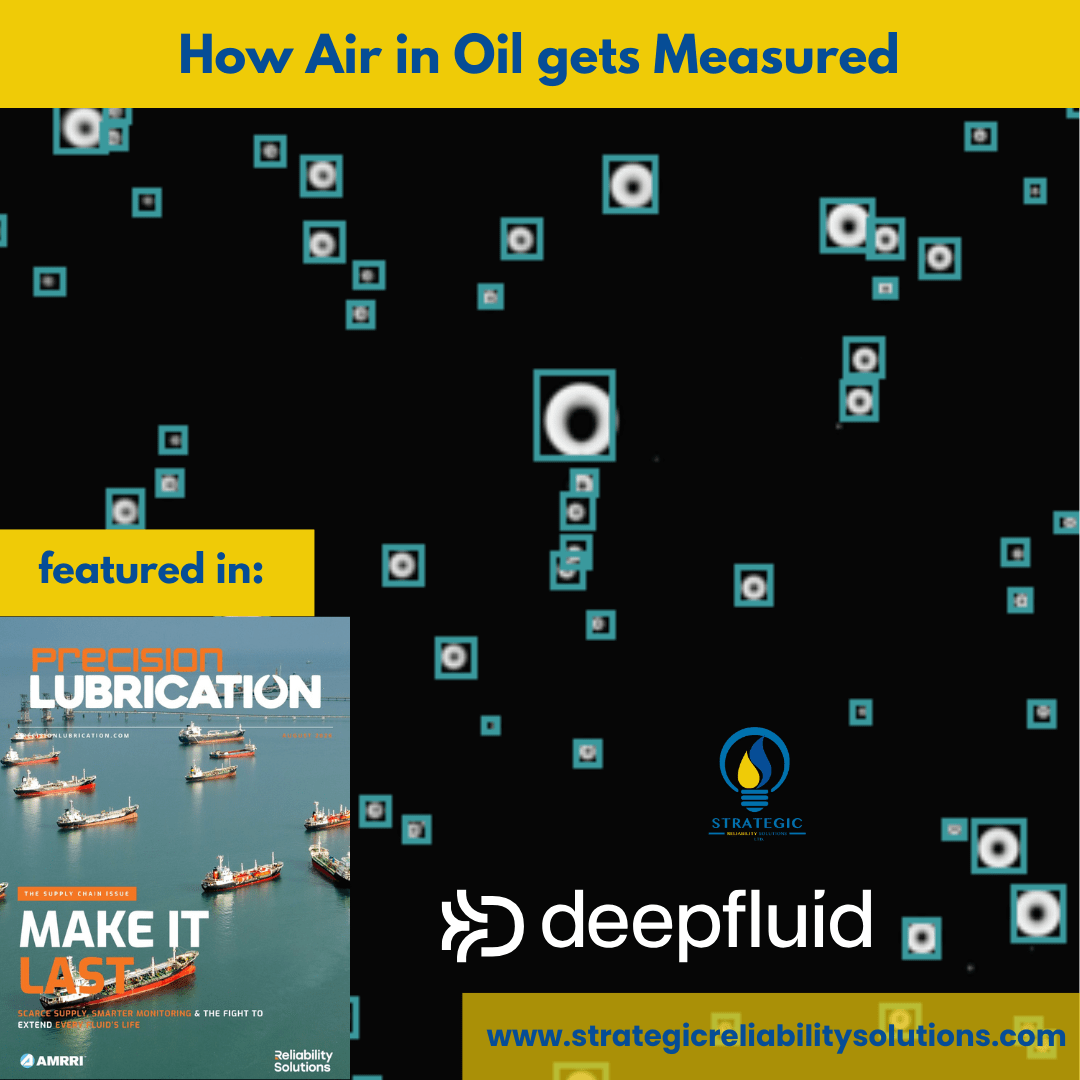
The Deepfluid bubble profiling technology combines an intelligent vision module and an intelligent LED system. This captures real-time images of the fluid as it flows through the device. Through the use of computer vision-based image processing, each air bubble is identified, sized and classified on a continuous basis. This allows trends and patterns to be recognized and established. No on-line calibration and constant re-calibration is required for this equipment, and it can work across various types of oils with different viscosity ranges and colors or aging-states.
The Deepfluid optical approach evaluates bubbles within a defined size range of 8 to 500 micrometers and generates time-resolved information such as:
- air content,
- bubble-size distribution,
- bubble count,
- bubble-population dynamics,
- oil-air contact surface / interfacial area, and
- transient air events.
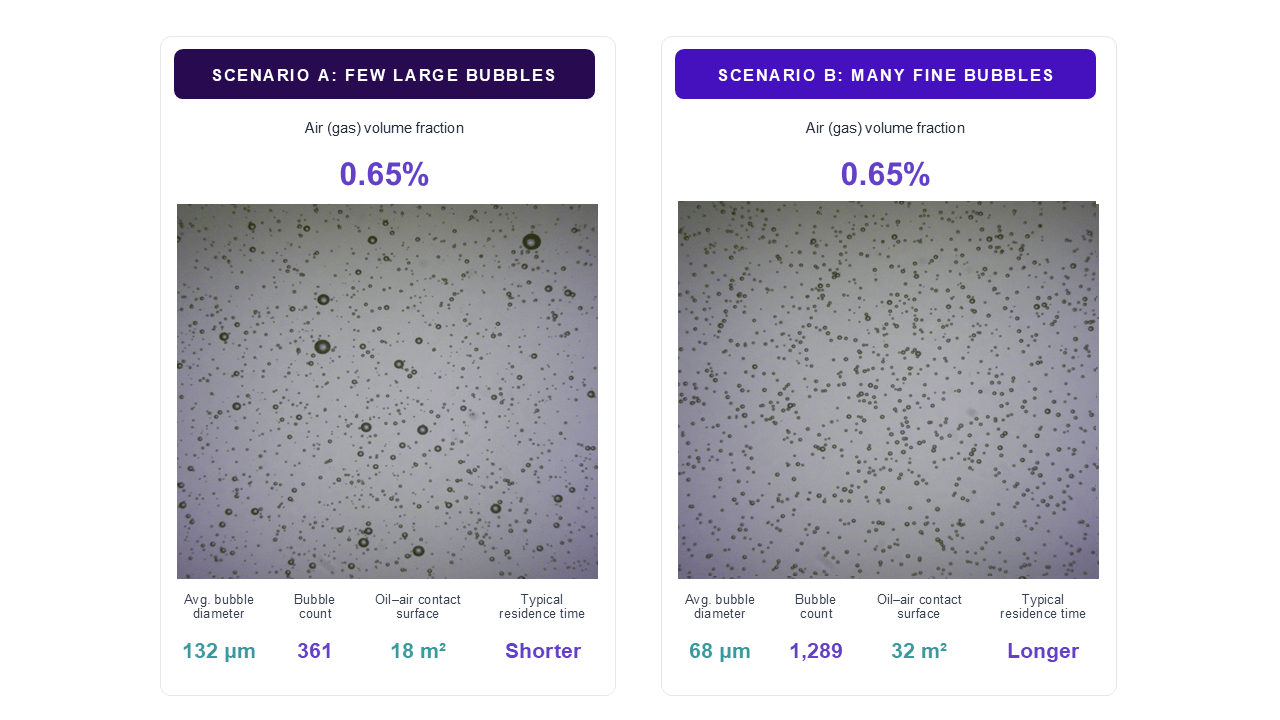
Until now, measuring air content has been possible primarily through indirect analytical methods. In this approach, the conductivity of the oil, excluding air content, was referenced to the conductivity of the oil-air mixture during operation. This allows for the analysis of air content percentages under constant conditions. The biggest problem with this measurement is the change in the oil during continuous operation of the system, since water content, particle content, temperature, and additive content are constantly changing, making continuous measurement during operation impossible.
As shown above in Figure 1, the traditional method of measuring the air volume does not accurately depict what is happening in the oil. The air volume of 0.65% only measures one aspect of the oil. With the direct measurement by Deepfluid, users can get deeper insights and explore another dimension of oil condition monitoring by measuring the bubble diameters during operation and compare it with the same technology in a lab-based air-in-oil analysis. Based on this information, short term behaviour (density change, viscosity change, lubricant film thickness, Air-Intake, Air-Release-Behaviour, thermal conductivity and NVH) as well as long term response (oxidation, additive depletion, mechanical robustness, risk of pitting) can be detected and their respective influence targeted.
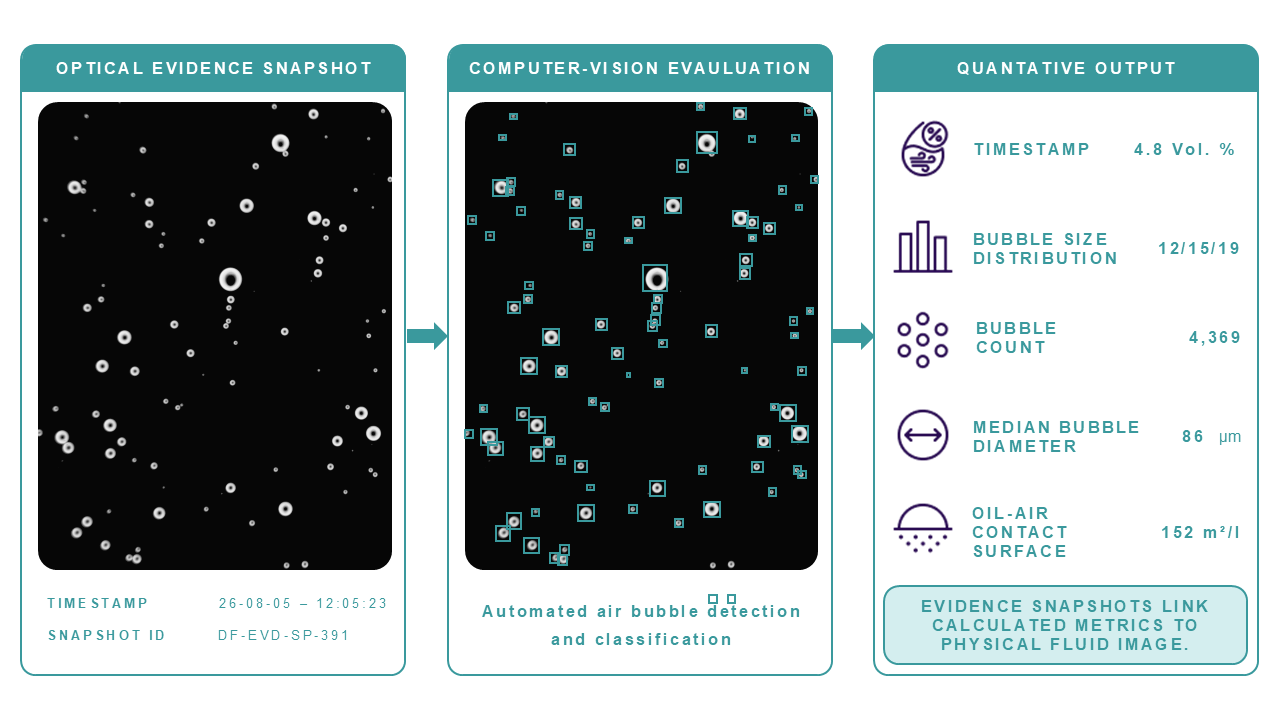
A key feature is the availability of so-called Evidence Snapshots. Each calculated measurement point can be linked to an optical image of the fluid at that moment. Engineers can review the underlying image, verify the detected bubble population, and relate an unusual value to the physical condition on which it is based.
This creates point-level traceability between the calculated metric and the visible evidence.
Evidence Snapshots do not replace numerical specifications for repeatability, accuracy, or measurement uncertainty. They add transparent verification and support more informed technical discussion between lubricant developers, test engineers, component specialists, and reliability teams.
The optical approach has also been demonstrated with visually challenging fluids, including dark, aged, and soot-loaded engine oil. As with any optical method, application limits must be understood. However, Deepfluid’s bubble-level analysis is not restricted to transparent new oils.
The objective is not to replace conventional oil analysis, pressure, temperature, vibration, or standardized air-release and foam testing. It is to add direct evidence about the dispersed air phase and its dynamics.
Find out more in the full article, "From Lab Insight to Field Action: How Air-in-Oil Diagnostics can support better Troubleshooting" featured in Precision Lubrication Magazine by Sanya Mathura, CEO & Founder of Strategic Reliability Solutions Ltd, David Placzek, Dr. Lukas Hafner