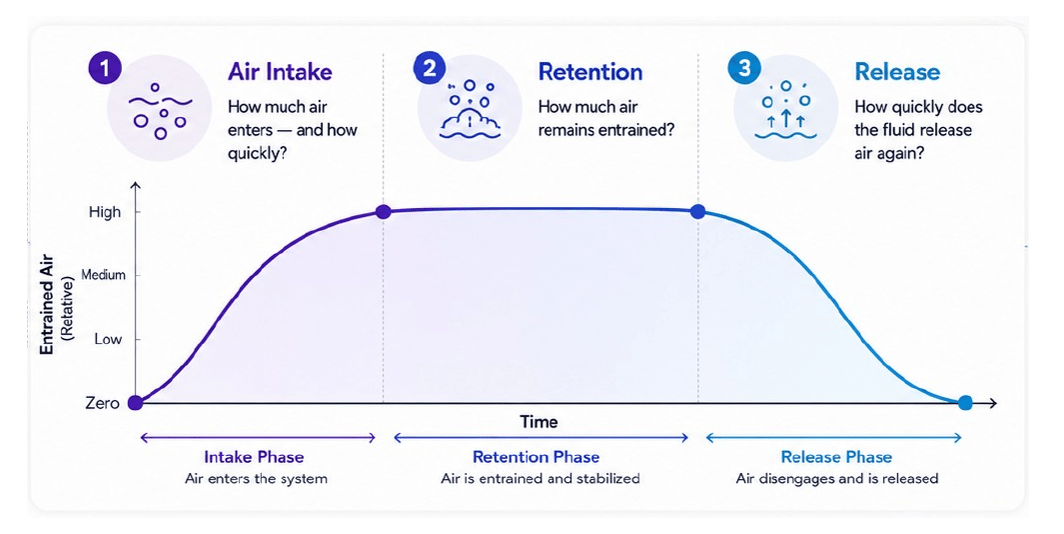
The Deepfluid AIR Framework turns insights from bubble-level evidence into three entirely new practical engineering questions and metrics:
Air Intake describes not only how quickly air enters the fluid system and under what conditions it is generated or introduced, but also how much air the oil can actually absorb over a specific period of time.
Air Retention describes how much air remains dispersed, how long it remains in the system, and how the bubble population changes.
Air Release describes how quickly and completely the fluid-system combination returns toward its baseline after aeration or an operating-state change. By having the Air Intake value, Deepfluid addresses a new question that has not yet been covered by conventional air release laboratory tests: “At what initial air content by volume does my air-release measurement actually begin?”
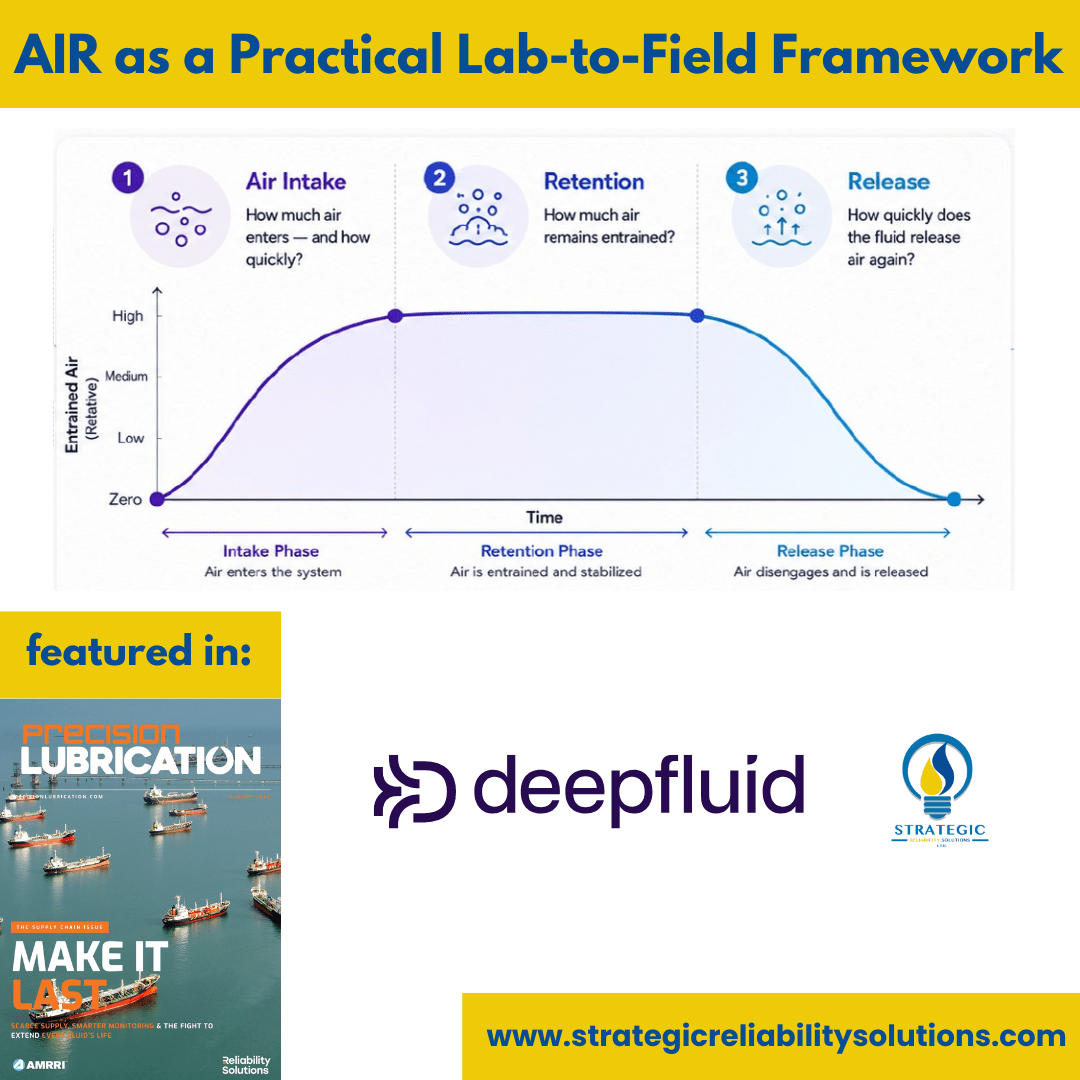
AIR is not an abstract research model. It is a practical structure for planning tests, defining measurement windows, comparing fluids, evaluating component and design variants, analyzing operating states, and verifying corrective actions.
In the laboratory, air release no longer has to be viewed only as a single endpoint under one fixed condition. Individually defined aeration durations, automated temperature conditioning, and time-resolved optical measurement make it possible to run a fully automated AIR test.
Such a sequence can establish a bubble-level baseline before aeration, follow the bubble population during a defined Air Intake phase, quantify Air Retention after the air supply stops, and measure the Air Release curve over time. The same workflow can connect air content, bubble-size distribution, and bubble-population dynamics with subsequent foam formation and foam decay.
This makes it possible to compare different fluids, additive concentrations, temperatures, or aeration durations within structured, automated test campaigns. The laboratory therefore moves closer to application-related questions without giving up controlled and repeatable conditions.
In testing and field operation, the same AIR logic can be applied to defined operating windows. A cycle may begin at a stable baseline, follow an increase in air content during a load, speed, pressure, or temperature change, quantify how much air remains dispersed, and measure recovery afterward.
The resulting bubble-level metrics can be related to operating data such as temperature, pressure, speed, load, flow, efficiency, vibration, or noise.
The conditions are not identical across lab, testing, and field environments but the measurement logic is.
AIR turns air release from a single laboratory result into a practical understanding of the full cycle around how air enters, remains, and leaves a fluid system.
Find out more in the full article, "From Lab Insight to Field Action: How Air-in-Oil Diagnostics can support better Troubleshooting" featured in Precision Lubrication Magazine by Sanya Mathura, CEO & Founder of Strategic Reliability Solutions Ltd, David Placzek, Dr. Lukas Hafner