Oils are composed of base oils and additives. Typically, additives are sacrificial; they deplete first before the base oil is affected. As such, by trending their quantities over time, we can gain insight into a few of the conditions to which the oil is subjected.
By interpreting these conditions and patterns, we can correlate them with the health of the asset and plan accordingly for possible repairs or maintenance. In this article, we will do a deeper dive into ways these can be explored to add value to your asset management program.
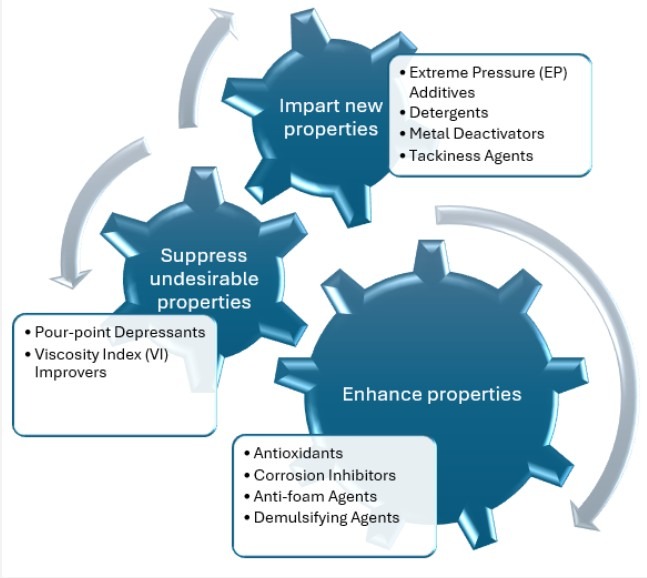
Additives come in various ratios and chemical compositions, but when we talk about additives in oils, they really have three main functions. They can either;
- Enhance the properties of the base oil, which already exist
- Suppress the undesirable base oil properties or
- Impart new properties to the base oil
On their own, they cannot affect anything, but when coupled with a base oil, they can impact an asset. Base oils also have specific properties, which, when combined with additives, allow assets to perform at their best.
The real performance comes from how the additives and base oil work together.
As shown in Figure 1, some additives that enhance properties include antioxidants, corrosion inhibitors, anti-foam agents, and demulsifying agents. Those responsible for suppressing undesirable properties can include pour-point depressants and viscosity improvers.
Finally, those responsible for imparting new properties include extreme-pressure additives, detergents, metal deactivators, and tackiness agents.
Here are some quick descriptions for a few of these additives, which will help you to gain an appreciation of their functions:
Antioxidants: these protect the oil from oxidation. They are very common in Turbine oils but can be found in many other oils. They are the first line of defense when oxidation begins and react with free radicals to neutralize them before they attack the base oil.
Corrosion inhibitors: adsorb onto the metal surfaces to help protect them. Comprised of sodium sulphonates, alkylbenzene sulphonates, or alkylphosphoric acid partial esters.
Anti-foam agents: reduce surface tension to break up foam formation. Typically, these are silicon-based, although silicone-free defoamers also exist.
Demulsifying agents: enable water and oil to separate. These were formerly composed of barium and calcium, but modern formulations use special polyethylene glycols.
Pour point depressant: alters oil crystallization, allowing the oil to form fewer crystals at lower temperatures.
Viscosity improvers: specifically designed to ensure that the viscosity of the lubricant can be more tolerant of changes in temperature and shear.
Extreme pressure additives: used under high stress to prevent the welding of moving parts. Usually comprised of a phosphorus compound.
Antiwear additives: designed to reduce wear under moderate stress. The most famous sulphur-phosphorus compound is ZDDP (Zinc Dialkyl dithiophosphate).
Detergents: keep oil soluble combustion products in suspension (especially for engine oils) and ensure they do not agglomerate. These usually contain metal additives such as Calcium and Magnesium.
Understanding the function and composition of these additives can help us to determine how they are performing in the oil. Since many of these are sacrificial, their values will decrease over time. As such, it is important to trend these values to determine whether they are remaining constant, increasing, decreasing, or decreasing at an accelerated rate.
Find out more in the full article, "Lubricant Additive Depletion as an Early Asset Health Signal" featured in Precision Lubrication Magazine by Sanya Mathura, CEO & Founder of Strategic Reliability Solutions Ltd.